Egg-eating Snake

Egg-eating Snake

Dasypeltis scabra

Silhouette: Alex Slavenko · PhyloPic

LCLeast ConcernNTVUENCR
Daily sighting probability ~10% · With luck
at Table Mountain National Park

In 3 days ~20% in a week ~40%

46 Verified sightings at Table Mountain National Park From 2019 to 2026
130 In all 5 parks
November Best month
☀️🌙 Day & Night When it's spotted

About the Egg-eating Snake

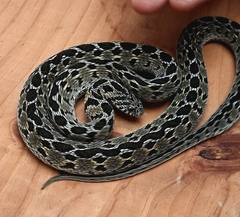
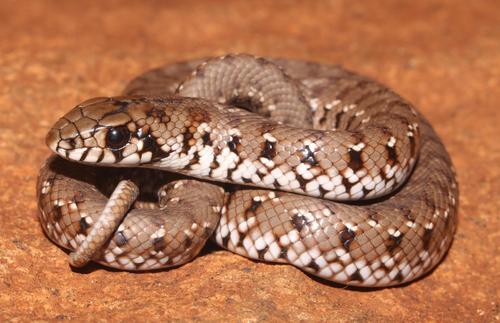
Dasypeltis scabra, also known commonly as the common egg eater, the egg-eating snake, and the rhombic egg eater, is a species of snake in the family Colubridae. The species is endemic to Africa. D. scabra is found in sub-Saharan Africa.

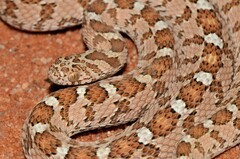
D. scabra grows to a total length (tail included) of 40–46 inches (100–120 cm), and has almost toothless jaws. Dorsally, it has a series of rhomboidal dark brown spots on a lighter background. There is an alternating series of brown spots on each side and a distinct V-shaped mark at the back of the neck. Ventrally it is yellowish, either uniform or with dark dots.

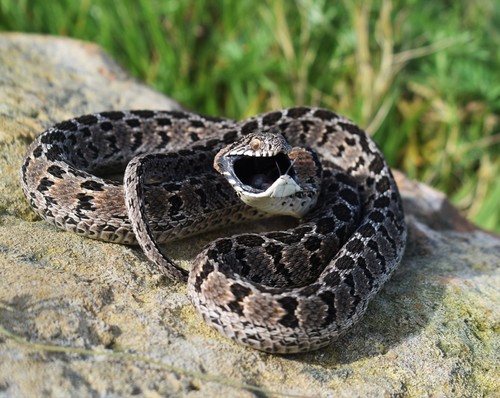
It has been suggested that non-venomous D. scabra is a mimic of venomous Echis carinatus, the saw-scaled viper, which it strongly resembles. Typical specimens of D. scabra even more closely resemble Causus rhombeatus, the rhombic night adder. The colouration of E. carinatus generally tends to be more reddish and brown, instead of shades of grey and black; and the V-shaped mark on its head is more patchy than in the other two species.

C. rhombeatus is not as slim as D. scabra, and its dorsal scales, unusual among viperids, are at most... Wikipedia →
Global Distribution

Parks Where Found

# Park Country Daily sighting probability
1 West Coast National Park 🇿🇦 South Africa
~20%
2 iSimangaliso Wetland Park 🇿🇦 South Africa
~10%
3 Kruger National Park 🇿🇦 South Africa
~10%
4 Garden Route National Park 🇿🇦 South Africa
~10%
5 Table Mountain National Park 🇿🇦 South Africa
~10%

Cities Where Found

# City Country Daily sighting probability
1 Pretoria 🇿🇦 South Africa
~10%
2 Cape Town 🇿🇦 South Africa
~10%

Zoos & Centres Where Found

# Zoo / Centre Country
1 Wilhelma 🇩🇪 Germany In captivity

Before you go

What are the chances of seeing an Egg-eating Snake in Table Mountain National Park?

With luck

About 10% of wildlife watchers report an Egg-eating Snake sighting in Table Mountain National Park on a given day, based on 46 verified sightings from GBIF citizen-science data from 2019 to 2026. It is the 24th most-seen of the 41 reptiles we can rate there. Over three days the chance rises to about 20%, and over a week to about 40%, if each day is a fresh chance.

When is the best time to see an Egg-eating Snake in Table Mountain National Park?

June and August–January

In those months about 10% of wildlife watchers report an Egg-eating Snake in Table Mountain National Park on a given day, against under 5% in February–May and July, the lowest months.

What time of day is best to see an Egg-eating Snake?

Between 7 and 10 pm

Across all the parks we cover, that three-hour window holds the most Egg-eating Snake sightings with a recorded time, and about half of them come between 6 am and 6 pm: it is seen both by day and at night.

Is Table Mountain National Park the best place to see an Egg-eating Snake?

5th of 5

Of the 5 parks where we can rate Egg-eating Snake sightings, Table Mountain National Park ranks 5th at about 10%. The best odds are in West Coast National Park (South Africa, about 20%), iSimangaliso Wetland Park (South Africa, about 10%) and Kruger National Park (South Africa, about 10%).

Which relatives of the Egg-eating Snake live in Table Mountain National Park?

Same family: Colubridae

The closest relatives of the Egg-eating Snake that you can see in Table Mountain National Park (family Colubridae, Colubrid Snakes) are Boomslang (about 10%) and Red-lipped Snake (about 10%), with each one's daily chance of a sighting.

Where does the Egg-eating Snake sighting chance come from?

GBIF citizen-science records

It is estimated from how often the Egg-eating Snake is recorded against all the reptiles logged in Table Mountain National Park (46 verified sightings from 2019 to 2026), calibrated against known sighting rates. Figures are rounded to the nearest 10% because citizen-science data supports honest approximations, not decimals, and months with records from fewer than five people show "—". How it works.

← Back to Table Mountain National Park