Himalayan Tahr

Himalayan Tahr

Hemitragus jemlahicus

Silhouette: [unknown] · PhyloPic

LCNTNear ThreatenedVUENCR
Daily sighting probability ~10% · With luck
at Table Mountain National Park

In 3 days ~20% in a week ~50%

86 Verified sightings at Table Mountain National Park From 2019 to 2026
112 In all 2 parks
February Best month
☀️ Diurnal When it's spotted

About the Himalayan Tahr

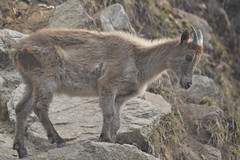
The Himalayan tahr (Hemitragus jemlahicus) is a large even-toed ungulate native to the Himalayas in southern Tibet, northern India, western Bhutan and Nepal. It is listed as Near Threatened on the IUCN Red List, as the population is declining due to hunting and habitat loss.

The Himalayan tahr has been introduced to Argentina, New Zealand, South Africa and the United States. Tahr belong to the subfamily Caprinae in the order Artiodactyla. Their closest relatives in the subfamily Caprinae are sheep and goats.

A subspecies, the Eastern Himalayan tahr or shapi, was described in 1944. This classification is not considered valid anymore, and no subspecies are currently recognized. A recent phylogenetic analysis indicates that the genus Hemitragus is monospecific, and that the Himalayan tahr is a wild goat.

The word "tahr," first used in English writings in 1835, is derived from the animal's local name in the Western Himalayas, which has otherwise been rendered as "tehr," "tare" and "tahir". Through confusion with thār, a Nepali word for the Himalayan serow, it has also been spelled "thar."

The genus name Hemitragus is derived from the Greek words... Wikipedia →

Global Distribution

Parks Where Found

# Park Country Daily sighting probability
1 Langtang National Park 🇳🇵 Nepal
~40%
2 Table Mountain National Park 🇿🇦 South Africa
~10%

Zoos & Centres Where Found

# Zoo / Centre Country
1 Prague Zoo 🇨🇿 Czechia In captivity
2 Basel Zoo 🇨🇭 Switzerland In captivity
3 Dresden Zoo 🇩🇪 Germany In captivity
4 Antwerp Zoo 🇧🇪 Belgium In captivity
5 Highland Wildlife Park 🇬🇧 United Kingdom In captivity
6 Seoul Zoo 🇰🇷 South Korea In captivity
7 Fuji Safari Park 🇯🇵 Japan In captivity
8 Карельский зоопарк 🇷🇺 Russia In captivity
9 Granby Zoo 🇨🇦 Canada In captivity
10 Berlin Zoological Garden 🇩🇪 Germany In captivity
11 Taronga Zoo 🇦🇺 Australia In captivity
12 Halls Gap Zoo 🇦🇺 Australia In captivity
13 Schönbrunn Zoo 🇦🇹 Austria In captivity
14 Reserva Animal La Pequeña África 🇪🇸 Spain In captivity
15 bioparco 🇮🇹 Italy In captivity
16 Himalayan Zoological Park 🇮🇳 India In captivity
17 Paradise Valley Springs 🇳🇿 New Zealand In captivity
18 Belgrade Zoo 🇷🇸 Serbia In captivity
19 Hamura Zoo 🇯🇵 Japan In captivity
20 Zoo Koki (Parque zoológico y botánico) 🇪🇸 Spain In captivity
21 Padmaja Naidu Himalayan Zoological Park 🇮🇳 India In captivity
22 Aquarium Berlin 🇩🇪 Germany In captivity
23 Rákosův pavilon 🇨🇿 Czechia In captivity
24 Velemlokárium 🇨🇿 Czechia In captivity
25 Aquatopia 🇧🇪 Belgium In captivity
26 Karelian Zoo 🇷🇺 Russia In captivity

Before you go

What are the chances of seeing a Himalayan Tahr in Table Mountain National Park?

With luck

About 10% of wildlife watchers report a Himalayan Tahr sighting in Table Mountain National Park on a given day, based on 86 verified sightings from GBIF citizen-science data from 2019 to 2026. It is the 17th most-seen of the 39 mammals we can rate there. Over three days the chance rises to about 20%, and over a week to about 50%, if each day is a fresh chance.

When is the best time to see a Himalayan Tahr in Table Mountain National Park?

October to August

In those months about 10% of wildlife watchers report a Himalayan Tahr in Table Mountain National Park on a given day, against under 5% in September, the lowest month.

What time of day is best to see a Himalayan Tahr?

Between 8 and 11 am

Across all the parks we cover, that three-hour window holds the most Himalayan Tahr sightings with a recorded time, and about 9 in 10 of them come between 6 am and 6 pm: it is a daytime animal.

Is Table Mountain National Park the best place to see a Himalayan Tahr?

2nd of 2

Of the 2 parks where we can rate Himalayan Tahr sightings, Table Mountain National Park ranks 2nd at about 10%. The best odds are in Langtang National Park (Nepal, about 40%).

Which relatives of the Himalayan Tahr live in Table Mountain National Park?

Same family: Bovidae

The closest relatives of the Himalayan Tahr that you can see in Table Mountain National Park (family Bovidae, Bovids) are Bontebok/Blesbok (about 30%), Common Eland (about 30%) and Klipspringer (about 10%), with each one's daily chance of a sighting.

Where does the Himalayan Tahr sighting chance come from?

GBIF citizen-science records

It is estimated from how often the Himalayan Tahr is recorded against all the mammals logged in Table Mountain National Park (86 verified sightings from 2019 to 2026), calibrated against known sighting rates. Figures are rounded to the nearest 10% because citizen-science data supports honest approximations, not decimals, and months with records from fewer than five people show "—". How it works.

← Back to Table Mountain National Park