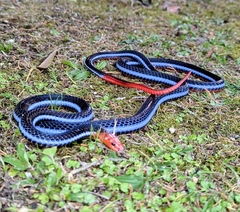
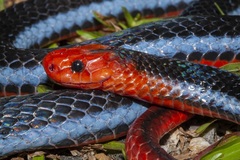
Blue Malaysian Coral Snake

Blue Malaysian Coral Snake

Calliophis bivirgatus

Silhouette: SeismicShrimp · PhyloPic

Daily sighting probability ~20% · Possible
at Taman Negara National Park

In 3 days ~50% in a week ~80%

8 Verified sightings at Taman Negara National Park From 2019 to 2026
20 In all 3 parks
November Best month
☀️🌙 Day & Night When it's spotted

About the Blue Malaysian Coral Snake

Calliophis bivirgatus, also known commonly as the blue coral snake, the blue Malayan coral snake, and the blue Malaysian coral snake, is a species of venomous snake in the family Elapidae. The species is native to Southeast Asia. There are three recognized subspecies.

Calliophis bivirgatus occurs in Brunei, Indonesia, Malaysia, Singapore, Thailand, and Burma, at 100 to 1,100 metres (300 to 3,600 ft) in elevation. There are three subspecies that are recognized as being valid, including the nominotypical subspecies.

Nota bene: A trinomial authority in parentheses indicates that the subspecies was originally described in a genus other than Calliophis. Originally described in the genus Elaps, the blue coral snake was assigned to the old world coral snake genus Maticora until phylogenetic studies revealed this species to be nested within the tropical coral snake species clade Calliophis and... Wikipedia →

Global Distribution

Parks Where Found

# Park Country Daily sighting probability
1 Taman Negara National Park 🇲🇾 Malaysia
~20%
2 Sepilok 🇲🇾 Malaysia
~10%
3 Kinabalu Park 🇲🇾 Malaysia
~10%

Cities Where Found

# City Country Daily sighting probability
1 Singapore 🇸🇬 Singapore
~10%

Closest Relatives at Taman Negara National Park

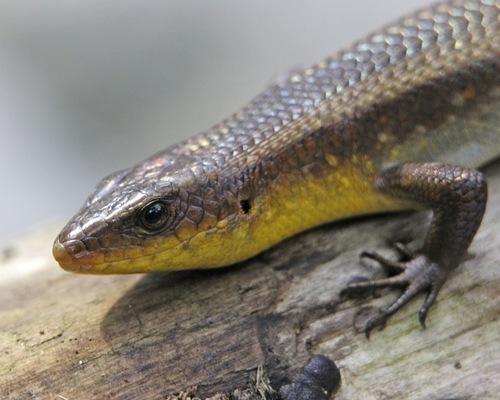
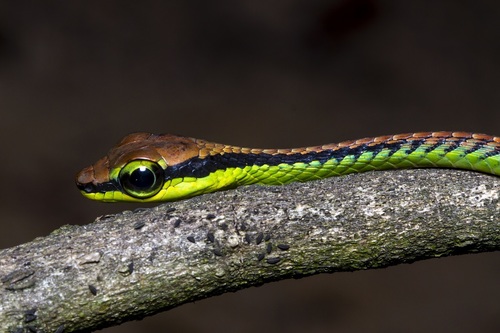
No species of the same family or order lives in Taman Negara National Park, so these are its closest relatives here: other reptiles.

Before you go

What are the chances of seeing a Blue Malaysian Coral Snake in Taman Negara National Park?

Possible

About 20% of wildlife watchers report a Blue Malaysian Coral Snake sighting in Taman Negara National Park on a given day, based on 8 verified sightings from GBIF citizen-science data from 2019 to 2026. It is the 12th most-seen of the 17 reptiles we can rate there. Over three days the chance rises to about 50%, and over a week to about 80%, if each day is a fresh chance.

When is the best time to see a Blue Malaysian Coral Snake in Taman Negara National Park?

November

In that month about 60% of wildlife watchers report a Blue Malaysian Coral Snake in Taman Negara National Park on a given day, against under 5% in March–July and October, the lowest months. That is one of Taman Negara National Park's wettest months, with about 330 mm of rain against 100 mm in March.

What time of day is best to see a Blue Malaysian Coral Snake?

Between 9 am and noon

Across all the parks we cover, that three-hour window holds the most Blue Malaysian Coral Snake sightings with a recorded time, and about half of them come between 6 am and 6 pm: it is seen both by day and at night.

Is Taman Negara National Park the best place to see a Blue Malaysian Coral Snake?

Yes

Of the 3 parks where we can rate Blue Malaysian Coral Snake sightings, Taman Negara National Park has the highest daily chance: about 20%. Next come Sepilok (Malaysia, about 10%) and Kinabalu Park (Malaysia, about 10%).

Where does the Blue Malaysian Coral Snake sighting chance come from?

GBIF citizen-science records

It is estimated from how often the Blue Malaysian Coral Snake is recorded against all the reptiles logged in Taman Negara National Park (8 verified sightings from 2019 to 2026), calibrated against known sighting rates. Figures are rounded to the nearest 10% because citizen-science data supports honest approximations, not decimals, and months with records from fewer than five people show "—". How it works.

← Back to Taman Negara National Park