Sunda Slow Loris

Sunda Slow Loris

Nycticebus coucang

Silhouette: Mareike C. Janiak · PhyloPic

LCNTVUENEndangeredCR
Daily sighting probability ~20% · Possible
at Taman Negara National Park

In 3 days ~60% in a week ~90%

12 Verified sightings at Taman Negara National Park From 2019 to 2026
22 In all 2 parks
July Best month
🌙 Nocturnal When it's spotted

About the Sunda Slow Loris

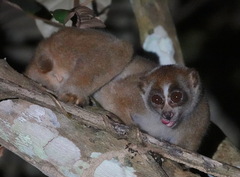
The Sunda slow loris (Nycticebus coucang), or greater slow loris, is a strepsirrhine primate and a species of slow loris native to Indonesia, West Malaysia, southern Thailand and Singapore. It measures 27 to 38 cm (11 to 15 in) from head to tail and weighs between 599 and 685 g (21.1 and 24.2 oz). Like other slow lorises, it has a wet nose (rhinarium), a round head, small ears hidden in thick fur, a flat face, large eyes and a vestigial tail.

The Sunda slow loris is nocturnal and arboreal, typically occurring in evergreen forests. It prefers rainforests with continuous dense canopies and has an extremely low metabolic rate compared to other mammals of its size. Its diet consists of sap, floral nectar, fruit and arthropods, and will feed on exudates such as gum and sap by licking wounds in trees. Individuals are generally solitary, with one study showing only 8% of its active time was spent near other individuals. It has a monogamous mating system with the offspring living with the parents. It sleeps during the day, rolled up in a ball in hidden parts of trees above the ground, often on branches, twigs, palm fronds, or lianas. The species is polyoestrous, usually giving birth to a single offspring after a gestation period of 192 days. The young disperses between 16 and 27 months, generally when it is sexually mature.

The species is listed as endangered on the IUCN Red List. It is threatened with extinction due to a growing demand in the exotic pet trade, and has become one of the most abundant primate species on sale at Indonesian pet markets. Its teeth are often pulled out before being sold as pets which can result in infection and/or death. Lack of teeth makes reintroduction to the wild impossible. It also suffers from habitat loss, which has been severe in the areas in which it is found. Wikipedia →

Global Distribution

Parks Where Found

# Park Country Daily sighting probability
1 Way Kambas National Park 🇮🇩 Indonesia
~50%
2 Taman Negara National Park 🇲🇾 Malaysia
~20%

Zoos & Centres Where Found

# Zoo / Centre Country
1 Gembira Loka Zoo 🇮🇩 Indonesia In captivity
2 Cambridge Butterfly Conservatory 🇨🇦 Canada In captivity
3 Farm in the City 🇲🇾 Malaysia In captivity

Before you go

What are the chances of seeing a Sunda Slow Loris in Taman Negara National Park?

Possible

About 20% of wildlife watchers report a Sunda Slow Loris sighting in Taman Negara National Park on a given day, based on 12 verified sightings from GBIF citizen-science data from 2019 to 2026. It is the 11th most-seen of the 22 mammals we can rate there. Over three days the chance rises to about 60%, and over a week to about 90%, if each day is a fresh chance.

When is the best time to see a Sunda Slow Loris in Taman Negara National Park?

July

In that month about 50% of wildlife watchers report a Sunda Slow Loris in Taman Negara National Park on a given day, against under 5% in February–April, June and September–November, the lowest months.

What time of day is best to see a Sunda Slow Loris?

Between 8 and 11 pm

Across all the parks we cover, that three-hour window holds the most Sunda Slow Loris sightings with a recorded time, and about 9 in 10 of them come between 6 pm and 6 am: it is mostly seen at night.

Is Taman Negara National Park the best place to see a Sunda Slow Loris?

2nd of 2

Of the 2 parks where we can rate Sunda Slow Loris sightings, Taman Negara National Park ranks 2nd at about 20%. The best odds are in Way Kambas National Park (Indonesia, about 50%).

Which relatives of the Sunda Slow Loris live in Taman Negara National Park?

Same order: Primates

The closest relatives of the Sunda Slow Loris that you can see in Taman Negara National Park (order Primates) are Crab-eating Macaque (about 60%), Lar Gibbon (about 30%) and Dusky Leaf-monkey (about 30%), with each one's daily chance of a sighting.

Where does the Sunda Slow Loris sighting chance come from?

GBIF citizen-science records

It is estimated from how often the Sunda Slow Loris is recorded against all the mammals logged in Taman Negara National Park (12 verified sightings from 2019 to 2026), calibrated against known sighting rates. Figures are rounded to the nearest 10% because citizen-science data supports honest approximations, not decimals, and months with records from fewer than five people show "—". How it works.

← Back to Taman Negara National Park