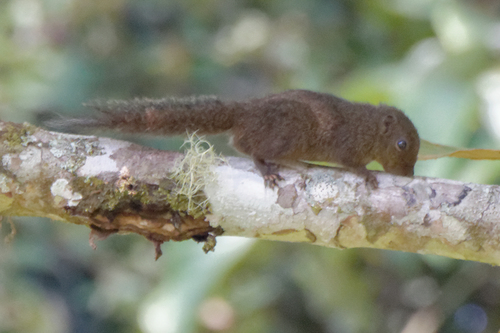
Gursky's Spectral Tarsier

Gursky's Spectral Tarsier

Tarsius spectrumgurskyae

Silhouette: Yan Wong · PhyloPic

LCNTVUVulnerableENCR Endemic
Daily sighting probability ~60% · Likely
at Tangkoko Nature Reserve

In 3 days ~90% in a week >90%

194 Verified sightings at Tangkoko Nature Reserve From 2019 to 2026
194 In 1 park
August Best month
☀️ Diurnal When it's spotted

About the Gursky's Spectral Tarsier

Gursky's spectral tarsier (Tarsius spectrumgurskyae), also known locally as wusing, is a species of tarsier found in the island of Sulawesi in Indonesia. A recent taxonomic revision split this species off from the spectral tarsier and other tarsier species based on difference in vocalisations and pelage. These tarsiers, like other species of primates, are able to communicate with other individuals of the same species through flexible call patterns, in which they output different note patterns based on their duet partner's calls.

The species is named after Dr. Sharon Gursky, who carried out studies on the species's behavioral ecology (published using the now-superseded taxonomy, with the studied population classified as spectral tarsier, Tarsius spectrum). The new name avoids the disconnect between the name used in the earlier publications and Gursky's study population.

Dr. Sharon Gursky profile at Texas A&M University Wikipedia →

Sounds

Call1:12

Indonesia · 2018

© Marc Anderson · XC979598 · CC BY-NC-ND 4.0

Social call0:37

Indonesia · 2024

© Ding Li Yong · XC961057 · CC BY-NC-ND 4.0

Call0:29

Indonesia · 2024

© Carlos Bocos · XC961577 · CC BY-NC-SA 4.0

Global Distribution

Parks Where Found

# Park Country Daily sighting probability
1 Tangkoko Nature Reserve 🇮🇩 Indonesia
~60%

More parks will be added in future updates.

Before you go

What are the chances of seeing a Gursky's Spectral Tarsier in Tangkoko Nature Reserve?

Likely

About 60% of wildlife watchers report a Gursky's Spectral Tarsier sighting in Tangkoko Nature Reserve on a given day, based on 194 verified sightings from GBIF citizen-science data from 2019 to 2026. It is the 3rd most-seen of the 7 mammals we can rate there. Over three days the chance rises to about 90%, and over a week to over 90%, if each day is a fresh chance.

When is the best time to see a Gursky's Spectral Tarsier in Tangkoko Nature Reserve?

June–August and December

In those months about 70% of wildlife watchers report a Gursky's Spectral Tarsier in Tangkoko Nature Reserve on a given day, against about 50% in January, March–May and September, the lowest months.

What time of day is best to see a Gursky's Spectral Tarsier?

Between 4 and 7 pm

Across all the parks we cover, that three-hour window holds the most Gursky's Spectral Tarsier sightings with a recorded time, and about 8 in 10 of them come between 6 am and 6 pm: it is a daytime animal.

Where else can you see a Gursky's Spectral Tarsier?

Only Tangkoko Nature Reserve, in our data

Tangkoko Nature Reserve is the only park on Wallace's Line with enough records to rate Gursky's Spectral Tarsier sightings: about 60% of wildlife watchers there report one on a given day.

Where does the Gursky's Spectral Tarsier sighting chance come from?

GBIF citizen-science records

It is estimated from how often the Gursky's Spectral Tarsier is recorded against all the mammals logged in Tangkoko Nature Reserve (194 verified sightings from 2019 to 2026), calibrated against known sighting rates. Figures are rounded to the nearest 10% because citizen-science data supports honest approximations, not decimals, and months with records from fewer than five people show "—". How it works.

← Back to Tangkoko Nature Reserve