Sulawesi Myna

Sulawesi Myna

Basilornis celebensis

Silhouette: Rafael Maia · PhyloPic

LCLeast ConcernNTVUENCR Endemic
Daily sighting probability ~20% · Possible
at Tangkoko Nature Reserve

In 3 days ~60% in a week ~90%

235 Verified sightings at Tangkoko Nature Reserve From 2019 to 2026
235 In 1 park
December Best month
☀️ Diurnal When it's spotted

About the Sulawesi Myna

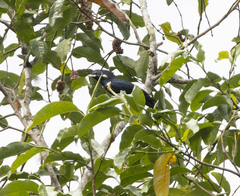
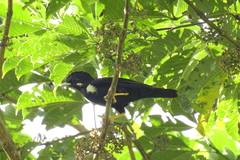
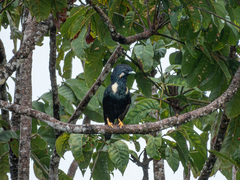
The Sulawesi myna (Basilornis celebensis) is a species of starling in the family Sturnidae. It is endemic to Sulawesi, Indonesia. Its natural habitat is subtropical or tropical moist lowland forests. The Sulawesi myna grows to a length of 23 to 27 cm (9.1 to 10.6 in). It is a glossy black bird with a permanently raised crest which is larger in the male. The sides of the face and throat have white patches. The eye is surrounded by a bluish-black ring of bare skin, the beak is pale bluish-green and the legs are yellowish. Juvenile birds are chocolate brown.

This myna has a range of sounds including grunts, high-pitched whistles, squeaks and warbles. One call is a descending sequence of whistles and another is a descending nasal call that sounds like "meeow" and is uttered with the head thrusting forwards and the back feathers fluffed up.

This myna is endemic to the humid forests of hilly districts of the Indonesian island of Sulawesi. Its main habitat here is forest fringes, clearings, scattered areas of woodland and secondary forests, although it is sometimes found in primary forests. It is also present on the smaller islands of Lembeh... Wikipedia →

Sounds

Call0:20

Indonesia · 2024

© Ding Li Yong · XC926396 · CC BY-NC-ND 4.0

?0:43

Indonesia · 2011

© Jerome Micheletta · XC75456 · CC BY-NC-ND 2.5

Call0:13

Indonesia · 2014

© Stijn Cooleman · XC207698 · CC BY-NC-SA 4.0

Global Distribution

Parks Where Found

# Park Country Daily sighting probability
1 Tangkoko Nature Reserve 🇮🇩 Indonesia
~20%

More parks will be added in future updates.

Zoos & Centres Where Found

# Zoo / Centre Country
1 Bird Paradise 🇸🇬 Singapore In captivity
2 Rainforest Wild Asia 🇸🇬 Singapore In captivity

Before you go

What are the chances of seeing a Sulawesi Myna in Tangkoko Nature Reserve?

Possible

About 20% of wildlife watchers report a Sulawesi Myna sighting in Tangkoko Nature Reserve on a given day, based on 235 verified sightings from GBIF citizen-science data from 2019 to 2026. It is the 43rd most-seen of the 138 birds we can rate there. Over three days the chance rises to about 60%, and over a week to about 90%, if each day is a fresh chance.

When is the best time to see a Sulawesi Myna in Tangkoko Nature Reserve?

March–April, June, September and November–January

In those months about 30% of wildlife watchers report a Sulawesi Myna in Tangkoko Nature Reserve on a given day, against about 20% in February, May, July–August and October, the lowest months.

What time of day is best to see a Sulawesi Myna?

Between 6 and 9 am

Across all the parks we cover, that three-hour window holds the most Sulawesi Myna sightings with a recorded time, and about 9 in 10 of them come between 6 am and 6 pm: it is a daytime animal.

Where else can you see a Sulawesi Myna?

Only Tangkoko Nature Reserve, in our data

Tangkoko Nature Reserve is the only park on Wallace's Line with enough records to rate Sulawesi Myna sightings: about 20% of wildlife watchers there report one on a given day.

Which relatives of the Sulawesi Myna live in Tangkoko Nature Reserve?

Same family: Sturnidae

The closest relatives of the Sulawesi Myna that you can see in Tangkoko Nature Reserve (family Sturnidae, Starlings) are Finch-billed Myna (about 50%) and White-necked Myna (about 50%), with each one's daily chance of a sighting.

Where does the Sulawesi Myna sighting chance come from?

GBIF citizen-science records

It is estimated from how often the Sulawesi Myna is recorded against all the birds logged in Tangkoko Nature Reserve (235 verified sightings from 2019 to 2026), calibrated against known sighting rates. Figures are rounded to the nearest 10% because citizen-science data supports honest approximations, not decimals, and months with records from fewer than five people show "—". How it works.

← Back to Tangkoko Nature Reserve