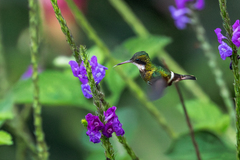
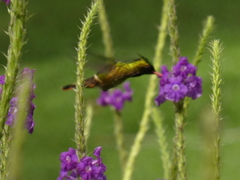

Black-crested Coquette

Black-crested Coquette

Lophornis helenae

Silhouette: Ferran Sayol · PhyloPic

LCLeast ConcernNTVUENCR
Daily sighting probability <5% · Rare
at Tapantí-Macizo de la Muerte National Park

In 3 days <5%

19 Verified sightings at Tapantí-Macizo de la Muerte National Park From 2019 to 2026
4,960 In all 7 parks
May Best month
☀️ Diurnal When it's spotted

About the Black-crested Coquette

The black-crested coquette (Lophornis helenae) is a species of hummingbird in the "coquettes", tribe Lesbiini of subfamily Lesbiinae. It is found in Belize, Costa Rica, Guatemala, Honduras, Mexico, and Nicaragua. The black-crested coquette was originally described as Ornismya helenae. Later it and the white-crested coquette (Lophornis adorabilis) were placed in genus Paphosia. The black-crested coquette is monotypic.

The black-crested coquette is 6.3 to 7.7 cm (2.5 to 3.0 in) long with an average weight of 2.6 to 2.8 g (0.092 to 0.099 oz). The adult male has a dark metallic green crown with a wispy greenish black crest. The nape and back are metallic bronze green; a white band separates the back from the sooty blackish rump and uppertail coverts. The central tail feathers are dull greenish bronze between their cinnamon rufous bases and dusky ends. The outer tail feathers are cinnamon rufous. The chin and upper throat are metallic yellowish green with a velvety black band below. The sides of the throat have tufts of buff feathers with velvety black margins. The breast is metallic bronze, the belly and flanks white with metallic bronze... Wikipedia →

Sounds

Call0:09

Costa Rica · 2014

© Andrew Spencer · XC168734 · CC BY-NC-SA 3.0

Global Distribution

Parks Where Found

# Park Country Daily sighting probability
1 Tenorio Volcano National Park 🇨🇷 Costa Rica
~20%
2 Arenal Volcano National Park 🇨🇷 Costa Rica
~20%
3 Cerro Azul Meámbar National Park 🇭🇳 Honduras
<5%
4 Braulio Carrillo National Park 🇨🇷 Costa Rica
<5%
5 Cusuco National Park 🇭🇳 Honduras
<5%
6 Tapantí-Macizo de la Muerte National Park 🇨🇷 Costa Rica
<5%
7 Poás Volcano National Park 🇨🇷 Costa Rica
<5%

Before you go

What are the chances of seeing a Black-crested Coquette in Tapantí-Macizo de la Muerte National Park?

Rare

Under 5% of wildlife watchers report a Black-crested Coquette sighting in Tapantí-Macizo de la Muerte National Park on a given day, based on 19 verified sightings from GBIF citizen-science data from 2019 to 2026. It is the 415th most-seen of the 467 birds we can rate there. Over three days the chance rises to under 5%, if each day is a fresh chance.

When is the best time to see a Black-crested Coquette in Tapantí-Macizo de la Muerte National Park?

Any time of year

In every month with enough records, under 5% of wildlife watchers report a Black-crested Coquette in Tapantí-Macizo de la Muerte National Park on a given day, so our monthly data shows no clear season.

What time of day is best to see a Black-crested Coquette?

Between 6 and 9 am

Across all the parks we cover, that three-hour window holds the most Black-crested Coquette sightings with a recorded time, and about 9 in 10 of them come between 6 am and 6 pm: it is a daytime animal.

Which relatives of the Black-crested Coquette live in Tapantí-Macizo de la Muerte National Park?

Same family: Trochilidae

The closest relatives of the Black-crested Coquette that you can see in Tapantí-Macizo de la Muerte National Park (family Trochilidae, Hummingbirds) are Volcano Hummingbird (about 60%), Talamanca Hummingbird (about 50%) and Lesser Violetear (about 50%), with each one's daily chance of a sighting.

Where does the Black-crested Coquette sighting chance come from?

GBIF citizen-science records

It is estimated from how often the Black-crested Coquette is recorded against all the birds logged in Tapantí-Macizo de la Muerte National Park (19 verified sightings from 2019 to 2026), calibrated against known sighting rates. Figures are rounded to the nearest 10% because citizen-science data supports honest approximations, not decimals, and months with records from fewer than five people show "—". How it works.

← Back to Tapantí-Macizo de la Muerte National Park