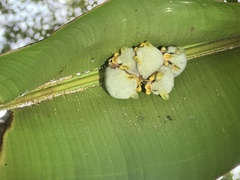
White Bat

White Bat

Ectophylla alba

Silhouette: Roberto Díaz Sibaja · PhyloPic

LCNTNear ThreatenedVUENCR
Daily sighting probability <5% · Rare
at Tapantí-Macizo de la Muerte National Park

In 3 days ~10% in a week ~20%

7 Verified sightings at Tapantí-Macizo de la Muerte National Park From 2019 to 2026
424 In all 3 parks
September Best month
☀️ Diurnal When it's spotted

About the White Bat

The Honduran white bat (Ectophylla alba), also called the Caribbean white tent-making bat, is a species of bat in the family Phyllostomatidae. It is the only member of the genus Ectophylla. The genus and the species were both scientifically described for the first time in 1892. It has distinctive, entirely white fur, which is only found in six of the roughly 1,300 known species of bat. It constructs "tents" out of understory plant leaves by strategically cutting the leaf ribs with its teeth; it roosts in these tents during the day. It is a specialist frugivore, consuming almost exclusively the fruits of one species of fig. Females can likely become pregnant twice per year, giving birth to one offspring at a time.

It is found in Honduras, Nicaragua, Costa Rica and western Panama at elevations from sea level to 700 m (2,300 ft). Due to habitat loss, it is evaluated as near-threatened by the IUCN. Its bright yellow ears, nose-leaf, and lips are a result of carotenoid deposition; the mechanism of this deposition is being researched as a way to understand and combat macular degeneration in humans.

The Honduran white bat was described as a new species, Ectophylla... Wikipedia →

Global Distribution

Parks Where Found

# Park Country Daily sighting probability
1 Braulio Carrillo National Park 🇨🇷 Costa Rica
~20%
2 Tortuguero National Park 🇨🇷 Costa Rica
~10%
3 Tapantí-Macizo de la Muerte National Park 🇨🇷 Costa Rica
<5%

Zoos & Centres Where Found

# Zoo / Centre Country
1 Centro de Vida Silvestre Snake Garden 🇨🇷 Costa Rica In captivity

Closest Relatives at Tapantí-Macizo de la Muerte National Park

No species of the same family or order lives in Tapantí-Macizo de la Muerte National Park, so these are its closest relatives here: other mammals.

Before you go

What are the chances of seeing a White Bat in Tapantí-Macizo de la Muerte National Park?

Rare

Under 5% of wildlife watchers report a White Bat sighting in Tapantí-Macizo de la Muerte National Park on a given day, based on 7 verified sightings from GBIF citizen-science data from 2019 to 2026. It is the 19th most-seen of the 21 mammals we can rate there. Over three days the chance rises to about 10%, and over a week to about 20%, if each day is a fresh chance.

When is the best time to see a White Bat in Tapantí-Macizo de la Muerte National Park?

June and September

In those months about 10% of wildlife watchers report a White Bat in Tapantí-Macizo de la Muerte National Park on a given day, against under 5% in July–August and October–May, the lowest months.

What time of day is best to see a White Bat?

Between 8 and 11 am

Across all the parks we cover, that three-hour window holds the most White Bat sightings with a recorded time, and about 9 in 10 of them come between 6 am and 6 pm: it is a daytime animal.

Is Tapantí-Macizo de la Muerte National Park the best place to see a White Bat?

3rd of 3

Of the 3 parks where we can rate White Bat sightings, Tapantí-Macizo de la Muerte National Park ranks 3rd at under 5%. The best odds are in Braulio Carrillo National Park (Costa Rica, about 20%) and Tortuguero National Park (Costa Rica, about 10%).

Where does the White Bat sighting chance come from?

GBIF citizen-science records

It is estimated from how often the White Bat is recorded against all the mammals logged in Tapantí-Macizo de la Muerte National Park (7 verified sightings from 2019 to 2026), calibrated against known sighting rates. Figures are rounded to the nearest 10% because citizen-science data supports honest approximations, not decimals, and months with records from fewer than five people show "—". How it works.

← Back to Tapantí-Macizo de la Muerte National Park