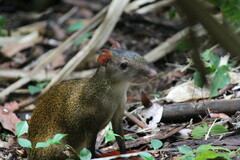
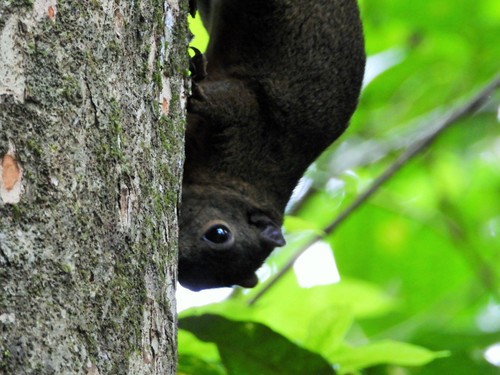
Central American Agouti

Central American Agouti

Dasyprocta punctata

Silhouette: Margot Michaud · PhyloPic

LCLeast ConcernNTVUENCR
Daily sighting probability ~20% · Possible
at Tapantí-Macizo de la Muerte National Park

In 3 days ~40% in a week ~70%

40 Verified sightings at Tapantí-Macizo de la Muerte National Park From 2019 to 2026
3,611 In all 33 parks
February Best month
☀️ Diurnal When it's spotted

About the Central American Agouti

The Central American agouti (Dasyprocta punctata) is a species of agouti from the family Dasyproctidae. The main portion of its range is from Chiapas and the Yucatan Peninsula (southern Mexico), through Central America, to northwestern Ecuador, Colombia and far western Venezuela. A highly disjunct population is found in southeastern Peru, far southwestern Brazil, Bolivia, western Paraguay and far northwestern Argentina. The disjunct population has been treated as a separate species, the brown agouti (Dasyprocta variegata), but a major review of the geographic variation is necessary. The Central American agouti has also been introduced to Cuba and the Cayman Islands.

Though some populations are reduced due to hunting and deforestation, large populations remain and it is not considered threatened. In an analysis of 240 species, agoutis came in fourth place for best sense of smell; better than dogs, which actually came out average. Their snouts are packed full of olfactory receptors.

Central American agoutis from the main part of their range weigh 3–4.2 kg (6.6–9.3 lb) and are typically reddish, orange or yellowish grizzled with black. In northern Colombia, western Venezuela... Wikipedia →

Sounds

Recording0:18

Panama · 2021

© Terry · iNaturalist · CC BY-NC 4.0

Global Distribution

Parks Where Found

# Park Country Daily sighting probability
1 Soberanía National Park 🇵🇦 Panama
~70%
2 Manuel Antonio National Park 🇨🇷 Costa Rica
~70%
3 Gandoca-Manzanillo Wildlife Refuge 🇨🇷 Costa Rica
~70%
4 Rincón de la Vieja National Park 🇨🇷 Costa Rica
~60%
5 Piedras Blancas National Park 🇨🇷 Costa Rica
~60%
6 Santa Rosa National Park 🇨🇷 Costa Rica
~60%
7 Tikal National Park 🇬🇹 Guatemala
~60%
8 Monteverde Cloud Forest Reserve 🇨🇷 Costa Rica
~60%
9 Pico Bonito National Park 🇭🇳 Honduras
~50%
10 Parque Natural Metropolitano 🇵🇦 Panama
~50%
11 Braulio Carrillo National Park 🇨🇷 Costa Rica
~40%
12 Carara National Park 🇨🇷 Costa Rica
~40%
13 Cabo Blanco Absolute Nature Reserve 🇨🇷 Costa Rica
~40%
14 Corcovado National Park 🇨🇷 Costa Rica
~40%
15 Tortuguero National Park 🇨🇷 Costa Rica
~40%
16 Tayrona National Natural Park 🇨🇴 Colombia
~40%
17 Arenal Volcano National Park 🇨🇷 Costa Rica
~40%
18 La Tigra National Park 🇭🇳 Honduras
~40%
19 Cahuita National Park 🇨🇷 Costa Rica
~40%
20 Chagres National Park 🇵🇦 Panama
~30%
21 Palo Verde National Park 🇨🇷 Costa Rica
~30%
22 Calakmul Biosphere Reserve 🇲🇽 Mexico
~30%
23 Farallones de Cali National Natural Park 🇨🇴 Colombia
~30%
24 Marino Ballena National Park 🇨🇷 Costa Rica
~20%
25 Cerro Azul Meámbar National Park 🇭🇳 Honduras
~20%
26 Chirripó National Park 🇨🇷 Costa Rica
~20%
27 Lago de Yojoa 🇭🇳 Honduras
~20%
28 Tapantí-Macizo de la Muerte National Park 🇨🇷 Costa Rica
~20%
29 Tenorio Volcano National Park 🇨🇷 Costa Rica
~20%
30 Sian Ka'an Biosphere Reserve 🇲🇽 Mexico
~10%
31 Bastimentos Island National Marine Park 🇵🇦 Panama
~10%
32 Arrecifes de Cozumel National Park 🇲🇽 Mexico
~10%
33 La Amistad International Park (Panama) 🇵🇦 Panama
~10%

Cities Where Found

# City Country Daily sighting probability
1 Cali 🇨🇴 Colombia
~50%
2 Panama City 🇵🇦 Panama
~30%
3 San Salvador 🇸🇻 El Salvador
~30%
4 Tegucigalpa 🇭🇳 Honduras
~20%
5 Guayaquil 🇪🇨 Ecuador
~20%
6 San Pedro Sula 🇭🇳 Honduras
~20%
7 San José 🇨🇷 Costa Rica
<5%

Zoos & Centres Where Found

# Zoo / Centre Country
1 ZooParc de Beauval 🇫🇷 France In captivity
2 Zoo Pilsen 🇨🇿 Czechia In captivity
3 Nanjing Hongshan Forest Zoo 🇨🇳 China In captivity
4 Wildlife World Zoo 🇺🇸 United States In captivity
5 Parque Municipal Summit 🇵🇦 Panama In captivity
6 Xcaret 🇲🇽 Mexico In captivity
7 Berlin Zoological Garden 🇩🇪 Germany In captivity
8 Terra Natura Benidorm 🇪🇸 Spain In captivity
9 Night Safari 🇸🇬 Singapore In captivity
10 Hamilton Zoo 🇳🇿 New Zealand In captivity
11 Singapore Zoo 🇸🇬 Singapore In captivity
12 Nikolaev Zoo 🇺🇦 Ukraine In captivity
13 Chapultepec Zoo 🇲🇽 Mexico In captivity
14 Ouwehands Dierenpark 🇳🇱 Netherlands In captivity
15 Minsk Zoo 🇧🇾 Belarus In captivity
16 Buffalo Zoo 🇺🇸 United States In captivity
17 La Paz Waterfall Gardens 🇨🇷 Costa Rica In captivity
18 Wellington Zoo 🇳🇿 New Zealand In captivity
19 River Wonders 🇸🇬 Singapore In captivity
20 Leningrad Zoo 🇷🇺 Russia In captivity
21 Refugio Silvestre Yanacocha 🇪🇨 Ecuador In captivity
22 Yanacocha Animal Rescue Centre 🇪🇨 Ecuador In captivity
23 Zoológico Thomas Belt 🇳🇮 Nicaragua In captivity
24 Papiliorama 🇨🇭 Switzerland In captivity
25 Ecozoológico San Martín 🇪🇨 Ecuador In captivity
26 El Nispero Zoo 🇵🇦 Panama In captivity
27 Zoo Criadero Tarqui 🇪🇨 Ecuador In captivity
28 zoologico de barranquilla 🇨🇴 Colombia In captivity
29 Aquarium Berlin 🇩🇪 Germany In captivity
30 Monteverde Theme Park 🇨🇷 Costa Rica In captivity
31 Wiwa Quito 🇪🇨 Ecuador In captivity
32 Zoológico Miguél Álvarez del Toro 🇲🇽 Mexico In captivity
33 Дэльфінарый 🇧🇾 Belarus In captivity

Before you go

What are the chances of seeing a Central American Agouti in Tapantí-Macizo de la Muerte National Park?

Possible

About 20% of wildlife watchers report a Central American Agouti sighting in Tapantí-Macizo de la Muerte National Park on a given day, based on 40 verified sightings from GBIF citizen-science data from 2019 to 2026. It is the 4th most-seen of the 21 mammals we can rate there. Over three days the chance rises to about 40%, and over a week to about 70%, if each day is a fresh chance.

When is the best time to see a Central American Agouti in Tapantí-Macizo de la Muerte National Park?

February

In that month about 40% of wildlife watchers report a Central American Agouti in Tapantí-Macizo de la Muerte National Park on a given day, against under 5% in August and October, the lowest months. That is one of Tapantí-Macizo de la Muerte National Park's driest months, with about 160 mm of rain against 570 mm in October.

What time of day is best to see a Central American Agouti?

Between 2 and 5 pm

Across all the parks we cover, that three-hour window holds the most Central American Agouti sightings with a recorded time, and about 9 in 10 of them come between 6 am and 6 pm: it is a daytime animal.

Which relatives of the Central American Agouti live in Tapantí-Macizo de la Muerte National Park?

Same order: Rodentia

The closest relatives of the Central American Agouti that you can see in Tapantí-Macizo de la Muerte National Park (order Rodentia, Rodents) are Red-tailed Squirrel (about 30%), Mexican Hairy Dwarf Porcupine (about 10%) and Variegated Squirrel (about 10%), with each one's daily chance of a sighting.

Where does the Central American Agouti sighting chance come from?

GBIF citizen-science records

It is estimated from how often the Central American Agouti is recorded against all the mammals logged in Tapantí-Macizo de la Muerte National Park (40 verified sightings from 2019 to 2026), calibrated against known sighting rates. Figures are rounded to the nearest 10% because citizen-science data supports honest approximations, not decimals, and months with records from fewer than five people show "—". How it works.

← Back to Tapantí-Macizo de la Muerte National Park