Red-bellied Parrot

Red-bellied Parrot

Poicephalus rufiventris

Silhouette: Sheatherius · PhyloPic

LCLeast ConcernNTVUENCR
Daily sighting probability ~40% · Likely
at Tarangire National Park

In 3 days ~80% in a week >90%

677 Verified sightings at Tarangire National Park From 2019 to 2026
1,832 In all 7 parks
April Best month
☀️ Diurnal When it's spotted

About the Red-bellied Parrot

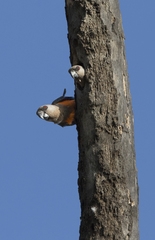
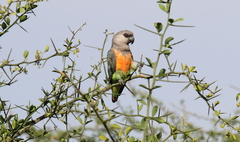
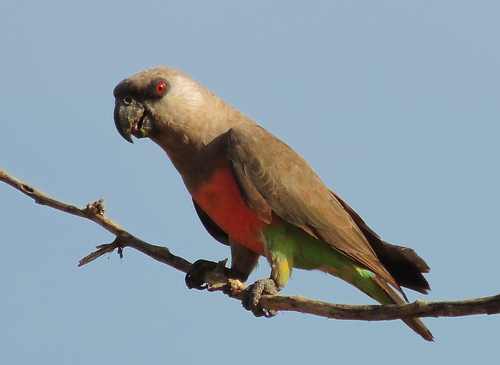
The red-bellied parrot (Poicephalus rufiventris) is a small African parrot about 23 cm (9 in) long of the genus Poicephalus. The genus Poicephalus has the greatest quantity of species and is widely spread in Africa. It is a mostly greenish and grey parrot. Males have a bright orange belly and females have a greenish belly.

The red-bellied parrot is a small parrot about 23 cm (9 in) long and weights 140 g (5 oz). It is a mostly greenish and grey bird with the green being more prominent over its lower surfaces and the grey more prominent over its upper surfaces. Adult birds have green feathers covering the upper portions of their legs, red irises and dark grey beaks. The species is sexually dimorphic; Typically, males have a bright orange lower chest and abdomen, whilst adult females are greenish on these lower areas. The dimorphism occurs from a young age and is seen even in young chicks still in the nest.

The red-bellied parrot eats seed, fruit kernels, flowers, nectar, and periodically leaves, bark, and juice from hard fruits. Although the name red-bellied parrot implies that the parrot has hints of red, the word for the color orange was not introduced into the... Wikipedia →
Sounds

Call0:14

Kenya · 2024

© Peter Boesman · XC948418 · CC BY-NC-ND 4.0

Flight call0:06

Ethiopia · 2019

© Oscar Campbell · XC473968 · CC BY-NC-SA 4.0

Call0:10

Kenya · 2022

© isaac kilusu · XC736030 · CC BY-NC-SA 4.0

Global Distribution

Parks Where Found

# Park Country Daily sighting probability
1 Tsavo West National Park 🇰🇪 Kenya
~50%
2 Tarangire National Park 🇹🇿 Tanzania
~40%
3 Samburu National Reserve 🇰🇪 Kenya
~40%
4 Mkomazi National Park 🇹🇿 Tanzania
~40%
5 Meru National Park 🇰🇪 Kenya
~30%
6 Tsavo East National Park 🇰🇪 Kenya
~20%
7 Awash National Park 🇪🇹 Ethiopia
~10%

Zoos & Centres Where Found

# Zoo / Centre Country
1 Oakland Zoo 🇺🇸 United States In captivity
2 Adelaide Zoo 🇦🇺 Australia In captivity

Before you go

What are the chances of seeing a Red-bellied Parrot in Tarangire National Park?

Likely

About 40% of wildlife watchers report a Red-bellied Parrot sighting in Tarangire National Park on a given day, based on 677 verified sightings from GBIF citizen-science data from 2019 to 2026. It is the 27th most-seen of the 411 birds we can rate there. Over three days the chance rises to about 80%, and over a week to over 90%, if each day is a fresh chance.

When is the best time to see a Red-bellied Parrot in Tarangire National Park?

April

In that month about 70% of wildlife watchers report a Red-bellied Parrot in Tarangire National Park on a given day, against about 20% in December, the lowest month. That is one of Tarangire National Park's wettest months, with about 170 mm of rain against almost none in September.

What time of day is best to see a Red-bellied Parrot?

Between 8 and 11 am

Across all the parks we cover, that three-hour window holds the most Red-bellied Parrot sightings with a recorded time, and about 8 in 10 of them come between 6 am and 6 pm: it is a daytime animal.

Is Tarangire National Park the best place to see a Red-bellied Parrot?

2nd of 7

Of the 7 parks where we can rate Red-bellied Parrot sightings, Tarangire National Park ranks 2nd at about 40%. The best odds are in Tsavo West National Park (Kenya, about 50%). All parks ranked.

Where does the Red-bellied Parrot sighting chance come from?

GBIF citizen-science records

It is estimated from how often the Red-bellied Parrot is recorded against all the birds logged in Tarangire National Park (677 verified sightings from 2019 to 2026), calibrated against known sighting rates. Figures are rounded to the nearest 10% because citizen-science data supports honest approximations, not decimals, and months with records from fewer than five people show "—". How it works.

← Back to Tarangire National Park