Chinese Moon Moth

Chinese Moon Moth

Actias ningpoana

Daily sighting probability ~10% · With luck
at Taroko National Park

In 3 days ~30% in a week ~50%

13 Verified sightings at Taroko National Park From 2019 to 2026
13 In 1 park
July Best month
☀️🌙 Day & Night When it's spotted

About the Chinese Moon Moth

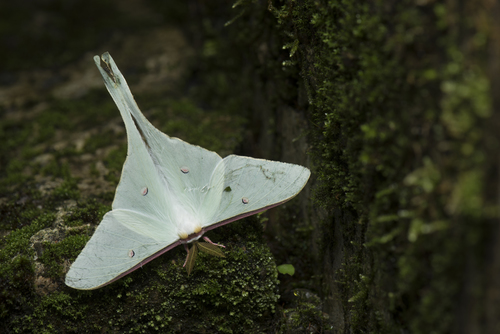
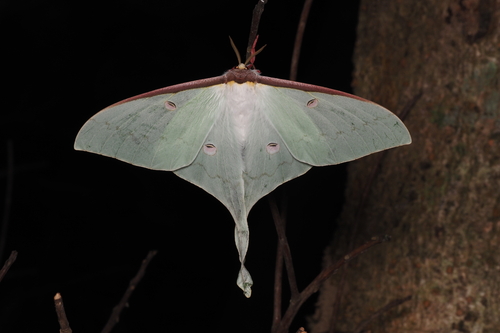
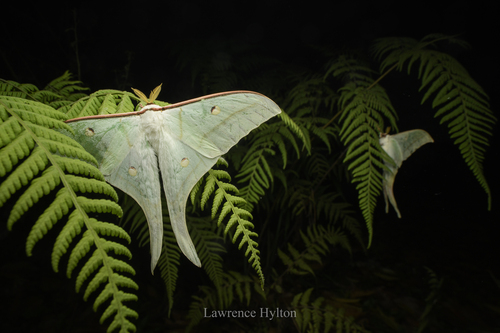
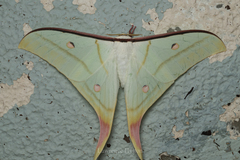
Actias ningpoana, commonly known as the Chinese moon moth, is a species of moth in the family Saturniidae. The species was first described by father-and-son entomologists Cajetan and Rudolf Felder in 1862. It is a large moth with long, curved hindwing tails. There are many congeners across Asia; the Luna moth (A. luna) of eastern Canada and the United States is closely related.

Actias ningpoana (Felder & Felder) was regarded as a subspecies of Actias selene, but was recently recognized as a separate species by Ylla et al. (2005). China (Jilin, Liaoning, Hebei, Henan, Jiangsu, Zhejiang, Jiangxi, Hubei, Hunan, Fujian, Guangdong, Hong Kong, Hainan, Sichuan, Yunnan) (Zhu & Wang, 1996)

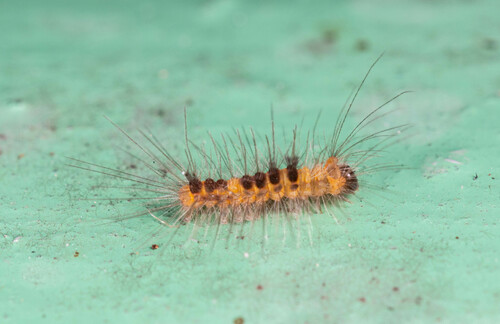
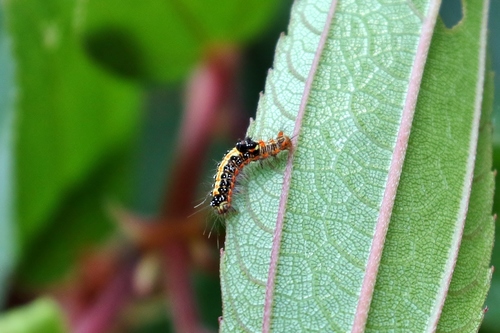
Russia (far east) (Zolotuhin & Chuvilin, 2009) India – Western Ghats Larvae are typically fleshy, with clumps of raised bristles. The pupa develops in a silken cocoon or in the soil. Adults lack functional mouthparts, and their lifespan is measured in days. They have small heads, densely hairy bodies, and wingspans ranging from 13 to 15 centimeters.

In Hong Kong, A. ningpoana has been reared on camphor (Cinnamomum camphora) (Hill et al., 1982 as Arctias... Wikipedia →
Global Distribution

Parks Where Found

# Park Country Daily sighting probability
1 Taroko National Park 🇹🇼 Taiwan
~10%

More parks will be added in future updates.

Cities Where Found

# City Country Daily sighting probability
1 Hefei 🇨🇳 China
~20%
2 Kunming 🇨🇳 China
~10%
3 Hong Kong 🇨🇳 China
~10%
4 Hangzhou 🇨🇳 China
~10%
5 Taipei 🇹🇼 Taiwan
<5%
6 Guangzhou 🇨🇳 China
<5%

Before you go

What are the chances of seeing a Chinese Moon Moth in Taroko National Park?

With luck

About 10% of wildlife watchers report a Chinese Moon Moth sighting in Taroko National Park on a given day, based on 13 verified sightings from GBIF citizen-science data from 2019 to 2026. It is the 196th most-seen of the 447 insects we can rate there. Over three days the chance rises to about 30%, and over a week to about 50%, if each day is a fresh chance.

When is the best time to see a Chinese Moon Moth in Taroko National Park?

April and July

In those months about 20% of wildlife watchers report a Chinese Moon Moth in Taroko National Park on a given day, against under 5% in June, August and October–February, the lowest months.

What time of day is best to see a Chinese Moon Moth?

Between 7 and 10 pm

Across all the parks we cover, that three-hour window holds the most Chinese Moon Moth sightings with a recorded time, and about half of them come between 6 pm and 6 am: it is seen both by day and at night.

Where else can you see a Chinese Moon Moth?

Only Taroko National Park, in our data

Taroko National Park is the only park on Wallace's Line with enough records to rate Chinese Moon Moth sightings: about 10% of wildlife watchers there report one on a given day.

Which relatives of the Chinese Moon Moth live in Taroko National Park?

Same genus: Actias

The closest relatives of the Chinese Moon Moth that you can see in Taroko National Park (genus Actias, Moon Moths) are Actias neidhoeferi (about 10%) and South China Moon Moth (about 10%), with each one's daily chance of a sighting.

Where does the Chinese Moon Moth sighting chance come from?

GBIF citizen-science records

It is estimated from how often the Chinese Moon Moth is recorded against all the insects logged in Taroko National Park (13 verified sightings from 2019 to 2026), calibrated against known sighting rates. Figures are rounded to the nearest 10% because citizen-science data supports honest approximations, not decimals, and months with records from fewer than five people show "—". How it works.

← Back to Taroko National Park