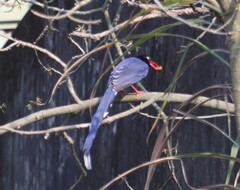
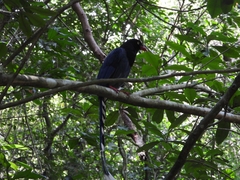
Formosan Magpie

Formosan Magpie

Urocissa caerulea

Silhouette: Lip Kee Yap (vectorized by T. Michael Keesey) · PhyloPic

LCLeast ConcernNTVUENCR Endemic
Daily sighting probability <5% · Rare
at Taroko National Park

In 3 days ~10% in a week ~30%

79 Verified sightings at Taroko National Park From 2019 to 2026
79 In 1 park
December Best month
☀️ Diurnal When it's spotted

About the Formosan Magpie

The Taiwan blue magpie (Urocissa caerulea), also called the Taiwan magpie, Formosan blue magpie (Chinese: 臺灣藍鵲; pinyin: Táiwān lán què), or the "long-tailed mountain lady" (Chinese: 長尾山娘; pinyin: Chángwěi shānniáng; Taiwanese Hokkien: Tn̂g-boé soaⁿ-niû), is a bird species in the crow family. It is endemic to Taiwan.

The Taiwan blue magpie was collected by Robert Swinhoe and described by John Gould. Swinhoe translated the magpie's Hokkien name into English, calling it the "Long-tailed Mountain-Nymph". The species is sometimes placed in the genus Cissa. It forms a superspecies with the yellow-billed blue magpie (Urocissa flavirostris) and the red-billed blue magpie (Urocissa erythroryncha). The species is monotypic.

The Taiwan blue magpie is endemic to Taiwan. It lives in broadleaf forests at elevations of 300–1,200 m (980–3,940 ft). It is 63–68 cm (25–27 in) in length. The tail measures around 34–42 cm (13–17 in) in length, and the wings are 20 cm (7.9 in) long. It weighs 254–260 g (9.0–9.2 oz).

The plumages of the male and female are similar. The head, neck and breast are black. The eyes are yellow, and... Wikipedia →

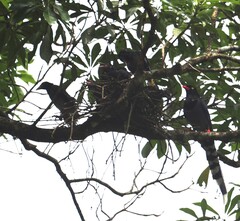
Sounds

Call1:11

Taiwan · 2026

© Joan Theng · XC1156276 · CC BY-NC-SA 4.0

Call0:29

Taiwan · 2021

© Sunny Tseng · XC631376 · CC BY-NC-SA 4.0

Call0:37

Taiwan · 2020

© An Chou · XC602941 · CC BY-NC-SA 4.0

Global Distribution

Parks Where Found

# Park Country Daily sighting probability
1 Taroko National Park 🇹🇼 Taiwan
<5%

More parks will be added in future updates.

Cities Where Found

# City Country Daily sighting probability
1 Taipei 🇹🇼 Taiwan
~20%

Zoos & Centres Where Found

# Zoo / Centre Country
1 Fonghuanggu Bird and Ecology Park 🇹🇼 Taiwan In captivity
2 Moody Gardens 🇺🇸 United States In captivity
3 Odense Zoo 🇩🇰 Denmark In captivity

Before you go

What are the chances of seeing a Formosan Magpie in Taroko National Park?

Rare

Under 5% of wildlife watchers report a Formosan Magpie sighting in Taroko National Park on a given day, based on 79 verified sightings from GBIF citizen-science data from 2019 to 2026. It is the 92nd most-seen of the 147 birds we can rate there. Over three days the chance rises to about 10%, and over a week to about 30%, if each day is a fresh chance.

When is the best time to see a Formosan Magpie in Taroko National Park?

December

In that month about 20% of wildlife watchers report a Formosan Magpie in Taroko National Park on a given day, against under 5% in January–March and June–November, the lowest months.

What time of day is best to see a Formosan Magpie?

Between 3 and 6 pm

Across all the parks we cover, that three-hour window holds the most Formosan Magpie sightings with a recorded time, and about 9 in 10 of them come between 6 am and 6 pm: it is a daytime animal.

Where else can you see a Formosan Magpie?

Only Taroko National Park, in our data

Taroko National Park is the only park on Wallace's Line with enough records to rate Formosan Magpie sightings: under 5% of wildlife watchers there report one on a given day.

Which relatives of the Formosan Magpie live in Taroko National Park?

Same family: Corvidae

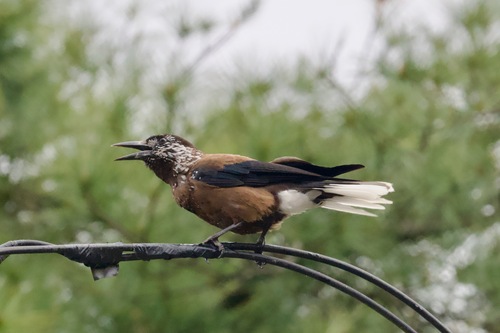
The closest relatives of the Formosan Magpie that you can see in Taroko National Park (family Corvidae, Crows, Jays, and Magpies) are Large-billed Crow (about 70%), Gray Treepie (about 20%) and Southern Nutcracker (about 20%), with each one's daily chance of a sighting.

Where does the Formosan Magpie sighting chance come from?

GBIF citizen-science records

It is estimated from how often the Formosan Magpie is recorded against all the birds logged in Taroko National Park (79 verified sightings from 2019 to 2026), calibrated against known sighting rates. Figures are rounded to the nearest 10% because citizen-science data supports honest approximations, not decimals, and months with records from fewer than five people show "—". How it works.

← Back to Taroko National Park