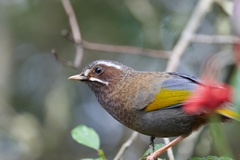
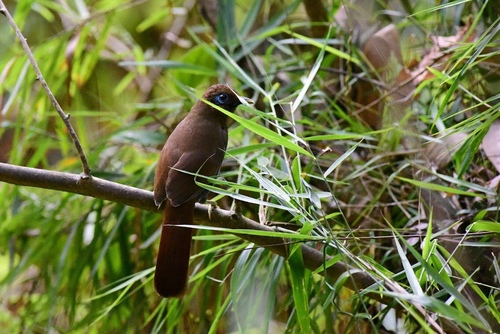
White-whiskered Laughingthrush

White-whiskered Laughingthrush

Trochalopteron morrisonianum

Silhouette: Sheatherius · PhyloPic

LCNTNear ThreatenedVUENCR Endemic
Daily sighting probability ~40% · Likely
at Taroko National Park

In 3 days ~80% in a week >90%

2,553 Verified sightings at Taroko National Park From 2019 to 2026
2,553 In 1 park
July Best month
🌅 Crepuscular When it's spotted

About the White-whiskered Laughingthrush

The white-whiskered laughingthrush or Formosan laughing thrush (Trochalopteron morrisonianum) is a species of bird in the family Leiothrichidae. It is endemic to montane forests of the island of Taiwan. White-whiskered laughingthrush is a large, 26 to 28 cm (10 to 11 in) long, laughingthrush with a distinctive face pattern. The bill is thrush-like and yellowish to horn-colored. The eyes are black. The legs are strong and brownish pink. The mean body weight is about 77 grams (2.7 oz).

It is a sociable species that often occurs in large groups. It is not necessarily afraid of humans. The species occurs at elevations between 1,475 and 3,300 m (4,839 and 10,827 ft) above sea level, but typically above 2000 m, in tall grass, forest undergrowth, thickets, and forest edge scrub. It can enter open areas by roadsides and in forest clearings. In the Yushan National Park, it was more abundant in mixed coniferous forest than in grassland, pine woodland, or spruce forest; along with Taiwan fulvetta (Fulvetta formosana) and Taiwan yuhina (Yuhina brunneiceps), it was a dominant species in that habitat. It is a ground omnivore.

White-whiskered... Wikipedia →

Sounds

Uncertain0:37

Taiwan · 2022

© Chi-Hsuan Shao · XC745954 · CC BY-NC-SA 4.0

Song0:08

Taiwan · 2010

© Kuan-Chieh (Chuck) Hung, Taiwanbirdguide.com · XC743894 · CC BY-NC-SA 4.0

Call0:25

Taiwan · 2021

© An Chou · XC636809 · CC BY-NC-SA 4.0

Global Distribution

Parks Where Found

# Park Country Daily sighting probability
1 Taroko National Park 🇹🇼 Taiwan
~40%

More parks will be added in future updates.

Before you go

What are the chances of seeing a White-whiskered Laughingthrush in Taroko National Park?

Likely

About 40% of wildlife watchers report a White-whiskered Laughingthrush sighting in Taroko National Park on a given day, based on 2,553 verified sightings from GBIF citizen-science data from 2019 to 2026. It is the 8th most-seen of the 147 birds we can rate there. Over three days the chance rises to about 80%, and over a week to over 90%, if each day is a fresh chance.

When is the best time to see a White-whiskered Laughingthrush in Taroko National Park?

July

In that month about 80% of wildlife watchers report a White-whiskered Laughingthrush in Taroko National Park on a given day, against about 10% in February, the lowest month.

What time of day is best to see a White-whiskered Laughingthrush?

Between 7 and 10 am

Across all the parks we cover, that three-hour window holds the most White-whiskered Laughingthrush sightings with a recorded time, and about half of them come between 6 pm and 6 am: it is most active around dawn and dusk.

Where else can you see a White-whiskered Laughingthrush?

Only Taroko National Park, in our data

Taroko National Park is the only park on Wallace's Line with enough records to rate White-whiskered Laughingthrush sightings: about 40% of wildlife watchers there report one on a given day.

Which relatives of the White-whiskered Laughingthrush live in Taroko National Park?

Same family: Leiothrichidae

The closest relatives of the White-whiskered Laughingthrush that you can see in Taroko National Park (family Leiothrichidae, Laughingthrushes and Allies) are White-eared Sibia (about 70%), Steere's Liocichla (about 50%) and Taiwan Barwing (about 20%), with each one's daily chance of a sighting.

Where does the White-whiskered Laughingthrush sighting chance come from?

GBIF citizen-science records

It is estimated from how often the White-whiskered Laughingthrush is recorded against all the birds logged in Taroko National Park (2,553 verified sightings from 2019 to 2026), calibrated against known sighting rates. Figures are rounded to the nearest 10% because citizen-science data supports honest approximations, not decimals, and months with records from fewer than five people show "—". How it works.

← Back to Taroko National Park