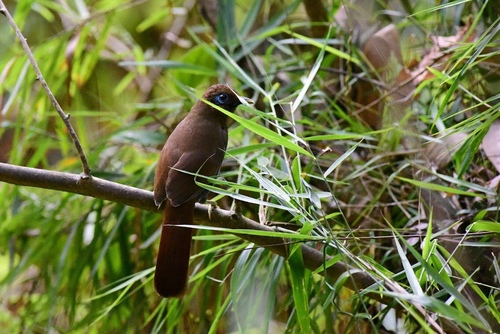
White-eared Sibia

White-eared Sibia

Heterophasia auricularis

Silhouette: Sheatherius · PhyloPic

LCLeast ConcernNTVUENCR Endemic
Daily sighting probability ~70% · Very likely
at Taroko National Park

In 3 days >90%

2,111 Verified sightings at Taroko National Park From 2019 to 2026
2,111 In 1 park
January Best month
🌅 Crepuscular When it's spotted

About the White-eared Sibia

The white-eared sibia (Heterophasia auricularis) is a bird in the laughingthrush family Leiothrichidae. The species is sometimes placed in the monotypic genus Malacias. It was first described by Robert Swinhoe in 1864. There are no subspecies.

It is endemic to the island of Taiwan, where it occupies a range of forest and woodland habitats. The species is a partial altitudinal migrant, breeding at 1,200–3,000 m (3,900–9,800 ft) above sea-level during the summer (or 2,780 m (9,120 ft) in the north of Taiwan), but with some individuals descending down to 700 m (2,300 ft) in winter, sometimes as low as 200 m (660 ft) in a particularly harsh spell. In the summer it inhabits evergreen forests, including mixed broadleaf coniferous forests, but will use deciduous forests in the winter.

The white-eared sibia is an elegant, long-tailed babbler, 22 to 24 cm (8.7–9.4 in) long and weighing an average of 40–50 g (1.4–1.8 oz). The head is black with a conspicuous white stripe through the eye, and the stripe ends in long white filamentous plumes. The wings and tail are deep blue-black, with a noticeable white wingbar. The upper back and breast is dark grey, and... Wikipedia →

Sounds

Song0:05

Taiwan · 2025

© Peter Ericsson · XC985715 · CC BY-NC-SA 4.0

Alarm call0:45

Taiwan · 2022

© Chi-Hsuan Shao · XC745938 · CC BY-NC-SA 4.0

Call0:30

Taiwan · 1983

© Jelle Scharringa · XC664339 · CC BY-NC-SA 4.0

Global Distribution

Parks Where Found

# Park Country Daily sighting probability
1 Taroko National Park 🇹🇼 Taiwan
~70%

More parks will be added in future updates.

Cities Where Found

# City Country Daily sighting probability
1 Kaohsiung 🇹🇼 Taiwan
<5%
2 Taipei 🇹🇼 Taiwan
<5%

Zoos & Centres Where Found

# Zoo / Centre Country
1 Disney's Animal Kingdom 🇺🇸 United States In captivity

Before you go

What are the chances of seeing a White-eared Sibia in Taroko National Park?

Very likely

About 70% of wildlife watchers report a White-eared Sibia sighting in Taroko National Park on a given day, based on 2,111 verified sightings from GBIF citizen-science data from 2019 to 2026. It is the 3rd most-seen of the 147 birds we can rate there. Over three days the chance rises to over 90%, if each day is a fresh chance.

When is the best time to see a White-eared Sibia in Taroko National Park?

January and February

In those months about 90% of wildlife watchers report a White-eared Sibia in Taroko National Park on a given day, against about 40% in May and July, the lowest months.

What time of day is best to see a White-eared Sibia?

Between 7 and 10 am

Across all the parks we cover, that three-hour window holds the most White-eared Sibia sightings with a recorded time, and about half of them come between 6 pm and 6 am: it is most active around dawn and dusk.

Where else can you see a White-eared Sibia?

Only Taroko National Park, in our data

Taroko National Park is the only park on Wallace's Line with enough records to rate White-eared Sibia sightings: about 70% of wildlife watchers there report one on a given day.

Which relatives of the White-eared Sibia live in Taroko National Park?

Same family: Leiothrichidae

The closest relatives of the White-eared Sibia that you can see in Taroko National Park (family Leiothrichidae, Laughingthrushes and Allies) are Steere's Liocichla (about 50%), White-whiskered Laughingthrush (about 40%) and Taiwan Barwing (about 20%), with each one's daily chance of a sighting.

Where does the White-eared Sibia sighting chance come from?

GBIF citizen-science records

It is estimated from how often the White-eared Sibia is recorded against all the birds logged in Taroko National Park (2,111 verified sightings from 2019 to 2026), calibrated against known sighting rates. Figures are rounded to the nearest 10% because citizen-science data supports honest approximations, not decimals, and months with records from fewer than five people show "—". How it works.

← Back to Taroko National Park