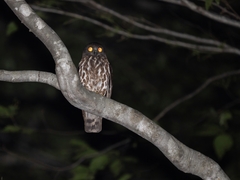
Northern Boobook

Northern Boobook

Ninox japonica

Silhouette: Rachel T Mason · PhyloPic

LCLeast ConcernNTVUENCR
Daily sighting probability <5% · Rare
at Taroko National Park

In 3 days ~10%

27 Verified sightings at Taroko National Park From 2019 to 2026
27 In 1 park
February Best month
☀️🌙 Day & Night When it's spotted

About the Northern Boobook

The northern boobook (Ninox japonica) belongs to the family Strigidae (true owls) and is a raptorial owl endemic to eastern and southern countries of Asia. The species was considered, until recently, a conspecific of Ninox scutulata or brown boobook, a species of similar distribution encompassing 11 subspecies. The species currently includes two subspecies, the migrant Ninox japonica japonica and the non-migrant Ninox japonica totogo. There are no indications of significant decline in northern boobook populations and therefore its conservation status has been classified as least concern by the IUCN Red List.

Ninox japonica is a hawk owl species with a body length averaging between 29 and 33 cm and a wingspan of approximately 60 to 70 cm wide. Current knowledge on the species shows no sexual dimorphism and an average weight of approximately 168g. The northern boobook has a hawk-like appearance and its subspecies are practically indistinguishable... Wikipedia →

Sounds

Call0:22

Malaysia · 2024

© Lim Ying Hien 林勇贤 · XC1161176 · CC BY-NC-ND 4.0

Song0:53

China · 2024

© Vincent · XC919644 · CC BY-NC-SA 4.0

Call0:16

Malaysia · 2024

© Lim Ying Hien · XC951749 · CC BY-NC-ND 4.0

Global Distribution

Parks Where Found

# Park Country Daily sighting probability
1 Taroko National Park 🇹🇼 Taiwan
<5%

More parks will be added in future updates.

Cities Where Found

# City Country Daily sighting probability
1 Naha 🇯🇵 Japan
<5%
2 Seoul 🇰🇷 South Korea
<5%
3 Kaohsiung 🇹🇼 Taiwan
<5%
4 Suzhou 🇨🇳 China
<5%
5 Shanghai 🇨🇳 China
<5%
6 Hong Kong 🇨🇳 China
<5%
7 Bangkok 🇹🇭 Thailand
<5%
8 Manila 🇵🇭 Philippines
<5%
9 Osaka 🇯🇵 Japan
<5%
10 Singapore 🇸🇬 Singapore
<5%

Zoos & Centres Where Found

# Zoo / Centre Country
1 Ueno Zoo 🇯🇵 Japan In captivity
2 Asahiyama Zoo 🇯🇵 Japan In captivity
3 Inokashira Park Zoo 🇯🇵 Japan In captivity

Before you go

What are the chances of seeing a Northern Boobook in Taroko National Park?

Rare

Under 5% of wildlife watchers report a Northern Boobook sighting in Taroko National Park on a given day, based on 27 verified sightings from GBIF citizen-science data from 2019 to 2026. It is the 110th most-seen of the 147 birds we can rate there. Over three days the chance rises to about 10%, if each day is a fresh chance.

When is the best time to see a Northern Boobook in Taroko National Park?

January and February

In those months about 10% of wildlife watchers report a Northern Boobook in Taroko National Park on a given day, against under 5% in March to December, the lowest months.

What time of day is best to see a Northern Boobook?

Between 10 am and 1 pm

Across all the parks we cover, that three-hour window holds the most Northern Boobook sightings with a recorded time, and about 6 in 10 of them come between 6 am and 6 pm: it is seen both by day and at night.

Where else can you see a Northern Boobook?

Only Taroko National Park, in our data

Taroko National Park is the only park on Wallace's Line with enough records to rate Northern Boobook sightings: under 5% of wildlife watchers there report one on a given day.

Which relatives of the Northern Boobook live in Taroko National Park?

Same family: Strigidae

The closest relatives of the Northern Boobook that you can see in Taroko National Park (family Strigidae, Typical Owls) are Collared Owlet (about 10%) and Mountain Scops-Owl (about 10%), with each one's daily chance of a sighting.

Where does the Northern Boobook sighting chance come from?

GBIF citizen-science records

It is estimated from how often the Northern Boobook is recorded against all the birds logged in Taroko National Park (27 verified sightings from 2019 to 2026), calibrated against known sighting rates. Figures are rounded to the nearest 10% because citizen-science data supports honest approximations, not decimals, and months with records from fewer than five people show "—". How it works.

← Back to Taroko National Park