About the Swinhoe's Pheasant
Swinhoe's pheasant (Lophura swinhoii), also known as the Taiwan blue pheasant, is a bird of the pheasant subfamily in the fowl family Phasianidae. It is endemic to Taiwan. Along with the Mikado pheasant and Taiwan blue magpie, two other Taiwan endemics, Swinhoe's pheasant is sometimes considered an unofficial national symbol for Taiwan, as it bears the colours of the national flag (red, white, and blue).
The bird was named after British naturalist Robert Swinhoe, who first discovered the species in 1862. Locally, the species is known in Mandarin as lánfùxián (Chinese: 藍腹鷴; lit. 'blue-breasted kalij'), and in Taiwanese Hokkien as wa-koe (華雞; hôa-koe; 'flowered fowl'; also 畫雞).
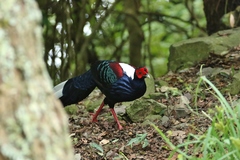
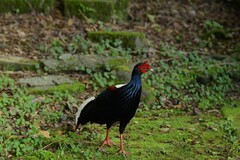
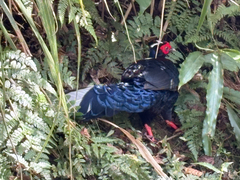
The male Swinhoe's pheasant can grow up to 79 cm. He has a glossy blue-purple chest, belly, and rump, white nape, red wattles, white tail feathers, and a white crest. The female is brown marked with yellow, arrow-shaped spots and complex barring patterns, and has maroon outer rectrices. The juvenile male is dark blue with brown and yellow patterns on its wings. Swinhoe's pheasants can also be distinguished from the Mikado pheasant by having red legs.
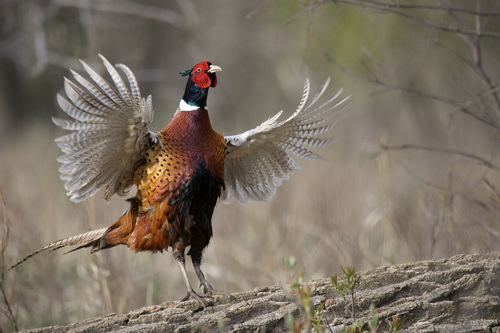
During display, the male... Wikipedia →