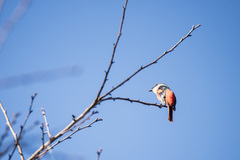

Gray-chinned Minivet

Gray-chinned Minivet

Pericrocotus solaris

Silhouette: PhyloPic

LCLeast ConcernNTVUENCR
Daily sighting probability ~40% · Likely
at Taroko National Park

In 3 days ~80% in a week >90%

1,210 Verified sightings at Taroko National Park From 2019 to 2026
3,589 In all 7 parks
February Best month
🌅 Crepuscular When it's spotted

About the Gray-chinned Minivet

The grey-chinned minivet (Pericrocotus solaris) is a species of bird in the family Campephagidae. It is found from the Himalayas to China, Taiwan and Southeast Asia. Its natural habitat is forests about 1,000–2,000 m (3,300–6,600 ft) in elevation. The International Union for Conservation of Nature (IUCN) has assessed it as a least-concern species.

This species was described from Darjeeling by Edward Blyth in 1846. The Handbook of the Birds of the World considers that montanus and cinereigula form a separate species. The grey-chinned minivet is 17–19 cm (6.7–7.5 in) long and weighs 11–17 g (0.39–0.60 oz). It is sexually dimorphic. The adult... Wikipedia →

Sounds

Call0:06

China · 2025

© LongChen · XC1065505 · CC BY-NC-SA 4.0

Song0:29

China · 2024

© Feather V · XC992717 · CC BY-NC-SA 4.0

Call0:24

China · 2025

© Peter Boesman · XC988558 · CC BY-NC-ND 4.0

Global Distribution

Parks Where Found

# Park Country Daily sighting probability
1 Kinabalu Park 🇲🇾 Malaysia
~50%
2 Taroko National Park 🇹🇼 Taiwan
~40%
3 Kerinci Seblat National Park 🇮🇩 Indonesia
~20%
4 Doi Inthanon National Park 🇹🇭 Thailand
~20%
5 Royal Manas National Park 🇧🇹 Bhutan
~20%
6 Namdapha National Park 🇮🇳 India
~10%
7 Kaeng Krachan National Park 🇹🇭 Thailand
<5%

Cities Where Found

# City Country Daily sighting probability
1 Fuzhou 🇨🇳 China
~20%
2 Hangzhou 🇨🇳 China
~10%
3 Changsha 🇨🇳 China
~10%
4 Wenzhou 🇨🇳 China
~10%
5 Hong Kong 🇨🇳 China
<5%
6 Tuen Mun 🇨🇳 China
<5%
7 Guangzhou 🇨🇳 China
<5%
8 Shanghai 🇨🇳 China
<5%
9 Taipei 🇹🇼 Taiwan
<5%

Zoos & Centres Where Found

# Zoo / Centre Country
1 Leofoo Village Theme Park 🇹🇼 Taiwan In captivity
2 Green World Ecological Farm 🇹🇼 Taiwan In captivity

Before you go

What are the chances of seeing a Gray-chinned Minivet in Taroko National Park?

Likely

About 40% of wildlife watchers report a Gray-chinned Minivet sighting in Taroko National Park on a given day, based on 1,210 verified sightings from GBIF citizen-science data from 2019 to 2026. It is the 10th most-seen of the 147 birds we can rate there. Over three days the chance rises to about 80%, and over a week to over 90%, if each day is a fresh chance.

When is the best time to see a Gray-chinned Minivet in Taroko National Park?

February

In that month about 70% of wildlife watchers report a Gray-chinned Minivet in Taroko National Park on a given day, against about 20% in August and December, the lowest months.

What time of day is best to see a Gray-chinned Minivet?

Between 4 and 7 am

Across all the parks we cover, that three-hour window holds the most Gray-chinned Minivet sightings with a recorded time, and about 6 in 10 of them come between 6 pm and 6 am: it is most active around dawn and dusk.

Is Taroko National Park the best place to see a Gray-chinned Minivet?

2nd of 7

Of the 7 parks where we can rate Gray-chinned Minivet sightings, Taroko National Park ranks 2nd at about 40%. The best odds are in Kinabalu Park (Malaysia, about 50%). All parks ranked.

Which relatives of the Gray-chinned Minivet live in Taroko National Park?

Same order: Passeriformes

The closest relatives of the Gray-chinned Minivet that you can see in Taroko National Park (order Passeriformes, Perching Birds) are Large-billed Crow (about 70%), Taiwan Yuhina (about 70%) and White-eared Sibia (about 70%), with each one's daily chance of a sighting.

Where does the Gray-chinned Minivet sighting chance come from?

GBIF citizen-science records

It is estimated from how often the Gray-chinned Minivet is recorded against all the birds logged in Taroko National Park (1,210 verified sightings from 2019 to 2026), calibrated against known sighting rates. Figures are rounded to the nearest 10% because citizen-science data supports honest approximations, not decimals, and months with records from fewer than five people show "—". How it works.

← Back to Taroko National Park