



Completed

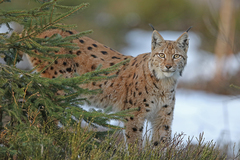

Eurasian Lynx
Lynx lynx
Silhouette: Margot Michaud · PhyloPic
- KingdomAnimalia (Animals)
- PhylumChordata (Chordates)
- ClassMammalia (Mammals)
- OrderCarnivora (Carnivorans)
- FamilyFelidae (Felids)
- GenusLynx (Lynxes)
- SpeciesLynx lynx (Eurasian Lynx)
In 3 days ~30% in a week ~50%
6 Verified sightings at Tatra National Park From 2019 to 2026
31 In all 3 parks
February Best month
🌅 Crepuscular When it's spotted
About the Eurasian Lynx
The Eurasian lynx (Lynx lynx) is one of the four extant species within the medium-sized wild cat genus Lynx. It is widely distributed from Northern, Central and Eastern Europe to Central Asia and Siberia, the Tibetan Plateau and the Himalayas. It inhabits temperate and boreal forests up to an elevation of 5,500 m (18,000 ft). Despite its wide distribution, it is threatened by habitat loss and fragmentation, poaching and depletion of prey.
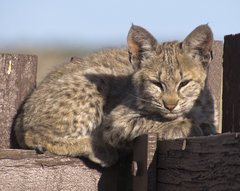
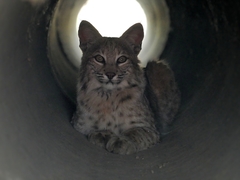
The Eurasian lynx has a relatively short, reddish or brown coat that is marked with black spots; their number and pattern are highly variable. The underparts, neck and chin are whitish. The fur is more brightly coloured with more numerous spots in animals living at the southern end of its range. In winter, it is much thicker and varies from silver-grey to greyish brown. Some animals have dark brown stripes on the forehead and back. It has powerful, relatively long legs, with large webbed and furred paws that act like snowshoes. It also has a short "bobbed" tail with an all-black tip, black tufts of hair on its ears, and a long grey-and-white ruff.
It is the largest of the four lynx species, ranging in body length from 76–106 cm... Wikipedia →
Sounds
Mating call0:39
Sweden · 2020
© Lars Edenius · XC960961 · CC BY-NC-SA 4.0
Call0:22
France · 2022
© Stanislas Wroza · XC708690 · CC BY-NC-SA 4.0
Recording0:48
Latvia · 2026
© Никита · iNaturalist · CC BY-NC 4.0
Recent sightings of Eurasian Lynx in Tatra National Park
LIVEiNaturalistGlobal Distribution
Parks Where Found
| # | Park | Country | Daily sighting probability |
|---|---|---|---|
| 1 | Hemis National Park | 🇮🇳 India | |
| 2 | Tatra National Park | 🇸🇰 Slovakia | |
| 3 | Bavarian Forest National Park | 🇩🇪 Germany |
Zoos & Centres Where Found
Closest Relatives at Tatra National Park




Before you go
What are the chances of seeing a Eurasian Lynx in Tatra National Park?
With luck
About 10% of wildlife watchers report a Eurasian Lynx sighting in Tatra National Park on a given day, based on 6 verified sightings from GBIF citizen-science data from 2019 to 2026. It is the 10th most-seen of the 10 mammals we can rate there. Over three days the chance rises to about 30%, and over a week to about 50%, if each day is a fresh chance.
When is the best time to see a Eurasian Lynx in Tatra National Park?
February and December
In those months about 30% of wildlife watchers report a Eurasian Lynx in Tatra National Park on a given day, against under 5% in January, March, May–July and September–November, the lowest months.
What time of day is best to see a Eurasian Lynx?
Between 1 and 4 am
Across all the parks we cover, that three-hour window holds the most Eurasian Lynx sightings with a recorded time, and about 6 in 10 of them come between 6 pm and 6 am: it is most active around dawn and dusk.
Is Tatra National Park the best place to see a Eurasian Lynx?
2nd of 3
Of the 3 parks where we can rate Eurasian Lynx sightings, Tatra National Park ranks 2nd at about 10%. The best odds are in Hemis National Park (India, about 20%).
Which relatives of the Eurasian Lynx live in Tatra National Park?
Same order: Carnivora
The closest relatives of the Eurasian Lynx that you can see in Tatra National Park (order Carnivora, Carnivorans) are Red Fox (about 50%) and Brown Bear (about 40%), with each one's daily chance of a sighting.
Where does the Eurasian Lynx sighting chance come from?
GBIF citizen-science records
It is estimated from how often the Eurasian Lynx is recorded against all the mammals logged in Tatra National Park (6 verified sightings from 2019 to 2026), calibrated against known sighting rates. Figures are rounded to the nearest 10% because citizen-science data supports honest approximations, not decimals, and months with records from fewer than five people show "—". How it works.
