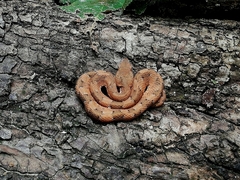
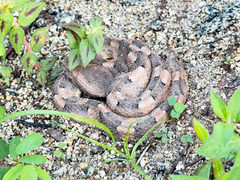
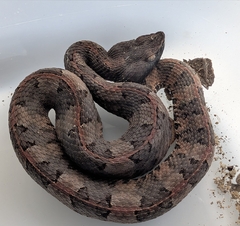
Lansberg's Hognose Viper

Lansberg's Hognose Viper

Porthidium lansbergii

Silhouette: Steven Traver · PhyloPic

LCLeast ConcernNTVUENCR
Daily sighting probability ~20% · Possible
at Tayrona National Natural Park

In 3 days ~60% in a week ~90%

12 Verified sightings at Tayrona National Natural Park From 2019 to 2026
12 In 1 park
September Best month
☀️ Diurnal When it's spotted

About the Lansberg's Hognose Viper

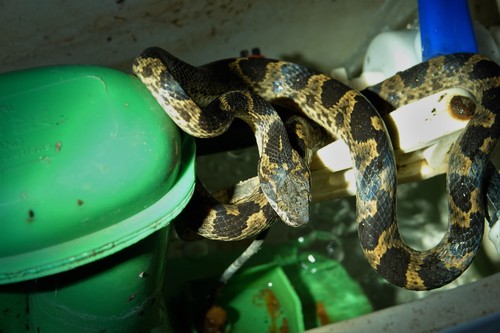
Common names: Lansberg's hognosed pit viper. Porthidium lansbergii is a species of venomous snake, a pit viper in the family Viperidae. The species is native to eastern Central America and northwestern South America. Three subspecies are recognized, including the nominate subspecies described here.

The specific name, lansbergii, is in honor of "M[onsieur]. de Lansberge" (Reinhart Frans von Lansberge), Dutch consul at Caracas, Venezuela, in 1841. Adults of P. lansbergii average 30–50 cm (11+3⁄4–19+5⁄8 in) in total length (including tail), with a maximum of 90 cm (35+1⁄2 in). A terrestrial snake, it is moderately slender.

Common names for P. lansbergii include Lansberge's hog-nosed pit-viper. It is also called patoca in Colombia and Panama. P. lansbergii is found in extreme eastern Central America in the xeric coastal lowlands of central and eastern Panama, in northern South America in the Atlantic lowlands of Colombia and northern Venezuela, as well as in the Pacific lowlands of Ecuador. The type locality given is "les environs de Turbaco [Department de Bolívar], en Colombie ". According to Amaral (1929), the... Wikipedia →

Global Distribution

Parks Where Found

# Park Country Daily sighting probability
1 Tayrona National Natural Park 🇨🇴 Colombia
~20%

More parks will be added in future updates.

Before you go

What are the chances of seeing a Lansberg's Hognose Viper in Tayrona National Natural Park?

Possible

About 20% of wildlife watchers report a Lansberg's Hognose Viper sighting in Tayrona National Natural Park on a given day, based on 12 verified sightings from GBIF citizen-science data from 2019 to 2026. It is the 18th most-seen of the 26 reptiles we can rate there. Over three days the chance rises to about 60%, and over a week to about 90%, if each day is a fresh chance.

When is the best time to see a Lansberg's Hognose Viper in Tayrona National Natural Park?

September

In that month about 60% of wildlife watchers report a Lansberg's Hognose Viper in Tayrona National Natural Park on a given day, against under 5% in February–March, May, August and October, the lowest months.

What time of day is best to see a Lansberg's Hognose Viper?

Between 8 and 11 am

Across all the parks we cover, that three-hour window holds the most Lansberg's Hognose Viper sightings with a recorded time, and about 7 in 10 of them come between 6 am and 6 pm: it is a daytime animal.

Where else can you see a Lansberg's Hognose Viper?

Only Tayrona National Natural Park, in our data

Tayrona National Natural Park is the only park on Wallace's Line with enough records to rate Lansberg's Hognose Viper sightings: about 20% of wildlife watchers there report one on a given day.

Where does the Lansberg's Hognose Viper sighting chance come from?

GBIF citizen-science records

It is estimated from how often the Lansberg's Hognose Viper is recorded against all the reptiles logged in Tayrona National Natural Park (12 verified sightings from 2019 to 2026), calibrated against known sighting rates. Figures are rounded to the nearest 10% because citizen-science data supports honest approximations, not decimals, and months with records from fewer than five people show "—". How it works.

← Back to Tayrona National Natural Park