
Costa Rican Coral Snake

Costa Rican Coral Snake

Micrurus mosquitensis

Silhouette: Edwin Price · PhyloPic

LCLeast ConcernNTVUENCR
Daily sighting probability ~20% · Possible
at Tenorio Volcano National Park

In 3 days ~50% in a week ~80%

15 Verified sightings at Tenorio Volcano National Park From 2019 to 2026
93 In all 6 parks
March Best month
🌅 Crepuscular When it's spotted

About the Costa Rican Coral Snake

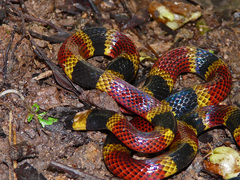
Micrurus mosquitensis, also known commonly as the mosquito coral snake and la coral misquita in Central American Spanish, is a species of venomous snake in the family Elapidae. The species is native to Central America. As in many species of the genus Micrurus, the color pattern of Micrurus mosquitensis consists of black, yellow, and red rings. The black rings are not arranged in triads, and there are 10–15 black rings on the body. The yellow rings are the narrowest, but are wider than in most coral snakes. The red rings are the widest, and have large black tips on the dorsal scales.

Males have 182–192 ventrals and 46–52 subcaudals; females have 197–211 ventrals and 35–43 subcaudals. Males have strongly developed supraanal tubercles. Adults usually have a total length of 50–75 cm (20–30 in). Micrurus mosquitensis is found in Costa Rica, Nicaragua, and Panama. The preferred natural habitat of Micrurus mosquitensis is forest, at altitudes from sea level to 900 m (3,000 ft). Micrurus mosquitensis is terrestrial.

Micrurus mosquitensis preys on lizards such as Scincella cherriei and Cnemidophorus spp.... Wikipedia →

Global Distribution

Parks Where Found

# Park Country Daily sighting probability
1 Tenorio Volcano National Park 🇨🇷 Costa Rica
~20%
2 Gandoca-Manzanillo Wildlife Refuge 🇨🇷 Costa Rica
~20%
3 Arenal Volcano National Park 🇨🇷 Costa Rica
~20%
4 Bastimentos Island National Marine Park 🇵🇦 Panama
~10%
5 Braulio Carrillo National Park 🇨🇷 Costa Rica
~10%
6 La Amistad International Park (Panama) 🇵🇦 Panama
~10%

Closest Relatives at Tenorio Volcano National Park

No species of the same family or order lives in Tenorio Volcano National Park, so these are its closest relatives here: other reptiles.

Before you go

What are the chances of seeing a Costa Rican Coral Snake in Tenorio Volcano National Park?

Possible

About 20% of wildlife watchers report a Costa Rican Coral Snake sighting in Tenorio Volcano National Park on a given day, based on 15 verified sightings from GBIF citizen-science data from 2019 to 2026. It is the 20th most-seen of the 38 reptiles we can rate there. Over three days the chance rises to about 50%, and over a week to about 80%, if each day is a fresh chance.

When is the best time to see a Costa Rican Coral Snake in Tenorio Volcano National Park?

March

In that month about 40% of wildlife watchers report a Costa Rican Coral Snake in Tenorio Volcano National Park on a given day, against under 5% in April and July–November, the lowest months. That is one of Tenorio Volcano National Park's driest months, with about 150 mm of rain against 420 mm in December.

What time of day is best to see a Costa Rican Coral Snake?

Between 7 and 10 pm

Across all the parks we cover, that three-hour window holds the most Costa Rican Coral Snake sightings with a recorded time, and about 7 in 10 of them come between 6 pm and 6 am: it is most active around dawn and dusk.

Is Tenorio Volcano National Park the best place to see a Costa Rican Coral Snake?

Yes

Of the 6 parks where we can rate Costa Rican Coral Snake sightings, Tenorio Volcano National Park has the highest daily chance: about 20%. Next come Gandoca-Manzanillo Wildlife Refuge (Costa Rica, about 20%) and Arenal Volcano National Park (Costa Rica, about 20%).

Where does the Costa Rican Coral Snake sighting chance come from?

GBIF citizen-science records

It is estimated from how often the Costa Rican Coral Snake is recorded against all the reptiles logged in Tenorio Volcano National Park (15 verified sightings from 2019 to 2026), calibrated against known sighting rates. Figures are rounded to the nearest 10% because citizen-science data supports honest approximations, not decimals, and months with records from fewer than five people show "—". How it works.

← Back to Tenorio Volcano National Park