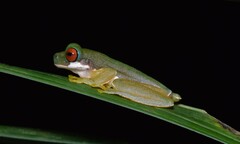

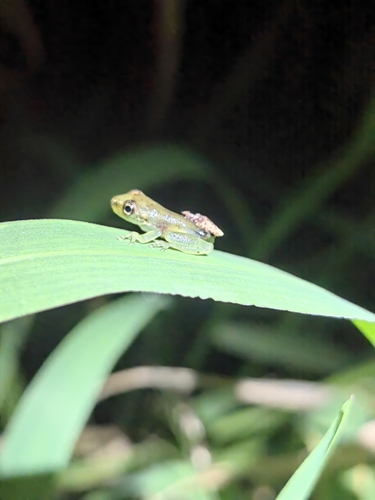
Rufous-eyed brook frog

Rufous-eyed brook frog

Duellmanohyla rufioculis

Silhouette: Dmitry Bogdanov (vectorized by T. Michael Keesey) · PhyloPic

LCLeast ConcernNTVUENCR Endemic
Daily sighting probability ~20% · Possible
at Tenorio Volcano National Park

In 3 days ~40% in a week ~70%

11 Verified sightings at Tenorio Volcano National Park From 2019 to 2026
151 In all 3 parks
October Best month
🌙 Nocturnal When it's spotted

About the Rufous-eyed brook frog

The rufous-eyed brook frog or rufous-eyed stream frog (Duellmanohyla rufioculis), is a species of frog in the family Hylidae. It is endemic to the mountains of Costa Rica. Its natural habitats are premontane wet forests and rainforests. Tadpoles are found in pools with standing water. Habitat loss is posing some threat to the species, although the overall population is stable.

These frogs grow to 4.1 cm (1.6 in) long; males are smaller than females. Color is extremely variable, ranging from brown to mottled mossy green. A distinct white stripe along the upper lip, flanks, and groin expands beneath the eyes to form a prominent white mark. All specimens have a distinctive red iris with horizontal pupils.

The rufous-eyed brook frog is endemic to the mountainous regions of Costa Rica, and can be found on the Caribbean and Pacific slopes from 700 to 1,600 m (2,310 to 5,250 ft) asl. This species favors humid forests, and lives in foliage alongside streams. Though threatened by habitat destruction and uncommon within its range, the overall population is believed to be stable. Wikipedia →

Global Distribution

Parks Where Found

# Park Country Daily sighting probability
1 Monteverde Cloud Forest Reserve 🇨🇷 Costa Rica
~30%
2 Tenorio Volcano National Park 🇨🇷 Costa Rica
~20%
3 Arenal Volcano National Park 🇨🇷 Costa Rica
~10%

Zoos & Centres Where Found

# Zoo / Centre Country
1 Monteverde Theme Park 🇨🇷 Costa Rica In captivity

Before you go

What are the chances of seeing a Rufous-eyed brook frog in Tenorio Volcano National Park?

Possible

About 20% of wildlife watchers report a Rufous-eyed brook frog sighting in Tenorio Volcano National Park on a given day, based on 11 verified sightings from GBIF citizen-science data from 2019 to 2026. It is the 21st most-seen of the 32 amphibians we can rate there. Over three days the chance rises to about 40%, and over a week to about 70%, if each day is a fresh chance.

When is the best time to see a Rufous-eyed brook frog in Tenorio Volcano National Park?

October and November

In those months about 30% of wildlife watchers report a Rufous-eyed brook frog in Tenorio Volcano National Park on a given day, against under 5% in March–April and June–September, the lowest months.

What time of day is best to see a Rufous-eyed brook frog?

Between 7 and 10 pm

Across all the parks we cover, that three-hour window holds the most Rufous-eyed brook frog sightings with a recorded time, and about 9 in 10 of them come between 6 pm and 6 am: it is mostly seen at night.

Is Tenorio Volcano National Park the best place to see a Rufous-eyed brook frog?

2nd of 3

Of the 3 parks where we can rate Rufous-eyed brook frog sightings, Tenorio Volcano National Park ranks 2nd at about 20%. The best odds are in Monteverde Cloud Forest Reserve (Costa Rica, about 30%).

Which relatives of the Rufous-eyed brook frog live in Tenorio Volcano National Park?

Same family: Hylidae

The closest relatives of the Rufous-eyed brook frog that you can see in Tenorio Volcano National Park (family Hylidae, Hylid Tree Frogs) are Masked Tree Frog (about 40%), Harlequin Treefrog (about 40%) and Sipurio Snouted Treefrog (about 40%), with each one's daily chance of a sighting.

Where does the Rufous-eyed brook frog sighting chance come from?

GBIF citizen-science records

It is estimated from how often the Rufous-eyed brook frog is recorded against all the amphibians logged in Tenorio Volcano National Park (11 verified sightings from 2019 to 2026), calibrated against known sighting rates. Figures are rounded to the nearest 10% because citizen-science data supports honest approximations, not decimals, and months with records from fewer than five people show "—". How it works.

← Back to Tenorio Volcano National Park