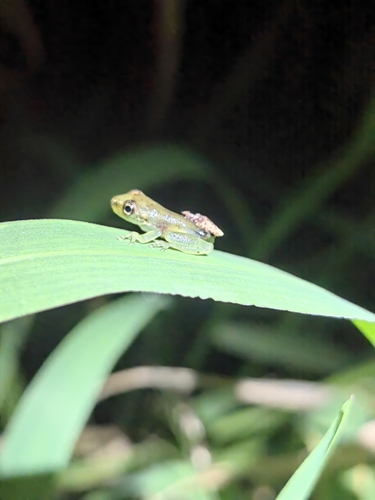
Red-webbed Tree Frog

Red-webbed Tree Frog

Boana rufitela

Silhouette: Andy Wilson · PhyloPic

Daily sighting probability ~40% · Likely
at Tenorio Volcano National Park

In 3 days ~80% in a week >90%

54 Verified sightings at Tenorio Volcano National Park From 2019 to 2026
318 In all 8 parks
August Best month
☀️🌙 Day & Night When it's spotted

About the Red-webbed Tree Frog

The Canal Zone tree frog (Boana rufitela) is a species of frog in the family Hylidae found in the Caribbean lowlands of eastern Nicaragua, Costa Rica, and central Panama, as well as the Pacific lowlands of Colombia, although the latter records are uncertain and may refer to Boana rosenbergi.

Boana rufitela is a medium-sized tree frog. Males measure 39–44 mm (1.5–1.7 in) in snout–urostyle length and females 46–48 mm (1.8–1.9 in). It is green above, with profuse, tiny, dark punctations and usually scattered dark spots. Fingers are about one-half and toes three-fourths webbed. Males have a distinct pollex rudiment bearing a spine.

Its natural habitats are humid lowland forests. It tolerates some disturbance and can be found in open areas close to forest. Breeding takes place in swamps surrounded by trees. It is a locally common tree frog in the appropriate habitat. Wikipedia →

Sounds

Recording0:14

Panama · 2026

© Chris Harrison · iNaturalist · CC BY-NC 4.0

Recording0:15

Panama · 2021

© Jeff Chapman · iNaturalist · CC BY-NC 4.0

Global Distribution

Parks Where Found

# Park Country Daily sighting probability
1 Tenorio Volcano National Park 🇨🇷 Costa Rica
~40%
2 Braulio Carrillo National Park 🇨🇷 Costa Rica
~40%
3 Tortuguero National Park 🇨🇷 Costa Rica
~40%
4 Bastimentos Island National Marine Park 🇵🇦 Panama
~20%
5 Cahuita National Park 🇨🇷 Costa Rica
~20%
6 La Amistad International Park (Panama) 🇵🇦 Panama
~10%
7 Soberanía National Park 🇵🇦 Panama
~10%
8 Tapantí-Macizo de la Muerte National Park 🇨🇷 Costa Rica
~10%

Zoos & Centres Where Found

# Zoo / Centre Country
1 La Paz Waterfall Gardens 🇨🇷 Costa Rica In captivity

Before you go

What are the chances of seeing a Red-webbed Tree Frog in Tenorio Volcano National Park?

Likely

About 40% of wildlife watchers report a Red-webbed Tree Frog sighting in Tenorio Volcano National Park on a given day, based on 54 verified sightings from GBIF citizen-science data from 2019 to 2026. It is the 7th most-seen of the 32 amphibians we can rate there. Over three days the chance rises to about 80%, and over a week to over 90%, if each day is a fresh chance.

When is the best time to see a Red-webbed Tree Frog in Tenorio Volcano National Park?

May–June, August and October–January

In those months about 40% of wildlife watchers report a Red-webbed Tree Frog in Tenorio Volcano National Park on a given day, against about 30% in February–April, July and September, the lowest months.

What time of day is best to see a Red-webbed Tree Frog?

Between 7 and 10 pm

Across all the parks we cover, that three-hour window holds the most Red-webbed Tree Frog sightings with a recorded time, and about 6 in 10 of them come between 6 pm and 6 am: it is seen both by day and at night.

Is Tenorio Volcano National Park the best place to see a Red-webbed Tree Frog?

Yes

Of the 8 parks where we can rate Red-webbed Tree Frog sightings, Tenorio Volcano National Park has the highest daily chance: about 40%. Next come Braulio Carrillo National Park (Costa Rica, about 40%) and Tortuguero National Park (Costa Rica, about 40%).

Which relatives of the Red-webbed Tree Frog live in Tenorio Volcano National Park?

Same family: Hylidae

The closest relatives of the Red-webbed Tree Frog that you can see in Tenorio Volcano National Park (family Hylidae, Hylid Tree Frogs) are Masked Tree Frog (about 40%), Harlequin Treefrog (about 40%) and Sipurio Snouted Treefrog (about 40%), with each one's daily chance of a sighting.

Where does the Red-webbed Tree Frog sighting chance come from?

GBIF citizen-science records

It is estimated from how often the Red-webbed Tree Frog is recorded against all the amphibians logged in Tenorio Volcano National Park (54 verified sightings from 2019 to 2026), calibrated against known sighting rates. Figures are rounded to the nearest 10% because citizen-science data supports honest approximations, not decimals, and months with records from fewer than five people show "—". How it works.

← Back to Tenorio Volcano National Park