
Flightless Steamer-Duck

Flightless Steamer-Duck

Tachyeres pteneres

Silhouette: PhyloPic

LCLeast ConcernNTVUENCR
Daily sighting probability ~60% · Likely
at Tierra del Fuego National Park

In 3 days ~90% in a week >90%

882 Verified sightings at Tierra del Fuego National Park From 2019 to 2026
882 In 1 park
April Best month
☀️ Diurnal When it's spotted

About the Flightless Steamer-Duck

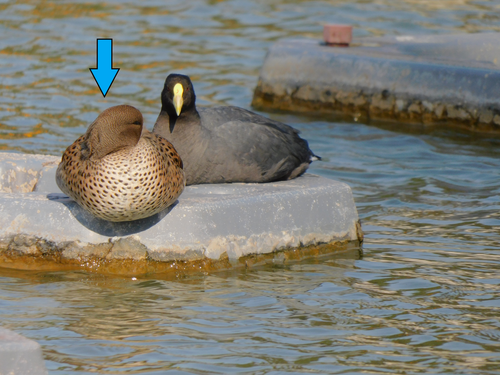
The flightless steamer-duck (Tachyeres pteneres), Magellanic flightless steamer-duck, or Fuegian steamer duck, is a flightless duck native to South America. It belongs to the steamer duck genus Tachyeres. It inhabits the rocky coasts and coastal islands from southern Chile and Chiloé to Tierra del Fuego, switching to the adjacent sheltered bays and lakes further inland when breeding.

This is the largest of the steamer duck species. It is a massively built waterfowl at 3.5–7 kg (7.7–15.4 lb) and 65–84 cm (26–33 in) in length, with the males noticeably larger than the females. Males weigh an average of 5.34 kg (11.8 lb) while females weigh around 4.2 kg (9.3 lb) on average. The wingspan is 85–110 cm (33–43 in), the wings being too small to functionally allow the birds to take flight. Instead, the wings are used like paddles to help skim rapidly across the surface of the water. This species outweighs any other wild species called "duck" and is about the same mass as the largest wild geese in the world, although this species is only distantly related to most true ducks (for example of the genus Anas). On males, the head and neck is blue-gray, with paler coloration crown... Wikipedia →

Sounds

Duet0:42

Argentina · 2008

© Bernabe Lopez-Lanus · XC44443 · CC BY-NC-SA 3.0

Call0:20

Chile · 2018

© Peter Boesman · XC450177 · CC BY-NC-ND 4.0

Global Distribution

Parks Where Found

# Park Country Daily sighting probability
1 Tierra del Fuego National Park 🇦🇷 Argentina
~60%

More parks will be added in future updates.

Zoos & Centres Where Found

# Zoo / Centre Country
1 Pairi Daiza 🇧🇪 Belgium In captivity
2 Prague Zoo 🇨🇿 Czechia In captivity
3 Zürich Zoo 🇨🇭 Switzerland In captivity
4 Walsrode World Bird Park 🇩🇪 Germany In captivity
5 Wildlands 🇳🇱 Netherlands In captivity
6 Wilhelma 🇩🇪 Germany In captivity
7 Cologne Zoological Garden 🇩🇪 Germany In captivity
8 Rákosův pavilon 🇨🇿 Czechia In captivity
9 Velemlokárium 🇨🇿 Czechia In captivity
10 Cologne Zoo Aquarium 🇩🇪 Germany In captivity

Before you go

What are the chances of seeing a Flightless Steamer-Duck in Tierra del Fuego National Park?

Likely

About 60% of wildlife watchers report a Flightless Steamer-Duck sighting in Tierra del Fuego National Park on a given day, based on 882 verified sightings from GBIF citizen-science data from 2019 to 2026. It is the 12th most-seen of the 78 birds we can rate there. Over three days the chance rises to about 90%, and over a week to over 90%, if each day is a fresh chance.

When is the best time to see a Flightless Steamer-Duck in Tierra del Fuego National Park?

April

In that month about 80% of wildlife watchers report a Flightless Steamer-Duck in Tierra del Fuego National Park on a given day, against about 30% in May, the lowest month. June has too few records to rate.

What time of day is best to see a Flightless Steamer-Duck?

Between noon and 3 pm

Across all the parks we cover, that three-hour window holds the most Flightless Steamer-Duck sightings with a recorded time, and about 8 in 10 of them come between 6 am and 6 pm: it is a daytime animal.

Where else can you see a Flightless Steamer-Duck?

Only Tierra del Fuego National Park, in our data

Tierra del Fuego National Park is the only park on Wallace's Line with enough records to rate Flightless Steamer-Duck sightings: about 60% of wildlife watchers there report one on a given day.

Where does the Flightless Steamer-Duck sighting chance come from?

GBIF citizen-science records

It is estimated from how often the Flightless Steamer-Duck is recorded against all the birds logged in Tierra del Fuego National Park (882 verified sightings from 2019 to 2026), calibrated against known sighting rates. Figures are rounded to the nearest 10% because citizen-science data supports honest approximations, not decimals, and months with records from fewer than five people show "—". How it works.

← Back to Tierra del Fuego National Park