Kelp Goose

Kelp Goose

Chloephaga hybrida

Silhouette: Edwin Price · PhyloPic

LCLeast ConcernNTVUENCR
Daily sighting probability ~20% · Possible
at Tierra del Fuego National Park

In 3 days ~40% in a week ~70%

659 Verified sightings at Tierra del Fuego National Park From 2019 to 2026
659 In 1 park
April Best month
☀️ Diurnal When it's spotted

About the Kelp Goose

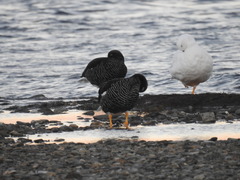
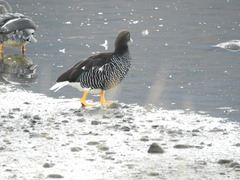
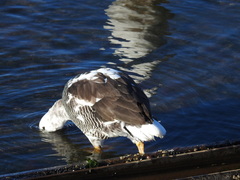
The kelp goose (Chloephaga hybrida) is a species of waterfowl in tribe the Tadornini of the subfamily Anserinae. It is found in Argentina, Chile, and the Falkland Islands. The kelp goose is 55 to 65 cm (22 to 26 in) long. Males of the nominate subspecies weigh 2.54 to 2.58 kg (5.6 to 5.7 lb) and females 2.00 to 2.02 kg (4.4 to 4.5 lb). Subspecies C. h. malvinarum is heavier: Males weigh 3.25 to 3.60 kg (7.2 to 7.9 lb) and females 2.05 to 2.80 kg (4.5 to 6.2 lb). The two subspecies have the same plumage but the sexes are completely different. Adult males are entirely white but for a black bill with a pink spot on the maxilla and yellow legs and feet. Adult females have a pale brown crown and chocolate brown head, neck, and mantle. Their breast and flanks have black and white bars and their back, tail, and undertail coverts are white. Their bill is pink and their legs and feet yellow. Juvenile males resemble adult females but with brown "shoulders" and greenish-yellow legs and feet. Juvenile females have a dark crown and dark uppertail coverts. Wikipedia →

Sounds

Call0:54

United Kingdom · 2013

© Michele Peron · XC172346 · CC BY-NC-SA 4.0

Alarm call0:08

Argentina · 2008

© Bernabe Lopez-Lanus · XC154331 · CC BY-NC-SA 3.0

Call0:09

Chile · 2015

© Ross Gallardy · XC295905 · CC BY-NC-SA 4.0

Global Distribution

Parks Where Found

# Park Country Daily sighting probability
1 Tierra del Fuego National Park 🇦🇷 Argentina
~20%

More parks will be added in future updates.

Before you go

What are the chances of seeing a Kelp Goose in Tierra del Fuego National Park?

Possible

About 20% of wildlife watchers report a Kelp Goose sighting in Tierra del Fuego National Park on a given day, based on 659 verified sightings from GBIF citizen-science data from 2019 to 2026. It is the 38th most-seen of the 78 birds we can rate there. Over three days the chance rises to about 40%, and over a week to about 70%, if each day is a fresh chance.

When is the best time to see a Kelp Goose in Tierra del Fuego National Park?

April

In that month about 70% of wildlife watchers report a Kelp Goose in Tierra del Fuego National Park on a given day, against about 10% in May and October–January, the lowest months. June has too few records to rate.

What time of day is best to see a Kelp Goose?

Between noon and 3 pm

Across all the parks we cover, that three-hour window holds the most Kelp Goose sightings with a recorded time, and about 8 in 10 of them come between 6 am and 6 pm: it is a daytime animal.

Where else can you see a Kelp Goose?

Only Tierra del Fuego National Park, in our data

Tierra del Fuego National Park is the only park on Wallace's Line with enough records to rate Kelp Goose sightings: about 20% of wildlife watchers there report one on a given day.

Which relatives of the Kelp Goose live in Tierra del Fuego National Park?

Same genus: Chloephaga

The closest relatives of the Kelp Goose that you can see in Tierra del Fuego National Park (genus Chloephaga, Austral Sheldgeese) are Upland Goose (about 80%) and Ashy-headed Goose (about 30%), with each one's daily chance of a sighting.

Where does the Kelp Goose sighting chance come from?

GBIF citizen-science records

It is estimated from how often the Kelp Goose is recorded against all the birds logged in Tierra del Fuego National Park (659 verified sightings from 2019 to 2026), calibrated against known sighting rates. Figures are rounded to the nearest 10% because citizen-science data supports honest approximations, not decimals, and months with records from fewer than five people show "—". How it works.

← Back to Tierra del Fuego National Park