Brown-backed Parrotlet

Brown-backed Parrotlet

Touit melanonotus

Silhouette: Sheatherius · PhyloPic

LCNTNear ThreatenedVUENCR Endemic
Daily sighting probability <5% · Rare
at Tijuca National Park

In 3 days ~10%

50 Verified sightings at Tijuca National Park From 2019 to 2026
99 In all 2 parks
November Best month
☀️ Diurnal When it's spotted

About the Brown-backed Parrotlet

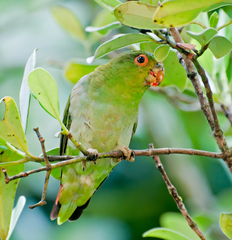
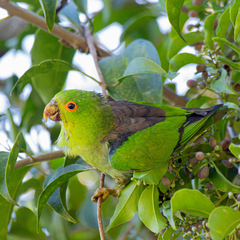
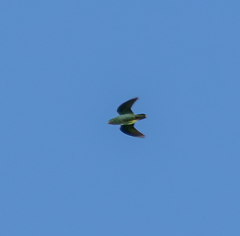
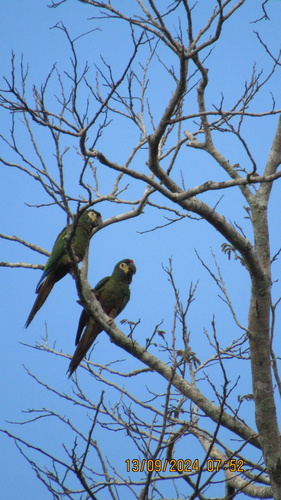
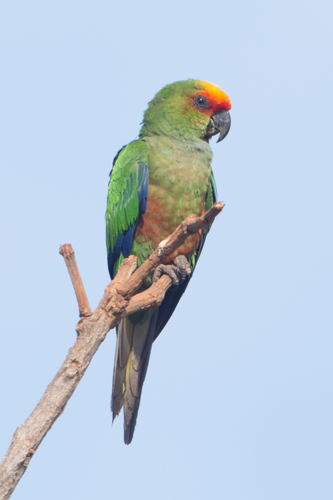
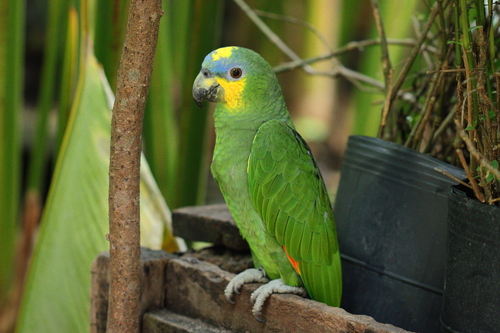
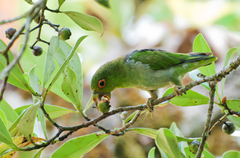
The brown-backed parrotlet (Touit melanonotus) also known as the black-backed parrotlet, the black-eared parrotlet, and Wied's parrotlet, is a small (15 cm or 6 in) green parrot found in south-eastern Brazil from Bahia to southern São Paulo. It has a dark brown mantle and back, brown ear coverts, and red outer tail with back tips. They frequent humid forest from 500–1,000 m (1,600–3,300 ft) (occasionally down to sea level), and are mostly found in small flocks of 3–20 birds.

It is mostly known from lower montane evergreen forest at 500–1,200 metres (1,600–3,900 ft), but also up to 1,400 m (4,600 ft) in the Itatiaia National Park. In addition it is found in near sea-level in Bahia and São Paulo. Seasonal migration or dispersal is suspected, though this may amount to little more than short altitudinal movements. Food items are poorly studied but include large leguminous seeds, fruit of Rapanea acuminata, Clusia sp. and mistletoes.

Observed feeding on Clusia criuva where presumed adults pluck the fruit from the tree snipping the stalk with their bills and carry the fruit to a more secure location on a firmer branch where they open the fruitwith their bill wedging it against... Wikipedia →

Sounds

Call0:06

Brazil · 2009

© Jeremy Minns · XC351033 · CC BY-NC-SA 4.0

Flight call0:12

Brazil · 2025

© Ricardo José Mitidieri · XC978374 · CC BY-NC-SA 4.0

Alarm call0:22

Brazil · 2007

© Marco · XC314264 · CC BY-NC-SA 4.0

Global Distribution

Parks Where Found

# Park Country Daily sighting probability
1 Serra dos Órgãos National Park 🇧🇷 Brazil
~10%
2 Tijuca National Park 🇧🇷 Brazil
<5%

Before you go

What are the chances of seeing a Brown-backed Parrotlet in Tijuca National Park?

Rare

Under 5% of wildlife watchers report a Brown-backed Parrotlet sighting in Tijuca National Park on a given day, based on 50 verified sightings from GBIF citizen-science data from 2019 to 2026. It is the 126th most-seen of the 214 birds we can rate there. Over three days the chance rises to about 10%, if each day is a fresh chance.

When is the best time to see a Brown-backed Parrotlet in Tijuca National Park?

November

In that month about 10% of wildlife watchers report a Brown-backed Parrotlet in Tijuca National Park on a given day, against under 5% in December to October, the lowest months. That is one of Tijuca National Park's wettest months, with about 160 mm of rain against 40 mm in July.

What time of day is best to see a Brown-backed Parrotlet?

Between 10 am and 1 pm

Across all the parks we cover, that three-hour window holds the most Brown-backed Parrotlet sightings with a recorded time, and about 9 in 10 of them come between 6 am and 6 pm: it is a daytime animal.

Is Tijuca National Park the best place to see a Brown-backed Parrotlet?

2nd of 2

Of the 2 parks where we can rate Brown-backed Parrotlet sightings, Tijuca National Park ranks 2nd at under 5%. The best odds are in Serra dos Órgãos National Park (Brazil, about 10%).

Which relatives of the Brown-backed Parrotlet live in Tijuca National Park?

Same family: Psittacidae

The closest relatives of the Brown-backed Parrotlet that you can see in Tijuca National Park (family Psittacidae, New World and African Parrots) are Plain Parakeet (about 60%), Maroon-bellied Parakeet (about 30%) and Monk Parakeet (about 20%), with each one's daily chance of a sighting.

Where does the Brown-backed Parrotlet sighting chance come from?

GBIF citizen-science records

It is estimated from how often the Brown-backed Parrotlet is recorded against all the birds logged in Tijuca National Park (50 verified sightings from 2019 to 2026), calibrated against known sighting rates. Figures are rounded to the nearest 10% because citizen-science data supports honest approximations, not decimals, and months with records from fewer than five people show "—". How it works.

← Back to Tijuca National Park