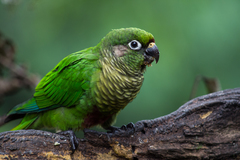
Maroon-bellied Parakeet

Maroon-bellied Parakeet

Pyrrhura frontalis

Silhouette: Sheatherius · PhyloPic

LCLeast ConcernNTVUENCR
Daily sighting probability ~30% · Possible
at Tijuca National Park

In 3 days ~60% in a week ~90%

871 Verified sightings at Tijuca National Park From 2019 to 2026
3,312 In all 7 parks
November Best month
☀️ Diurnal When it's spotted

About the Maroon-bellied Parakeet

The maroon-bellied parakeet (Pyrrhura frontalis) is a small parrot found from southeastern Brazil to north-eastern Argentina, including eastern Paraguay and Uruguay. It is also known as the reddish-bellied parakeet, and in aviculture it is usually referred to as the maroon-bellied conure, reddish-bellied conure or brown-eared conure.

The maroon-bellied parakeet was formally described in 1818 by the French ornithologist Louis Vieillot and given the binomial name Psittacus frontalis. Vieillot based his description on "La Perruche Ara à bandeau rouge" that had been described and illustrated by François Levaillant in 1801. The specific epithet frontalis is Modern Latin meaning "fronted" or "browed". Levaillant specified the locality as Brazil but Vieillot mistakenly changed this to Cayenne in French Guiana where the species does not occur. The locality is now restricted to the state of Espírito Santo in Brazil. The English naturalist George Shaw was formerly credited with introducing a binomial name for this species. In 1811 he had described the "banded parrakeet" and coined the name Psittacus vittatus, but in 1917 the American ornithologist Harry C. Oberholser pointed out... Wikipedia →

Sounds

Flight call0:09

Brazil · 2026

© JAYRSON ARAUJO DE OLIVEIRA · XC1136271 · CC BY-NC-SA 4.0

Call0:19

Brazil · 2025

© Robson Silva e Silva · XC1059982 · CC BY-NC-SA 4.0

Song0:07

Argentina · 2019

© Franco Vushurovich · XC548410 · CC BY-NC-SA 4.0

Global Distribution

Parks Where Found

# Park Country Daily sighting probability
1 Serra dos Órgãos National Park 🇧🇷 Brazil
~70%
2 Itatiaia National Park 🇧🇷 Brazil
~60%
3 Tijuca National Park 🇧🇷 Brazil
~30%
4 Serra da Canastra National Park 🇧🇷 Brazil
~20%
5 Iguazú National Park 🇦🇷 Argentina
~10%
6 Chapada Diamantina National Park 🇧🇷 Brazil
~10%
7 Iguaçu National Park 🇧🇷 Brazil
~10%

Cities Where Found

# City Country Daily sighting probability
1 Rio de Janeiro 🇧🇷 Brazil
~20%
2 Buenos Aires 🇦🇷 Argentina
~10%
3 São Paulo 🇧🇷 Brazil
~10%
4 Curitiba 🇧🇷 Brazil
<5%
5 Santos 🇧🇷 Brazil
<5%

Zoos & Centres Where Found

# Zoo / Centre Country
1 Parque das Aves 🇧🇷 Brazil In captivity
2 Hamilton Zoo 🇳🇿 New Zealand In captivity
3 Halls Gap Zoo 🇦🇺 Australia In captivity
4 Rio de Janeiro Zoological Garden 🇧🇷 Brazil In captivity
5 Loro Parque 🇪🇸 Spain In captivity
6 Kuala Lumpur Bird Park 🇲🇾 Malaysia In captivity
7 Cambridge Butterfly Conservatory 🇨🇦 Canada In captivity

Before you go

What are the chances of seeing a Maroon-bellied Parakeet in Tijuca National Park?

Possible

About 30% of wildlife watchers report a Maroon-bellied Parakeet sighting in Tijuca National Park on a given day, based on 871 verified sightings from GBIF citizen-science data from 2019 to 2026. It is the 26th most-seen of the 214 birds we can rate there. Over three days the chance rises to about 60%, and over a week to about 90%, if each day is a fresh chance.

When is the best time to see a Maroon-bellied Parakeet in Tijuca National Park?

November

In that month about 40% of wildlife watchers report a Maroon-bellied Parakeet in Tijuca National Park on a given day, against about 20% in January, the lowest month. That is one of Tijuca National Park's wettest months, with about 160 mm of rain against 40 mm in July.

What time of day is best to see a Maroon-bellied Parakeet?

Between 9 am and noon

Across all the parks we cover, that three-hour window holds the most Maroon-bellied Parakeet sightings with a recorded time, and about 9 in 10 of them come between 6 am and 6 pm: it is a daytime animal.

Which relatives of the Maroon-bellied Parakeet live in Tijuca National Park?

Same family: Psittacidae

The closest relatives of the Maroon-bellied Parakeet that you can see in Tijuca National Park (family Psittacidae, New World and African Parrots) are Plain Parakeet (about 60%), Monk Parakeet (about 20%) and White-eyed Parakeet (about 20%), with each one's daily chance of a sighting.

Where does the Maroon-bellied Parakeet sighting chance come from?

GBIF citizen-science records

It is estimated from how often the Maroon-bellied Parakeet is recorded against all the birds logged in Tijuca National Park (871 verified sightings from 2019 to 2026), calibrated against known sighting rates. Figures are rounded to the nearest 10% because citizen-science data supports honest approximations, not decimals, and months with records from fewer than five people show "—". How it works.

← Back to Tijuca National Park