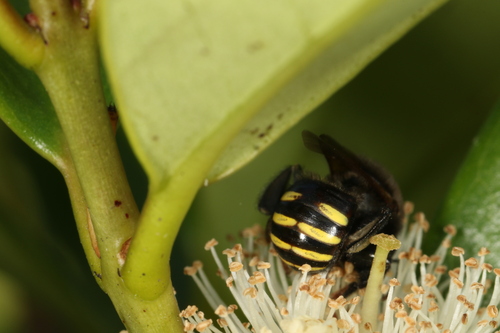
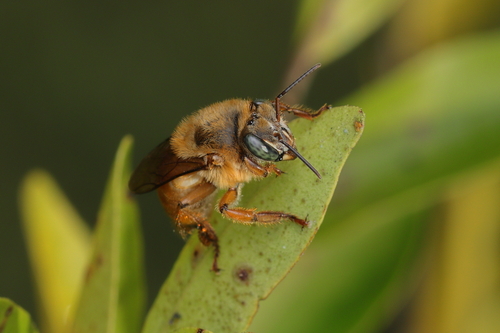
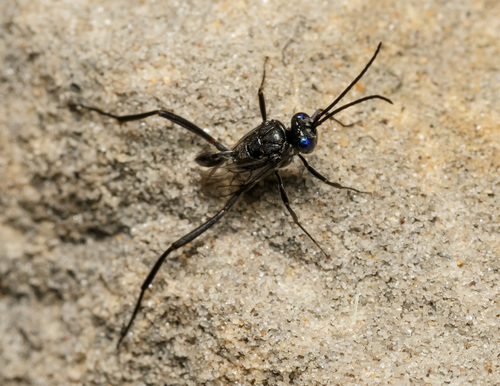
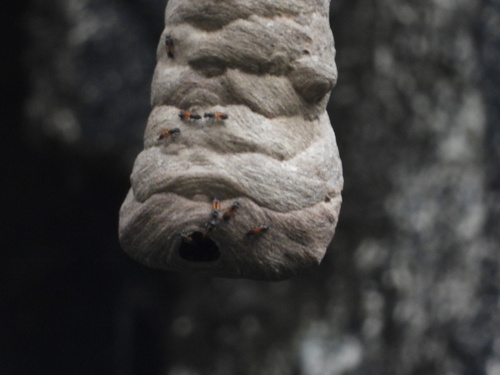
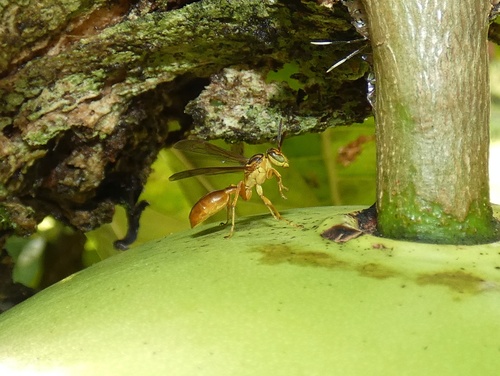
Four-Striped Melipona

Four-Striped Melipona

Melipona quadrifasciata

Daily sighting probability <5% · Rare
at Tijuca National Park

In 3 days ~10% in a week ~30%

6 Verified sightings at Tijuca National Park From 2019 to 2026
6 In 1 park
August Best month
☀️ Diurnal When it's spotted

About the Four-Striped Melipona

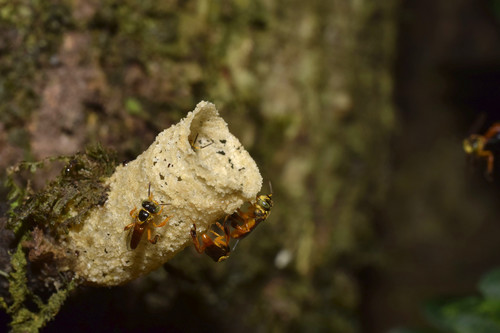
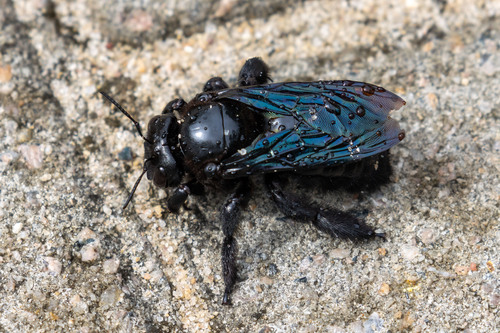
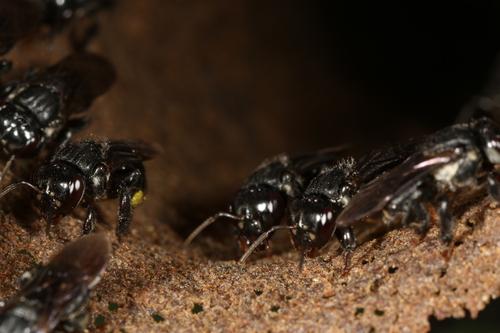
Melipona quadrifasciata is a species of eusocial, stingless bee of the order Hymenoptera. It is native to the southeastern coastal states of Brazil, where it is more commonly known as mandaçaia, which means "beautiful guard," as there is always a bee at the narrow entrance of the nest. M. quadrifasciata constructs mud hives in the hollows of trees to create thin passages that only allow one bee to pass at a time. Because they are stingless bees, M. quadrifasciata are often used as pollinators in greenhouses, outperforming honey bees in efficiency and leading to overall larger yields of fruits that are heavier, larger, and contain more seeds.

Melipona quadrifasciata is a member of the family Apidae and the order Hymenoptera. M. quadrifasciata is in the subfamily Meliponini which is commonly referred to as "stingless bees". The genus Melipona includes nearly 50 other species. M. quadrifasciata can be categorized into two subspecies: M. quadrifasciata quadrifasciata which occupies the northern range of the species, and M. quadrifasciata anthidioides which are more often found in the southern range. However, there is a large hybrid area where the subspecies overlap.

��2... Wikipedia →

Global Distribution

Parks Where Found

# Park Country Daily sighting probability
1 Tijuca National Park 🇧🇷 Brazil
<5%

More parks will be added in future updates.

Cities Where Found

# City Country Daily sighting probability
1 Curitiba 🇧🇷 Brazil
~10%
2 São Paulo 🇧🇷 Brazil
~10%
3 Porto Alegre 🇧🇷 Brazil
~10%
4 Rio de Janeiro 🇧🇷 Brazil
<5%
5 Belo Horizonte 🇧🇷 Brazil
<5%

Before you go

What are the chances of seeing a Four-Striped Melipona in Tijuca National Park?

Rare

Under 5% of wildlife watchers report a Four-Striped Melipona sighting in Tijuca National Park on a given day, based on 6 verified sightings from GBIF citizen-science data from 2019 to 2026. It is the 95th most-seen of the 132 insects we can rate there. Over three days the chance rises to about 10%, and over a week to about 30%, if each day is a fresh chance.

When is the best time to see a Four-Striped Melipona in Tijuca National Park?

January, March, June–August and October

In those months about 10% of wildlife watchers report a Four-Striped Melipona in Tijuca National Park on a given day, against under 5% in February, April–May, September and November–December, the lowest months.

What time of day is best to see a Four-Striped Melipona?

Between 9 am and noon

Across all the parks we cover, that three-hour window holds the most Four-Striped Melipona sightings with a recorded time, and nearly all of them come between 6 am and 6 pm: it is a daytime animal.

Where else can you see a Four-Striped Melipona?

Only Tijuca National Park, in our data

Tijuca National Park is the only park on Wallace's Line with enough records to rate Four-Striped Melipona sightings: under 5% of wildlife watchers there report one on a given day.

Where does the Four-Striped Melipona sighting chance come from?

GBIF citizen-science records

It is estimated from how often the Four-Striped Melipona is recorded against all the insects logged in Tijuca National Park (6 verified sightings from 2019 to 2026), calibrated against known sighting rates. Figures are rounded to the nearest 10% because citizen-science data supports honest approximations, not decimals, and months with records from fewer than five people show "—". How it works.

← Back to Tijuca National Park