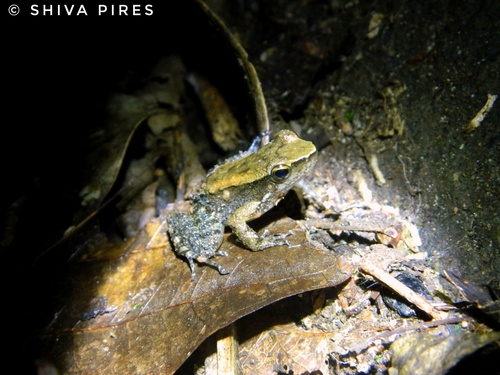
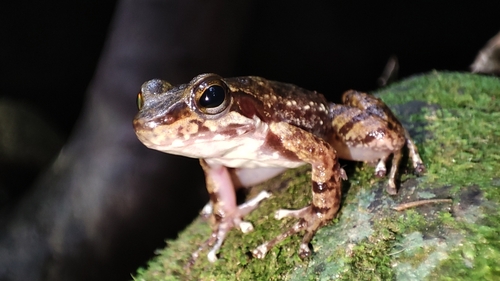
Goeldi's Frog

Goeldi's Frog

Fritziana goeldii

Silhouette: PhyloPic

LCLeast ConcernNTVUENCR Endemic
Daily sighting probability ~10% · With luck
at Tijuca National Park

In 3 days ~10% in a week ~30%

5 Verified sightings at Tijuca National Park From 2019 to 2026
5 In 1 park
June Best month
☀️🌙 Day & Night When it's spotted

About the Goeldi's Frog

Fritziana goeldii, also known as Goeldi's frog or Colonia Alpina treefrog, is a species of frog in the family Hemiphractidae. It is endemic to southeastern Brazil and found in Rio de Janeiro, Espírito Santo, and São Paulo states. The species is named after Émil Goeldi, Swiss zoologist who worked in Brazil. Fritziana goeldii may be locally threatened by habitat destruction but over most of its range it is a common species with a large total population, and the International Union for Conservation of Nature has rated its conservation status as being of "least concern".

Fritziana goeldii is a small, slender frog; females are 32 to 35 mm (1.26 to 1.38 in) long and males are slightly smaller. The snout is pointed, the eyes are large, and there are adhesive discs on the tips of the fingers and toes. The upper parts of the head and body are some shade of pale grey or brown, blotched and streaked with darker colour.

Fritziana goeldii is endemic to southeastern Brazil, where it is found in the states of Rio de Janeiro, São Paulo and Espírito Santo. Its natural habitat is forest at altitudes between sea level and about 1,000 m (3,300 ft) above... Wikipedia →

Global Distribution

Parks Where Found

# Park Country Daily sighting probability
1 Tijuca National Park 🇧🇷 Brazil
~10%

More parks will be added in future updates.

Before you go

What are the chances of seeing a Goeldi's Frog in Tijuca National Park?

With luck

About 10% of wildlife watchers report a Goeldi's Frog sighting in Tijuca National Park on a given day, based on 5 verified sightings from GBIF citizen-science data from 2019 to 2026. It is the 8th most-seen of the 9 amphibians we can rate there. Over three days the chance rises to about 10%, and over a week to about 30%, if each day is a fresh chance.

When is the best time to see a Goeldi's Frog in Tijuca National Park?

March, June and August

In those months about 10% of wildlife watchers report a Goeldi's Frog in Tijuca National Park on a given day, against under 5% in April–May, July and September–February, the lowest months.

What time of day is best to see a Goeldi's Frog?

Between 10 am and 1 pm

Across all the parks we cover, that three-hour window holds the most Goeldi's Frog sightings with a recorded time, and about 6 in 10 of them come between 6 am and 6 pm: it is seen both by day and at night.

Where else can you see a Goeldi's Frog?

Only Tijuca National Park, in our data

Tijuca National Park is the only park on Wallace's Line with enough records to rate Goeldi's Frog sightings: about 10% of wildlife watchers there report one on a given day.

Which relatives of the Goeldi's Frog live in Tijuca National Park?

Same order: Anura

The closest relatives of the Goeldi's Frog that you can see in Tijuca National Park (order Anura, Frogs and Toads) are Ornate Forest toad (about 20%), Gaudichaud's Frog (about 10%) and Santa Catarina Tree Toad (about 10%), with each one's daily chance of a sighting.

Where does the Goeldi's Frog sighting chance come from?

GBIF citizen-science records

It is estimated from how often the Goeldi's Frog is recorded against all the amphibians logged in Tijuca National Park (5 verified sightings from 2019 to 2026), calibrated against known sighting rates. Figures are rounded to the nearest 10% because citizen-science data supports honest approximations, not decimals, and months with records from fewer than five people show "—". How it works.

← Back to Tijuca National Park