White-necked Hawk

White-necked Hawk

Leucopternis lacernulatus

Silhouette: Lauren Anderson · PhyloPic

Daily sighting probability <5% · Rare
at Tijuca National Park

In 3 days <5%

37 Verified sightings at Tijuca National Park From 2019 to 2026
83 In all 2 parks
April Best month
☀️ Diurnal When it's spotted

About the White-necked Hawk

The white-necked hawk (Buteogallus lacernulatus) is a Vulnerable species of bird of prey in the subfamily Accipitrinae, the "true" hawks, of family Accipitridae. It is endemic to Brazil. The white-necked hawk was for a time placed in genus Leucopternis but molecular studies placed it in Buteogallus. A 2009 paper proposed the new monotypic genus Amadonastur for it but this treatment has not been accepted by worldwide taxonomic systems. The white-necked hawk is monotypic.

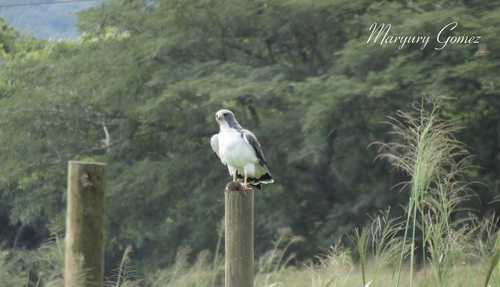
The white-necked hawk is 43 to 48 cm (17 to 19 in) long with a 91 to 101 cm (36 to 40 in) wingspan. Males and females have the same plumage, though females are about 4% larger than males. Adults have a white head and underparts and black upperparts. Their tail is black with a wide white band in the middle. Their eye is brown or pale yellow and their legs and feed yellow. Immatures are similar to adults but with dark streaks on their crown and neck, brown tips on some upperparts feathers, and white barring on the black base of their tail.

The white-necked hawk is found discontinuously in southeastern Brazil from Paraíba south to Paraná state... Wikipedia →

Sounds

Recording2:02

Brazil · 2024

© Marcelo Schmidt Roberti · iNaturalist · CC BY-NC 4.0

Global Distribution

Parks Where Found

# Park Country Daily sighting probability
1 Serra dos Órgãos National Park 🇧🇷 Brazil
~10%
2 Tijuca National Park 🇧🇷 Brazil
<5%

Cities Where Found

# City Country Daily sighting probability
1 Santos 🇧🇷 Brazil
<5%
2 Rio de Janeiro 🇧🇷 Brazil
<5%

Zoos & Centres Where Found

# Zoo / Centre Country
1 Curitiba Zoo 🇧🇷 Brazil In captivity
2 São Paulo Zoo 🇧🇷 Brazil In captivity
3 Agroflori Parque de las Aves 🇧🇴 Bolivia In captivity

Before you go

What are the chances of seeing a White-necked Hawk in Tijuca National Park?

Rare

Under 5% of wildlife watchers report a White-necked Hawk sighting in Tijuca National Park on a given day, based on 37 verified sightings from GBIF citizen-science data from 2019 to 2026. It is the 163rd most-seen of the 214 birds we can rate there. Over three days the chance rises to under 5%, if each day is a fresh chance.

When is the best time to see a White-necked Hawk in Tijuca National Park?

Any time of year

In every month with enough records, under 5% of wildlife watchers report a White-necked Hawk in Tijuca National Park on a given day, so our monthly data shows no clear season.

What time of day is best to see a White-necked Hawk?

Between 7 and 10 am

Across all the parks we cover, that three-hour window holds the most White-necked Hawk sightings with a recorded time, and about 9 in 10 of them come between 6 am and 6 pm: it is a daytime animal.

Is Tijuca National Park the best place to see a White-necked Hawk?

2nd of 2

Of the 2 parks where we can rate White-necked Hawk sightings, Tijuca National Park ranks 2nd at under 5%. The best odds are in Serra dos Órgãos National Park (Brazil, about 10%).

Which relatives of the White-necked Hawk live in Tijuca National Park?

Same family: Accipitridae

The closest relatives of the White-necked Hawk that you can see in Tijuca National Park (family Accipitridae, Hawks, Eagles, and Kites) are Roadside Hawk (about 30%) and Harris' Hawk (about 10%), with each one's daily chance of a sighting.

Where does the White-necked Hawk sighting chance come from?

GBIF citizen-science records

It is estimated from how often the White-necked Hawk is recorded against all the birds logged in Tijuca National Park (37 verified sightings from 2019 to 2026), calibrated against known sighting rates. Figures are rounded to the nearest 10% because citizen-science data supports honest approximations, not decimals, and months with records from fewer than five people show "—". How it works.

← Back to Tijuca National Park