Orange-breasted Falcon

Orange-breasted Falcon

Falco deiroleucus

Silhouette: Shyamal · PhyloPic

LCNTNear ThreatenedVUENCR
Daily sighting probability ~50% · Likely
at Tikal National Park

In 3 days ~80% in a week >90%

68 Verified sightings at Tikal National Park From 2019 to 2026
68 In 1 park
January Best month
☀️ Diurnal When it's spotted

About the Orange-breasted Falcon

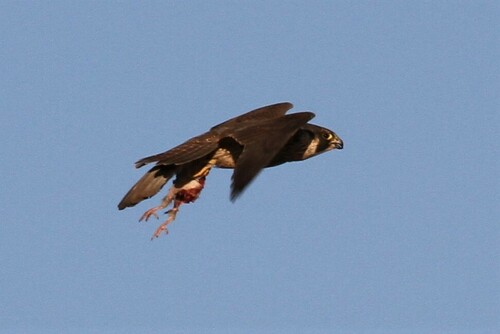
The orange-breasted falcon (Falco deiroleucus) is a bird of prey in the family Falconidae, the falcons and caracaras. It is found in southern Mexico, Belize, Guatemala, Panama, and in all South American countries except Chile and Uruguay, though in Argentina only in the far northwest. Despite its wide range, it is scarce, and considered by IUCN to be Near Threatened.

The orange-breasted falcon looks like a larger version of the bat falcon (F. rufigularis) with which it can easily be mistaken. They share plumage and vocal characteristics and are sister species. These two had been thought to be closely related to the aplomado falcon (F. femoralis), but more recent genetic evidence shows they are more closely related to the Old World hobbies than to any other New World falcon.

The orange-breasted falcon is monotypic. Male orange-breasted falcons are 35 to 36 cm (14 to 14 in) long and weigh 325 to 425 g (11 to 15 oz). Females are 38 to 40 cm (15 to 16 in) long and weigh 550 to 700 g (19 to 25 oz). Of all the falcons, this species has the greatest difference in size between the sexes. It is a rather husky, large-headed bird. The sexes have... Wikipedia →

Sounds

Song0:51

Brazil · 2008

© Dante Buzzetti · XC486990 · CC BY-NC-SA 4.0

Call0:08

Ecuador · 1988

© Robert S. Ridgely · XC274921 · CC BY-NC-SA 4.0

Flight call0:07

Ecuador · 1993

© Paul Coopmans · XC264384 · CC BY-NC-SA 4.0

Global Distribution

Parks Where Found

# Park Country Daily sighting probability
1 Tikal National Park 🇬🇹 Guatemala
~50%

More parks will be added in future updates.

Before you go

What are the chances of seeing an Orange-breasted Falcon in Tikal National Park?

Likely

About 50% of wildlife watchers report an Orange-breasted Falcon sighting in Tikal National Park on a given day, based on 68 verified sightings from GBIF citizen-science data from 2019 to 2026. It is the 24th most-seen of the 300 birds we can rate there. Over three days the chance rises to about 80%, and over a week to over 90%, if each day is a fresh chance.

When is the best time to see an Orange-breasted Falcon in Tikal National Park?

January

In that month about 60% of wildlife watchers report an Orange-breasted Falcon in Tikal National Park on a given day, against about 30% in March, the lowest month. That is one of Tikal National Park's driest months, with about 45 mm of rain against 190 mm in June.

What time of day is best to see an Orange-breasted Falcon?

Between 7 and 10 am

Across all the parks we cover, that three-hour window holds the most Orange-breasted Falcon sightings with a recorded time, and about 9 in 10 of them come between 6 am and 6 pm: it is a daytime animal.

Where else can you see an Orange-breasted Falcon?

Only Tikal National Park, in our data

Tikal National Park is the only park on Wallace's Line with enough records to rate Orange-breasted Falcon sightings: about 50% of wildlife watchers there report one on a given day.

Where does the Orange-breasted Falcon sighting chance come from?

GBIF citizen-science records

It is estimated from how often the Orange-breasted Falcon is recorded against all the birds logged in Tikal National Park (68 verified sightings from 2019 to 2026), calibrated against known sighting rates. Figures are rounded to the nearest 10% because citizen-science data supports honest approximations, not decimals, and months with records from fewer than five people show "—". How it works.

← Back to Tikal National Park