Collared Forest Falcon

Collared Forest Falcon

Micrastur semitorquatus

Silhouette: Unknown (photo), John E. McCormack, Michael G. Harvey, Brant C. Faircloth, Nicholas G. Crawford, Travis C. Glenn, Robb T. Brumfield & T. Michael Keesey · PhyloPic

LCLeast ConcernNTVUENCR
Daily sighting probability <5% · Rare
at Tikal National Park

In 3 days ~10% in a week ~20%

60 Verified sightings at Tikal National Park From 2019 to 2026
5,341 In all 59 parks
December Best month
☀️ Diurnal When it's spotted

About the Collared Forest Falcon

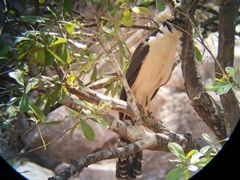
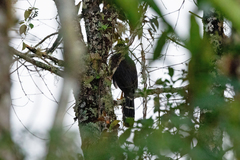
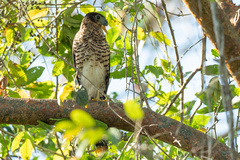
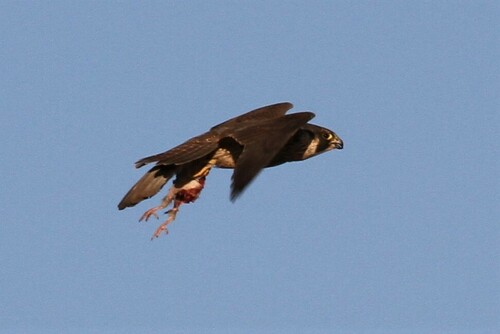
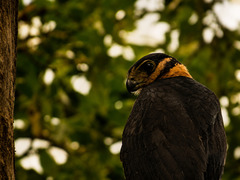
The collared forest falcon (Micrastur semitorquatus) is a species of bird of prey in the family Falconidae. It is the largest member of the Micrastur genus and a common inhabitant of tropical rainforests in Latin America. Hiding in the dense forest canopy, they are a secretive bird often only recognized by their distinctive call. With a morphology or body type allowing them to be agile in their forested habitat, their diet comprises a wide variety of prey from smaller frogs (20 g) to adult turkeys (2.7-3.2 kg).

Nesting occurs mainly in the cavities of Spanish cedar trees, which are also a key species exploited by the local logging industry. This is a potential conservation concern for the collared forest falcon. The collared forest falcon has a dark coloured back with a white neck and breast. The species has three morphological variants (morphs): pale, tawny and dark. The former two have a light coloured collar at the back of their neck, which explains their name. This is the largest species of the forest falcon genus, with a total length of 46 to 58 cm (18 to 23 in), wingspan of 72 to 86 cm (28 to 34 in) and male weights of 467 to 646 g (1.030 to 1.424 lb), averaging... Wikipedia →

Sounds

Song0:04

Argentina · 2026

© Faustino Hollmann · XC1176801 · CC BY-NC-SA 4.0

Call0:58

Ecuador · 2024

© Manuel Sánchez-Nivicela · XC1142549 · CC BY-NC-ND 4.0

Duet0:32

Brazil · 2017

© Rodrigo Y Castro · XC915055 · CC BY-NC-SA 4.0

Global Distribution

Parks Where Found

# Park Country Daily sighting probability
1 El Triunfo 🇲🇽 Mexico
~20%
2 Carara National Park 🇨🇷 Costa Rica
~10%
3 Cerro Azul Meámbar National Park 🇭🇳 Honduras
~10%
4 Cumbres de Monterrey National Park 🇲🇽 Mexico
~10%
5 Calakmul Biosphere Reserve 🇲🇽 Mexico
~10%
6 Pico Bonito National Park 🇭🇳 Honduras
~10%
7 Montes Azules Biosphere Reserve 🇲🇽 Mexico
~10%
8 La Tigra National Park 🇭🇳 Honduras
~10%
9 Soberanía National Park 🇵🇦 Panama
~10%
10 Celaque National Park 🇭🇳 Honduras
~10%
11 Santa Rosa National Park 🇨🇷 Costa Rica
~10%
12 Cockscomb Basin Wildlife Sanctuary 🇧🇿 Belize
~10%
13 Piedras Blancas National Park 🇨🇷 Costa Rica
~10%
14 Lago de Yojoa 🇭🇳 Honduras
~10%
15 Corcovado National Park 🇨🇷 Costa Rica
~10%
16 Tambopata National Reserve 🇵🇪 Peru
<5%
17 Palo Verde National Park 🇨🇷 Costa Rica
<5%
18 Iguazú National Park 🇦🇷 Argentina
<5%
19 Serra dos Órgãos National Park 🇧🇷 Brazil
<5%
20 Rincón de la Vieja National Park 🇨🇷 Costa Rica
<5%
21 Sian Ka'an Biosphere Reserve 🇲🇽 Mexico
<5%
22 Cabo Blanco Absolute Nature Reserve 🇨🇷 Costa Rica
<5%
23 Braulio Carrillo National Park 🇨🇷 Costa Rica
<5%
24 Iguaçu National Park 🇧🇷 Brazil
<5%
25 Tikal National Park 🇬🇹 Guatemala
<5%
26 Cusuco National Park 🇭🇳 Honduras
<5%
27 Gandoca-Manzanillo Wildlife Refuge 🇨🇷 Costa Rica
<5%
28 Ostional Wildlife Refuge 🇨🇷 Costa Rica
<5%
29 Marino Ballena National Park 🇨🇷 Costa Rica
<5%
30 Chagres National Park 🇵🇦 Panama
<5%
31 Manuel Antonio National Park 🇨🇷 Costa Rica
<5%
32 Tayrona National Natural Park 🇨🇴 Colombia
<5%
33 Manu National Park 🇵🇪 Peru
<5%
34 Amboró National Park 🇧🇴 Bolivia
<5%
35 Celestún Biosphere Reserve 🇲🇽 Mexico
<5%
36 Tortuguero National Park 🇨🇷 Costa Rica
<5%
37 Cahuita National Park 🇨🇷 Costa Rica
<5%
38 Darién National Park 🇵🇦 Panama
<5%
39 Cuyabeno Wildlife Reserve 🇪🇨 Ecuador
<5%
40 Biotopo Cerro Cahuí 🇬🇹 Guatemala
<5%
41 Las Baulas Marine National Park 🇨🇷 Costa Rica
<5%
42 Cañón del Sumidero National Park 🇲🇽 Mexico
<5%
43 La Amistad International Park (Panama) 🇵🇦 Panama
<5%
44 Machalilla National Park 🇪🇨 Ecuador
<5%
45 Parque Natural Metropolitano 🇵🇦 Panama
<5%
46 Monteverde Cloud Forest Reserve 🇨🇷 Costa Rica
<5%
47 Parque Estadual Encontro das Águas 🇧🇷 Brazil
<5%
48 Amacayacu National Natural Park 🇨🇴 Colombia
<5%
49 Itatiaia National Park 🇧🇷 Brazil
<5%
50 Arenal Volcano National Park 🇨🇷 Costa Rica
<5%
51 Tenorio Volcano National Park 🇨🇷 Costa Rica
<5%
52 Bastimentos Island National Marine Park 🇵🇦 Panama
<5%
53 Tapantí-Macizo de la Muerte National Park 🇨🇷 Costa Rica
<5%
54 Yasuní National Park 🇪🇨 Ecuador
<5%
55 Los Nevados National Natural Park 🇨🇴 Colombia
<5%
56 Poás Volcano National Park 🇨🇷 Costa Rica
<5%
57 Volcán Barú National Park 🇵🇦 Panama
<5%
58 Los Quetzales National Park 🇨🇷 Costa Rica
<5%
59 Farallones de Cali National Natural Park 🇨🇴 Colombia
<5%

Cities Where Found

# City Country Daily sighting probability
1 San Pedro Sula 🇭🇳 Honduras
<5%
2 João Pessoa 🇧🇷 Brazil
<5%
3 San Salvador 🇸🇻 El Salvador
<5%
4 Managua 🇳🇮 Nicaragua
<5%
5 San José 🇨🇷 Costa Rica
<5%
6 Curitiba 🇧🇷 Brazil
<5%
7 Guatemala City 🇬🇹 Guatemala
<5%
8 Panama City 🇵🇦 Panama
<5%
9 São Paulo 🇧🇷 Brazil
<5%

Zoos & Centres Where Found

# Zoo / Centre Country
1 Auto Safari Chapin 🇬🇹 Guatemala In captivity
2 GüiráOga 🇦🇷 Argentina In captivity

Before you go

What are the chances of seeing a Collared Forest Falcon in Tikal National Park?

Rare

Under 5% of wildlife watchers report a Collared Forest Falcon sighting in Tikal National Park on a given day, based on 60 verified sightings from GBIF citizen-science data from 2019 to 2026. It is the 187th most-seen of the 300 birds we can rate there. Over three days the chance rises to about 10%, and over a week to about 20%, if each day is a fresh chance.

When is the best time to see a Collared Forest Falcon in Tikal National Park?

October and December

In those months about 10% of wildlife watchers report a Collared Forest Falcon in Tikal National Park on a given day, against under 5% in January–September and November, the lowest months.

What time of day is best to see a Collared Forest Falcon?

Between 8 and 11 am

Across all the parks we cover, that three-hour window holds the most Collared Forest Falcon sightings with a recorded time, and about 9 in 10 of them come between 6 am and 6 pm: it is a daytime animal.

Is Tikal National Park the best place to see a Collared Forest Falcon?

25th of 59

Of the 59 parks where we can rate Collared Forest Falcon sightings, Tikal National Park ranks 25th at under 5%. The best odds are in El Triunfo (Mexico, about 20%), Carara National Park (Costa Rica, about 10%) and Cerro Azul Meámbar National Park (Honduras, about 10%).

Where does the Collared Forest Falcon sighting chance come from?

GBIF citizen-science records

It is estimated from how often the Collared Forest Falcon is recorded against all the birds logged in Tikal National Park (60 verified sightings from 2019 to 2026), calibrated against known sighting rates. Figures are rounded to the nearest 10% because citizen-science data supports honest approximations, not decimals, and months with records from fewer than five people show "—". How it works.

← Back to Tikal National Park