Ashy-headed Goose

Ashy-headed Goose

Chloephaga poliocephala

Silhouette: Edwin Price · PhyloPic

LCLeast ConcernNTVUENCR
Daily sighting probability ~10% · With luck
at Torres del Paine National Park

In 3 days ~40% in a week ~70%

235 Verified sightings at Torres del Paine National Park From 2019 to 2026
1,615 In all 4 parks
September Best month
☀️ Diurnal When it's spotted

About the Ashy-headed Goose

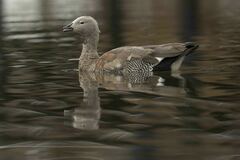
The ashy-headed goose (Chloephaga poliocephala) is a species of waterfowl in tribe Tadornini of subfamily Anserinae. It is found in Argentina and Chile. The ashy-headed goose is monotypic. The ashy-headed goose is 50 to 60 cm (20 to 24 in) long. Males weigh 1.62 to 2.27 kg (3.6 to 5.0 lb) and females 1.47 to 1.49 kg (3.2 to 3.3 lb). Adults have the same plumage. Their heads and necks are gray, their upper back and breast chestnut with fine barring, their flanks barred black and white, and their belly white. In flight their blackish wings show bold white leading and trailing patches and a metallic green speculum. Their bill is black and the legs and feet orange with black markings. Juveniles' rufous areas are much duller, their back and breast barring stronger, and their speculum dark brownish.

The ashy-headed goose is a bird of South America's southern cone from central Chile and Buenos Aires Province, Argentina, south into Tierra del Fuego. It also occurs as vagrant on the Falkland Islands and has bred there. In summer it primarily inhabits clearings in damp forests of southern beech (Nothofagus sp.) around... Wikipedia →

Sounds

Flight call0:17

Argentina · 2017

© Étienne Leroy · XC396627 · CC BY-NC-SA 4.0

Call0:09

Argentina · 2011

© Andrew Spencer · XC89728 · CC BY-NC-ND 2.5

Flight call0:23

Argentina · 2008

© Bernabe Lopez-Lanus · XC44472 · CC BY-NC-SA 3.0

Global Distribution

Parks Where Found

# Park Country Daily sighting probability
1 Nahuel Huapi National Park 🇦🇷 Argentina
~40%
2 Tierra del Fuego National Park 🇦🇷 Argentina
~30%
3 Torres del Paine National Park 🇨🇱 Chile
~10%
4 Vicente Pérez Rosales National Park 🇨🇱 Chile
<5%

Zoos & Centres Where Found

# Zoo / Centre Country
1 San Diego Zoo 🇺🇸 United States In captivity
2 Moscow Zoo 🇷🇺 Russia In captivity
3 Slimbridge Wetland Centre 🇬🇧 United Kingdom In captivity
4 Temaikén 🇦🇷 Argentina In captivity
5 Cologne Zoological Garden 🇩🇪 Germany In captivity
6 Faunia 🇪🇸 Spain In captivity
7 Rio de Janeiro Zoological Garden 🇧🇷 Brazil In captivity
8 Chilean National Zoo 🇨🇱 Chile In captivity
9 Cologne Zoo Aquarium 🇩🇪 Germany In captivity

Before you go

What are the chances of seeing an Ashy-headed Goose in Torres del Paine National Park?

With luck

About 10% of wildlife watchers report an Ashy-headed Goose sighting in Torres del Paine National Park on a given day, based on 235 verified sightings from GBIF citizen-science data from 2019 to 2026. It is the 46th most-seen of the 106 birds we can rate there. Over three days the chance rises to about 40%, and over a week to about 70%, if each day is a fresh chance.

When is the best time to see an Ashy-headed Goose in Torres del Paine National Park?

September

In that month about 30% of wildlife watchers report an Ashy-headed Goose in Torres del Paine National Park on a given day, against under 5% in April, the lowest month.

What time of day is best to see an Ashy-headed Goose?

Between 11 am and 2 pm

Across all the parks we cover, that three-hour window holds the most Ashy-headed Goose sightings with a recorded time, and about 8 in 10 of them come between 6 am and 6 pm: it is a daytime animal.

Is Torres del Paine National Park the best place to see an Ashy-headed Goose?

3rd of 4

Of the 4 parks where we can rate Ashy-headed Goose sightings, Torres del Paine National Park ranks 3rd at about 10%. The best odds are in Nahuel Huapi National Park (Argentina, about 40%) and Tierra del Fuego National Park (Argentina, about 30%).

Where does the Ashy-headed Goose sighting chance come from?

GBIF citizen-science records

It is estimated from how often the Ashy-headed Goose is recorded against all the birds logged in Torres del Paine National Park (235 verified sightings from 2019 to 2026), calibrated against known sighting rates. Figures are rounded to the nearest 10% because citizen-science data supports honest approximations, not decimals, and months with records from fewer than five people show "—". How it works.

← Back to Torres del Paine National Park