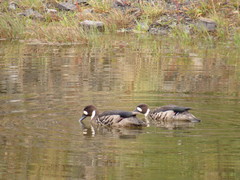

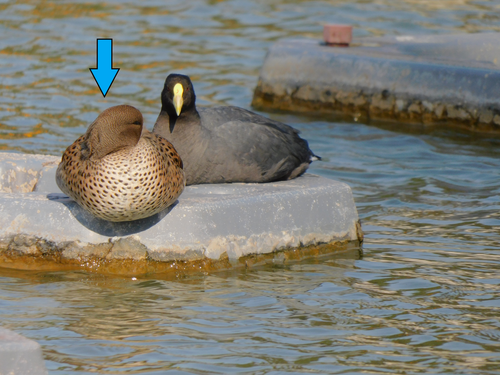
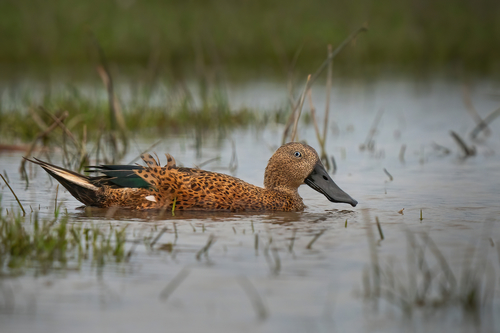
Spectacled Duck

Spectacled Duck

Speculanas specularis

Silhouette: Sheatherius · PhyloPic

LCNTNear ThreatenedVUENCR
Daily sighting probability ~20% · Possible
at Torres del Paine National Park

In 3 days ~60% in a week ~90%

457 Verified sightings at Torres del Paine National Park From 2019 to 2026
783 In all 2 parks
July Best month
☀️ Diurnal When it's spotted

About the Spectacled Duck

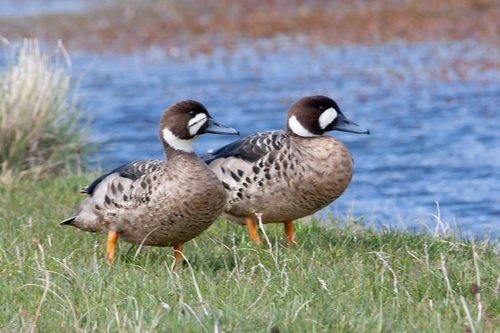
The bronze-winged duck (Speculanas specularis) also known as the spectacled duck, is a dabbling duck and the sole member of its genus Speculanas. It is often placed in Anas with most other dabbling ducks, but its closest relative is either the crested duck or the Brazilian duck, which likewise form monotypic genera. Together they belong to a South American lineage which diverged early from the other dabbling ducks and may include the steamer ducks.

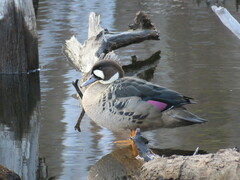
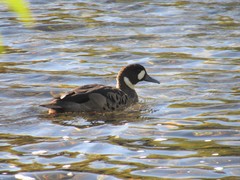
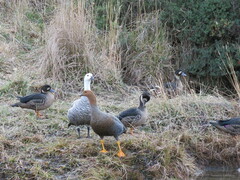
Named after the "bronze" speculum this species is also known as "pato perro" or "dog-duck" after the harsh barking call of the female. The bronze-winged duck lives among forested rivers and fast-flowing streams on the lower slopes of the South American Andes, in central and southern Chile and adjacent parts of Argentina.

The sexes are alike. The species lives on forested rivers. While they appear to prefer fast-moving water, they can also be found less frequently in forested ponds. They eat plants and small invertebrates, including water crowfoot (Ranunculus sp.), water milfoil (Myriophyllum sp.), bulrushes, as well as caddisfly larvae and snails. Wikipedia →

Sounds

Call0:08

Chile · 2011

© Andrew Spencer · XC92061 · CC BY-NC-ND 2.5

Call0:13

Argentina · 2020

© GABRIEL LEITE · XC521634 · CC BY-NC-SA 4.0

Global Distribution

Parks Where Found

# Park Country Daily sighting probability
1 Tierra del Fuego National Park 🇦🇷 Argentina
~30%
2 Torres del Paine National Park 🇨🇱 Chile
~20%

Zoos & Centres Where Found

# Zoo / Centre Country
1 Ostrava Zoo 🇨🇿 Czechia In captivity
2 Whitcliff Park (Deer Park) 🇬🇧 United Kingdom In captivity
3 Santillana Zoo 🇪🇸 Spain In captivity
4 Wild Discovery Zoo 🇬🇧 United Kingdom In captivity

Before you go

What are the chances of seeing a Spectacled Duck in Torres del Paine National Park?

Possible

About 20% of wildlife watchers report a Spectacled Duck sighting in Torres del Paine National Park on a given day, based on 457 verified sightings from GBIF citizen-science data from 2019 to 2026. It is the 29th most-seen of the 106 birds we can rate there. Over three days the chance rises to about 60%, and over a week to about 90%, if each day is a fresh chance.

When is the best time to see a Spectacled Duck in Torres del Paine National Park?

July

In that month about 60% of wildlife watchers report a Spectacled Duck in Torres del Paine National Park on a given day, against about 20% in April and October–January, the lowest months.

What time of day is best to see a Spectacled Duck?

Between 3 and 6 pm

Across all the parks we cover, that three-hour window holds the most Spectacled Duck sightings with a recorded time, and about 8 in 10 of them come between 6 am and 6 pm: it is a daytime animal.

Is Torres del Paine National Park the best place to see a Spectacled Duck?

2nd of 2

Of the 2 parks where we can rate Spectacled Duck sightings, Torres del Paine National Park ranks 2nd at about 20%. The best odds are in Tierra del Fuego National Park (Argentina, about 30%).

Which relatives of the Spectacled Duck live in Torres del Paine National Park?

Same family: Anatidae

The closest relatives of the Spectacled Duck that you can see in Torres del Paine National Park (family Anatidae, Ducks, Geese, and Swans) are Upland Goose (about 80%), Yellow-billed Pintail (about 30%) and Crested Duck (about 30%), with each one's daily chance of a sighting.

Where does the Spectacled Duck sighting chance come from?

GBIF citizen-science records

It is estimated from how often the Spectacled Duck is recorded against all the birds logged in Torres del Paine National Park (457 verified sightings from 2019 to 2026), calibrated against known sighting rates. Figures are rounded to the nearest 10% because citizen-science data supports honest approximations, not decimals, and months with records from fewer than five people show "—". How it works.

← Back to Torres del Paine National Park