Andean Ruddy Duck

Andean Ruddy Duck

Oxyura ferruginea

Silhouette: Sheatherius · PhyloPic

LCLeast ConcernNTVUENCR
Daily sighting probability ~20% · Possible
at Torres del Paine National Park

In 3 days ~40% in a week ~70%

266 Verified sightings at Torres del Paine National Park From 2019 to 2026
2,255 In all 4 parks
July Best month
☀️ Diurnal When it's spotted

About the Andean Ruddy Duck

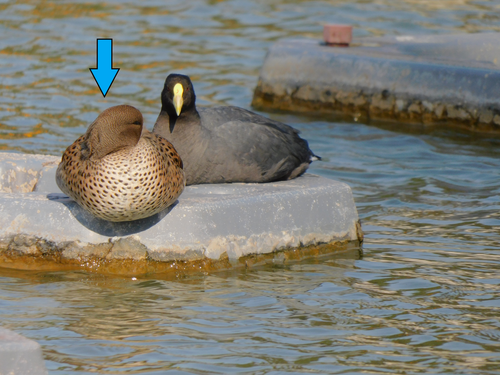
The Andean duck (Oxyura ferruginea) is a bird species native to the Andean Mountains of South America, one of the stiff-tailed ducks. It was considered a subspecies of the ruddy duck. In fact, some taxonomic authorities still consider it conspecific, including the American Ornithological Society.

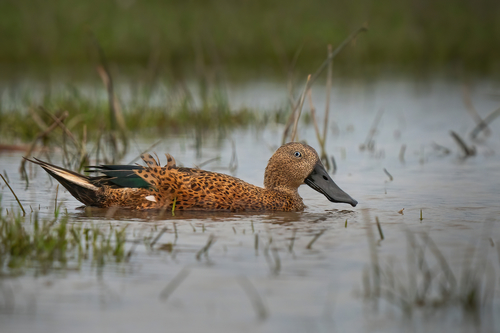
These are small, compact ducks with stout, scoop-shaped bills, and long, stiff tails they often hold cocked upward. They have slightly peaked heads and fairly short, thick necks. In summer, they have rich chestnut bodies with bright blue bills. In winter, they are dull gray-brown above and paler below with dull gray bills. Females and first-year males are brownish, somewhat like winter males but with a blurry stripe across the pale cheek patch. It is separable from the ruddy duck by its all-black face and larger size.

Their breeding habitat is marshy lakes and ponds. They nest in dense marsh vegetation near water. The female builds the nest out of grass, locating it in tall vegetation to hide it from predators. A typical brood contains 5 to 15 ducklings.

These birds dive and swim underwater. They mainly eat seeds and roots of aquatic plants, aquatic... Wikipedia →

Sounds

Song0:20

Chile · 2019

© Cristian Pinto · XC522022 · CC BY-NC-SA 4.0

Chest clapping0:26

Ecuador · 1993

© Robert S. Ridgely · XC274910 · CC BY-NC-SA 4.0

Call0:15

Ecuador · 2000

© John V. Moore · XC257288 · CC BY-NC-SA 4.0

Global Distribution

Parks Where Found

# Park Country Daily sighting probability
1 Lauca National Park 🇨🇱 Chile
~40%
2 Los Nevados National Natural Park 🇨🇴 Colombia
~20%
3 Torres del Paine National Park 🇨🇱 Chile
~20%
4 Chingaza National Natural Park 🇨🇴 Colombia
~10%

Cities Where Found

# City Country Daily sighting probability
1 Cochabamba 🇧🇴 Bolivia
~40%
2 Bogota 🇨🇴 Colombia
~20%
3 La Paz 🇧🇴 Bolivia
~10%
4 Lima 🇵🇪 Peru
~10%

Zoos & Centres Where Found

# Zoo / Centre Country
1 Sedgwick County Zoo 🇺🇸 United States In captivity
2 Chester Zoo 🇬🇧 United Kingdom In captivity
3 San Francisco Zoo 🇺🇸 United States In captivity
4 Queens Zoo 🇺🇸 United States In captivity

Before you go

What are the chances of seeing an Andean Ruddy Duck in Torres del Paine National Park?

Possible

About 20% of wildlife watchers report an Andean Ruddy Duck sighting in Torres del Paine National Park on a given day, based on 266 verified sightings from GBIF citizen-science data from 2019 to 2026. It is the 44th most-seen of the 106 birds we can rate there. Over three days the chance rises to about 40%, and over a week to about 70%, if each day is a fresh chance.

When is the best time to see an Andean Ruddy Duck in Torres del Paine National Park?

July and September

In those months about 30% of wildlife watchers report an Andean Ruddy Duck in Torres del Paine National Park on a given day, against under 5% in April, the lowest month.

What time of day is best to see an Andean Ruddy Duck?

Between 9 am and noon

Across all the parks we cover, that three-hour window holds the most Andean Ruddy Duck sightings with a recorded time, and about 9 in 10 of them come between 6 am and 6 pm: it is a daytime animal.

Is Torres del Paine National Park the best place to see an Andean Ruddy Duck?

3rd of 4

Of the 4 parks where we can rate Andean Ruddy Duck sightings, Torres del Paine National Park ranks 3rd at about 20%. The best odds are in Lauca National Park (Chile, about 40%) and Los Nevados National Natural Park (Colombia, about 20%).

Where does the Andean Ruddy Duck sighting chance come from?

GBIF citizen-science records

It is estimated from how often the Andean Ruddy Duck is recorded against all the birds logged in Torres del Paine National Park (266 verified sightings from 2019 to 2026), calibrated against known sighting rates. Figures are rounded to the nearest 10% because citizen-science data supports honest approximations, not decimals, and months with records from fewer than five people show "—". How it works.

← Back to Torres del Paine National Park