Chilean Flicker

Chilean Flicker

Colaptes pitius

Silhouette: Edwin Price · PhyloPic

LCLeast ConcernNTVUENCR
Daily sighting probability ~20% · Possible
at Torres del Paine National Park

In 3 days ~50% in a week ~80%

324 Verified sightings at Torres del Paine National Park From 2019 to 2026
589 In all 3 parks
March Best month
☀️ Diurnal When it's spotted

About the Chilean Flicker

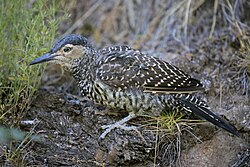
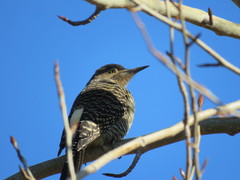
The Chilean flicker (Colaptes pitius) is a species of bird in subfamily Picinae of the woodpecker family Picidae. It is found in Argentina and Chile. The Chilean flicker was originally described as Picus Pitius. For a time it was put in the monotypic genus Pituipicus that was later merged into Colaptes. The Chilean flicker and Andean flicker (C. rupicola) are sister species.

The Chilean flicker is monotypic. The Chilean flicker is about 30 cm (12 in) long and weighs 100 to 163 g (3.5 to 5.7 oz). Males and females have the same plumage except on their heads. Adult males are dark slate gray from forehead to nape; the last occasionally has a hint of red. They are buffish from their lores around the eye to the nape with fine black or black and red spots on the malar area that show as a diffuse patch. Their chin and throat are buffish white with black spots on the lower throat. Adult females have a buffish malar area with no spots and never any red on the nape. Both sexes have blackish brown upperparts with narrow white to buff-white bars; their rump is white with sometimes a few black spots. Their flight feathers are dark brown with pale... Wikipedia →

Sounds

Call0:09

Chile · 2019

© Ignacio Escobar · XC617690 · CC BY-NC-SA 4.0

Alarm call0:10

Chile · 2016

© Cristian Pinto · XC379539 · CC BY-NC-SA 4.0

Song0:18

Chile · 2003

© Rodrigo Valenzuela Aceval · XC988 · CC BY-NC-ND 2.5

Global Distribution

Parks Where Found

# Park Country Daily sighting probability
1 Vicente Pérez Rosales National Park 🇨🇱 Chile
~30%
2 Torres del Paine National Park 🇨🇱 Chile
~20%
3 Nahuel Huapi National Park 🇦🇷 Argentina
~10%

Cities Where Found

# City Country Daily sighting probability
1 Santiago 🇨🇱 Chile
<5%

Before you go

What are the chances of seeing a Chilean Flicker in Torres del Paine National Park?

Possible

About 20% of wildlife watchers report a Chilean Flicker sighting in Torres del Paine National Park on a given day, based on 324 verified sightings from GBIF citizen-science data from 2019 to 2026. It is the 36th most-seen of the 106 birds we can rate there. Over three days the chance rises to about 50%, and over a week to about 80%, if each day is a fresh chance.

When is the best time to see a Chilean Flicker in Torres del Paine National Park?

March and April

In those months about 40% of wildlife watchers report a Chilean Flicker in Torres del Paine National Park on a given day, against about 10% in November, the lowest month.

What time of day is best to see a Chilean Flicker?

Between noon and 3 pm

Across all the parks we cover, that three-hour window holds the most Chilean Flicker sightings with a recorded time, and about 8 in 10 of them come between 6 am and 6 pm: it is a daytime animal.

Is Torres del Paine National Park the best place to see a Chilean Flicker?

2nd of 3

Of the 3 parks where we can rate Chilean Flicker sightings, Torres del Paine National Park ranks 2nd at about 20%. The best odds are in Vicente Pérez Rosales National Park (Chile, about 30%).

Which relatives of the Chilean Flicker live in Torres del Paine National Park?

Same family: Picidae

The closest relatives of the Chilean Flicker that you can see in Torres del Paine National Park (family Picidae, Woodpeckers) are Magellanic Woodpecker (about 10%) and Striped Woodpecker (about 10%), with each one's daily chance of a sighting.

Where does the Chilean Flicker sighting chance come from?

GBIF citizen-science records

It is estimated from how often the Chilean Flicker is recorded against all the birds logged in Torres del Paine National Park (324 verified sightings from 2019 to 2026), calibrated against known sighting rates. Figures are rounded to the nearest 10% because citizen-science data supports honest approximations, not decimals, and months with records from fewer than five people show "—". How it works.

← Back to Torres del Paine National Park