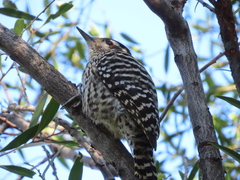
Striped Woodpecker

Striped Woodpecker

Veniliornis lignarius

Silhouette: Pepe Reigada · PhyloPic

LCLeast ConcernNTVUENCR
Daily sighting probability ~10% · With luck
at Torres del Paine National Park

In 3 days ~20% in a week ~40%

120 Verified sightings at Torres del Paine National Park From 2019 to 2026
273 In all 3 parks
May Best month
☀️ Diurnal When it's spotted

About the Striped Woodpecker

The striped woodpecker (Veniliornis lignarius) is a species of bird in subfamily Picinae of the woodpecker family Picidae. It is found in Argentina, Bolivia, and Chile. The striped woodpecker was originally described as Picus Lignarius. It was later placed in Dyctiopicus, which was merged into Dendrocopos, which in turn was merged into Picoides where it and its sister species the checkered woodpecker (V. mixtus) were considered outliers. In 2006, Moore et al. published research on mtDNA COI and Cyt b sequences which suggested that the two belong in genus Veniliornis. That treatment is now (2023) followed by the International Ornithological Committee and BirdLife International's Handbook of the Birds of the World. However, starting in 2018, the American Ornithological Society and the Clements taxonomy moved all species of genus Veniliornis into genus Dryobates. In addition, there have been suggestions that the striped and checkered woodpeckers are conspecific.

The striped woodpecker is treated as monotypic by all of the above taxonomic systems. However, the population in Bolivia differs in several ways from that further south and may deserve to be treated... Wikipedia →

Sounds

Call0:19

Chile · 2025

© Marc Anderson · XC1075548 · CC BY-NC-ND 4.0

Recording0:09

Chile · 2019

© Ignacio Escobar · XC584993 · CC BY-NC-SA 4.0

Song0:10

Chile · 2014

© Francisco Rivas Fuenzalida · XC176372 · CC BY-NC-SA 4.0

Global Distribution

Parks Where Found

# Park Country Daily sighting probability
1 Vicente Pérez Rosales National Park 🇨🇱 Chile
~20%
2 Torres del Paine National Park 🇨🇱 Chile
~10%
3 Nahuel Huapi National Park 🇦🇷 Argentina
~10%

Cities Where Found

# City Country Daily sighting probability
1 Santiago 🇨🇱 Chile
~20%
2 Cochabamba 🇧🇴 Bolivia
<5%

Before you go

What are the chances of seeing a Striped Woodpecker in Torres del Paine National Park?

With luck

About 10% of wildlife watchers report a Striped Woodpecker sighting in Torres del Paine National Park on a given day, based on 120 verified sightings from GBIF citizen-science data from 2019 to 2026. It is the 60th most-seen of the 106 birds we can rate there. Over three days the chance rises to about 20%, and over a week to about 40%, if each day is a fresh chance.

When is the best time to see a Striped Woodpecker in Torres del Paine National Park?

May

In that month about 20% of wildlife watchers report a Striped Woodpecker in Torres del Paine National Park on a given day, against under 5% in November, the lowest month.

What time of day is best to see a Striped Woodpecker?

Between 10 am and 1 pm

Across all the parks we cover, that three-hour window holds the most Striped Woodpecker sightings with a recorded time, and about 8 in 10 of them come between 6 am and 6 pm: it is a daytime animal.

Is Torres del Paine National Park the best place to see a Striped Woodpecker?

2nd of 3

Of the 3 parks where we can rate Striped Woodpecker sightings, Torres del Paine National Park ranks 2nd at about 10%. The best odds are in Vicente Pérez Rosales National Park (Chile, about 20%).

Which relatives of the Striped Woodpecker live in Torres del Paine National Park?

Same family: Picidae

The closest relatives of the Striped Woodpecker that you can see in Torres del Paine National Park (family Picidae, Woodpeckers) are Chilean Flicker (about 20%) and Magellanic Woodpecker (about 10%), with each one's daily chance of a sighting.

Where does the Striped Woodpecker sighting chance come from?

GBIF citizen-science records

It is estimated from how often the Striped Woodpecker is recorded against all the birds logged in Torres del Paine National Park (120 verified sightings from 2019 to 2026), calibrated against known sighting rates. Figures are rounded to the nearest 10% because citizen-science data supports honest approximations, not decimals, and months with records from fewer than five people show "—". How it works.

← Back to Torres del Paine National Park