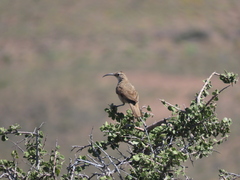
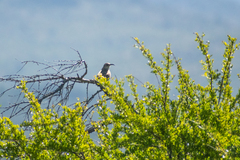
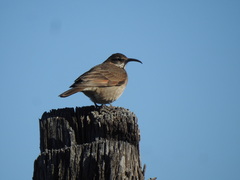

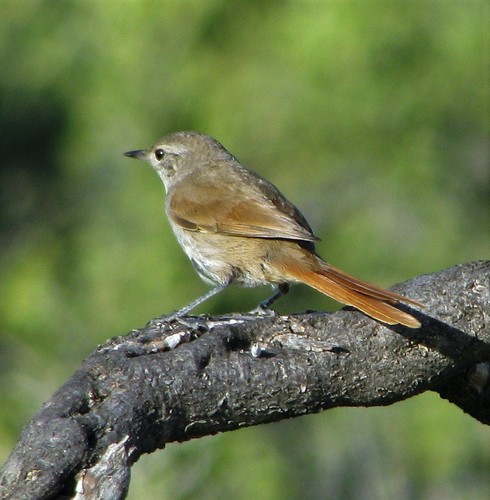
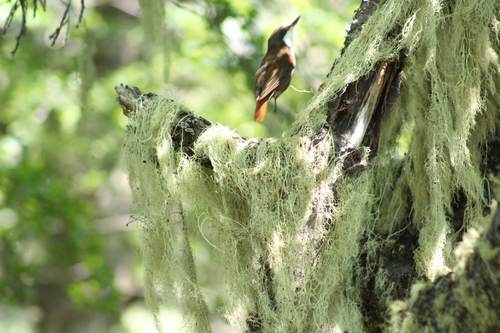
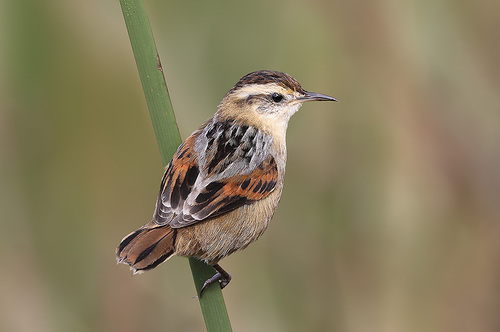
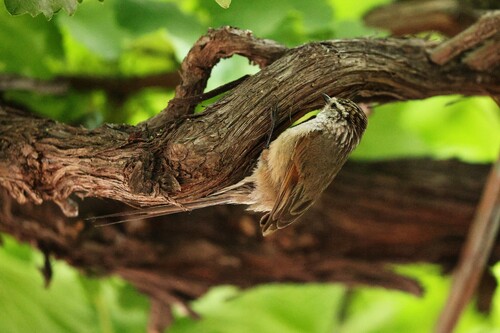
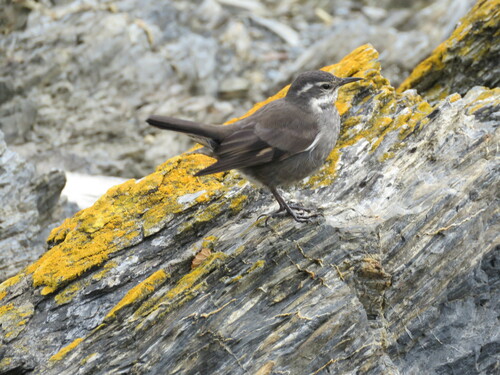
Scale-throated Earthcreeper

Scale-throated Earthcreeper

Upucerthia dumetaria

Silhouette: Sheatherius · PhyloPic

LCLeast ConcernNTVUENCR
Daily sighting probability ~20% · Possible
at Torres del Paine National Park

In 3 days ~50% in a week ~80%

277 Verified sightings at Torres del Paine National Park From 2019 to 2026
407 In all 3 parks
September Best month
☀️ Diurnal When it's spotted

About the Scale-throated Earthcreeper

The scale-throated earthcreeper (Upucerthia dumetaria) is a species of bird in the Furnariinae subfamily of the ovenbird family Furnariidae. It is found in Argentina, Bolivia, Chile, Peru, and possibly Uruguay. What is now the Patagonian forest earthcreeper (U. saturatior) was considered a fourth subspecies until about 2009.

The scale-throated earthcreeper is 20 to 22 cm (7.9 to 8.7 in) long and weighs 37 to 55.5 g (1.3 to 2.0 oz). It is a large earthcreeper with a long and very decurved bill. The sexes' plumages are alike. Adults of the nominate subspecies have a whitish supercilium on an otherwise grayish white and dark grayish brown face. Their crown is a dull dark grayish brown with some fainter mottling. Their nape, back, rump, and uppertail coverts are uniform dull brownish gray. Their tail's central feathers are dull grayish brown and the rest blackish brown with dull rufous tips; the amount of rufous increases from inner to outer feathers.... Wikipedia →

Sounds

Song1:11

Chile · 2023

© Barry Edmonston · XC856868 · CC BY-NC-SA 4.0

Call0:24

Chile · 2018

© Peter Boesman · XC450213 · CC BY-NC-ND 4.0

Song0:45

Chile · 2019

© Étienne Leroy · XC508092 · CC BY-NC-SA 4.0

Global Distribution

Parks Where Found

# Park Country Daily sighting probability
1 Península Valdés 🇦🇷 Argentina
~20%
2 Torres del Paine National Park 🇨🇱 Chile
~20%
3 Nahuel Huapi National Park 🇦🇷 Argentina
<5%

Before you go

What are the chances of seeing a Scale-throated Earthcreeper in Torres del Paine National Park?

Possible

About 20% of wildlife watchers report a Scale-throated Earthcreeper sighting in Torres del Paine National Park on a given day, based on 277 verified sightings from GBIF citizen-science data from 2019 to 2026. It is the 38th most-seen of the 106 birds we can rate there. Over three days the chance rises to about 50%, and over a week to about 80%, if each day is a fresh chance.

When is the best time to see a Scale-throated Earthcreeper in Torres del Paine National Park?

September and November

In those months about 30% of wildlife watchers report a Scale-throated Earthcreeper in Torres del Paine National Park on a given day, against under 5% in April, the lowest month.

What time of day is best to see a Scale-throated Earthcreeper?

Between 9 am and noon

Across all the parks we cover, that three-hour window holds the most Scale-throated Earthcreeper sightings with a recorded time, and about 9 in 10 of them come between 6 am and 6 pm: it is a daytime animal.

Is Torres del Paine National Park the best place to see a Scale-throated Earthcreeper?

Among the best

Of the 3 parks where we can rate Scale-throated Earthcreeper sightings, Torres del Paine National Park ranks 2nd at about 20%, level with the leaders once rounded. The best odds are in Península Valdés (Argentina, about 20%).

Which relatives of the Scale-throated Earthcreeper live in Torres del Paine National Park?

Same family: Furnariidae

The closest relatives of the Scale-throated Earthcreeper that you can see in Torres del Paine National Park (family Furnariidae, Ovenbirds and Woodcreepers) are Thorn-tailed Rayadito (about 40%), Dark-bellied Cinclodes (about 20%) and Buff-winged Cinclodes (about 10%), with each one's daily chance of a sighting.

Where does the Scale-throated Earthcreeper sighting chance come from?

GBIF citizen-science records

It is estimated from how often the Scale-throated Earthcreeper is recorded against all the birds logged in Torres del Paine National Park (277 verified sightings from 2019 to 2026), calibrated against known sighting rates. Figures are rounded to the nearest 10% because citizen-science data supports honest approximations, not decimals, and months with records from fewer than five people show "—". How it works.

← Back to Torres del Paine National Park