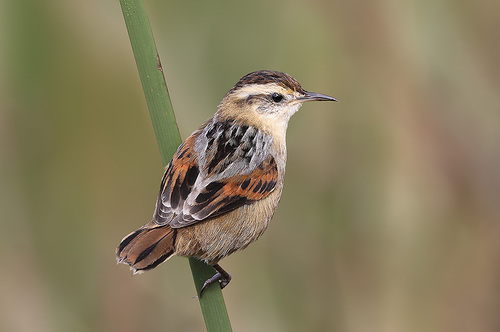

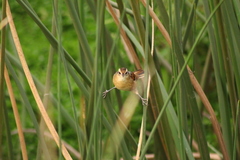

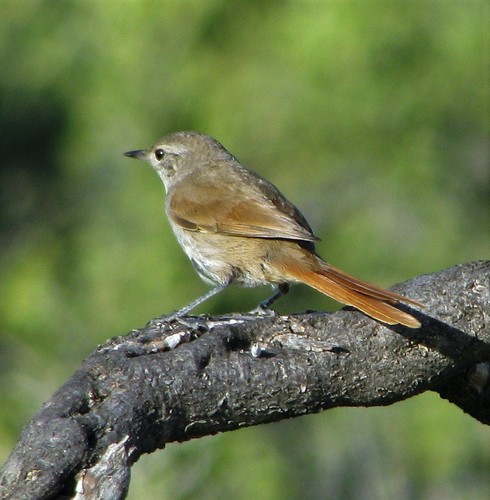

Wren-like Rushbird

Wren-like Rushbird

Phleocryptes melanops

Silhouette: Sheatherius · PhyloPic

LCLeast ConcernNTVUENCR
Daily sighting probability <5% · Rare
at Torres del Paine National Park

In 3 days ~10% in a week ~30%

63 Verified sightings at Torres del Paine National Park From 2019 to 2026
122 In all 3 parks
December Best month
☀️ Diurnal When it's spotted

About the Wren-like Rushbird

The wren-like rushbird (Phleocryptes melanops) is a species of bird in the Furnariinae subfamily of the ovenbird family Furnariidae. It is found in Argentina, Bolivia, Brazil, Chile, Paraguay, Peru, and Uruguay. The wren-like rushbird is the only member of its genus and has these four subspecies:

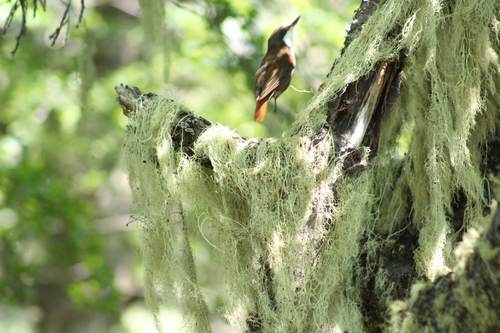
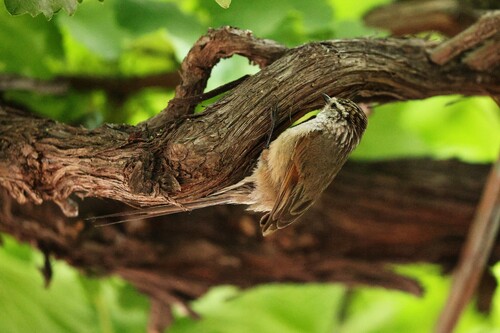
The wren-like rushbird is genetically most closely related to the curve-billed reedhaunter (Limnornis curvirostris). The wren-like rushbird is 13 to 14 cm (5.1 to 5.5 in) long and weighs 11 to 16 g (0.39 to 0.56 oz). It is a small furnariid whose plumage closely resembles that of the wholly unrelated marsh wren (Cistothorus palustris). It has a longish slightly decurved bill. The sexes' plumages are essentially alike though females are slightly paler than males. Adults of the nominate subspecies P. m. melanops have a wide buff supercilium, grayish lores, a dark brown band behind the eye, mottled dark brown ear coverts, and a buff malar area. Their crown is blackish with wide brown streaks... Wikipedia →

Sounds

Call0:04

Argentina · 2023

© Bernard BOUSQUET · XC826850 · CC BY-NC-SA 4.0

Song1:13

Peru · 2009

© Peter Boesman · XC227724 · CC BY-NC-ND 4.0

Song?1:02

Chile · 2007

© Doug Knapp · XC16343 · CC BY-NC-ND 2.5

Global Distribution

Parks Where Found

# Park Country Daily sighting probability
1 Torres del Paine National Park 🇨🇱 Chile
<5%
2 Iberá National Park 🇦🇷 Argentina
<5%
3 Tijuca National Park 🇧🇷 Brazil
<5%

Cities Where Found

# City Country Daily sighting probability
1 Rosario 🇦🇷 Argentina
~20%
2 Cochabamba 🇧🇴 Bolivia
~20%
3 Lima 🇵🇪 Peru
~20%
4 Buenos Aires 🇦🇷 Argentina
~10%
5 La Paz 🇧🇴 Bolivia
~10%
6 Montevideo 🇺🇾 Uruguay
<5%
7 Cordoba 🇦🇷 Argentina
<5%
8 Santiago 🇨🇱 Chile
<5%
9 Rio de Janeiro 🇧🇷 Brazil
<5%

Before you go

What are the chances of seeing a Wren-like Rushbird in Torres del Paine National Park?

Rare

Under 5% of wildlife watchers report a Wren-like Rushbird sighting in Torres del Paine National Park on a given day, based on 63 verified sightings from GBIF citizen-science data from 2019 to 2026. It is the 68th most-seen of the 106 birds we can rate there. Over three days the chance rises to about 10%, and over a week to about 30%, if each day is a fresh chance.

When is the best time to see a Wren-like Rushbird in Torres del Paine National Park?

February and November–December

In those months about 10% of wildlife watchers report a Wren-like Rushbird in Torres del Paine National Park on a given day, against under 5% in January and March–October, the lowest months.

What time of day is best to see a Wren-like Rushbird?

Between 9 am and noon

Across all the parks we cover, that three-hour window holds the most Wren-like Rushbird sightings with a recorded time, and about 9 in 10 of them come between 6 am and 6 pm: it is a daytime animal.

Is Torres del Paine National Park the best place to see a Wren-like Rushbird?

Yes

Of the 3 parks where we can rate Wren-like Rushbird sightings, Torres del Paine National Park has the highest daily chance: under 5%. Next come Iberá National Park (Argentina, under 5%) and Tijuca National Park (Brazil, under 5%).

Which relatives of the Wren-like Rushbird live in Torres del Paine National Park?

Same family: Furnariidae

The closest relatives of the Wren-like Rushbird that you can see in Torres del Paine National Park (family Furnariidae, Ovenbirds and Woodcreepers) are Thorn-tailed Rayadito (about 40%), Dark-bellied Cinclodes (about 20%) and Scale-throated Earthcreeper (about 20%), with each one's daily chance of a sighting.

Where does the Wren-like Rushbird sighting chance come from?

GBIF citizen-science records

It is estimated from how often the Wren-like Rushbird is recorded against all the birds logged in Torres del Paine National Park (63 verified sightings from 2019 to 2026), calibrated against known sighting rates. Figures are rounded to the nearest 10% because citizen-science data supports honest approximations, not decimals, and months with records from fewer than five people show "—". How it works.

← Back to Torres del Paine National Park