Blackspotted Longhorn Beetle

Blackspotted Longhorn Beetle

Rhagium mordax

Daily sighting probability ~20% · Possible
at Triglav National Park

In 3 days ~40% in a week ~70%

19 Verified sightings at Triglav National Park From 2019 to 2026
69 In all 5 parks
May Best month
☀️ Diurnal When it's spotted

About the Blackspotted Longhorn Beetle

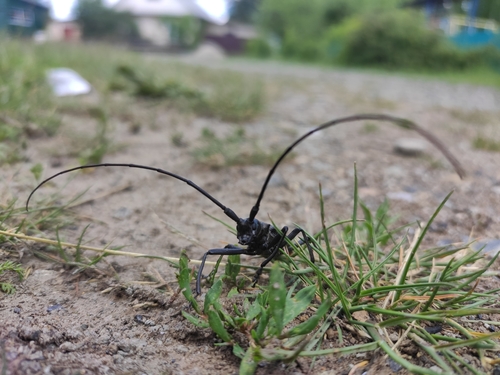
Rhagium mordax, the black-spotted longhorn beetle, is a species of long-horned beetle. This beetle is found throughout Europe and to Kazakhstan and Russia. Larvae develop in silver fir, hazel, European weeping birch, European beech, and the European chestnut. Ischnoceros rusticus is an ichneumonid parasitoid wasp that feds on Rhagium mordax larvae.

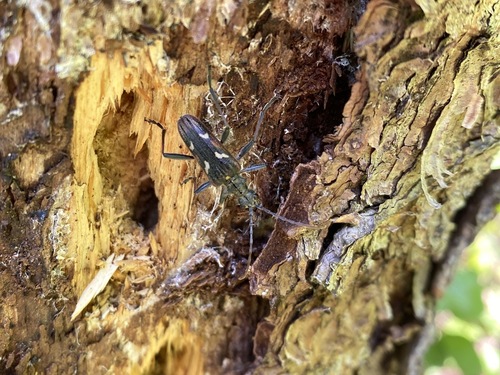
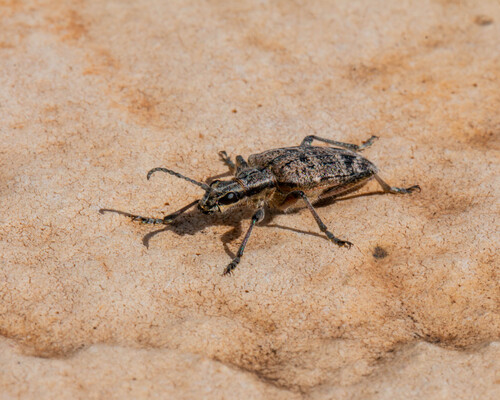
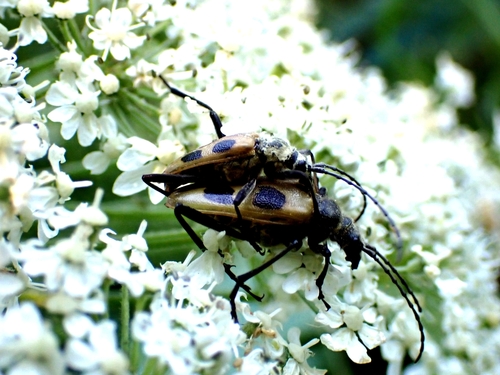
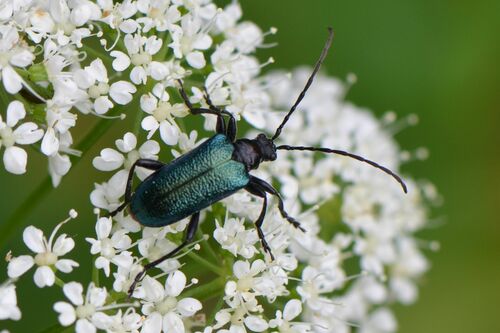
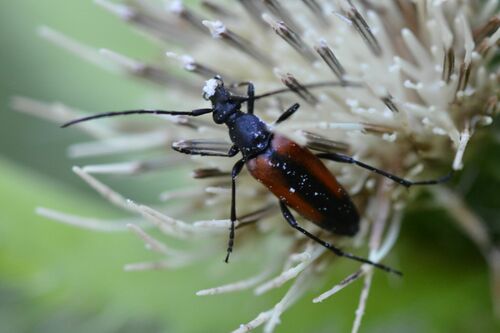
Rhagium mordax grows from 13 to 26 millimetres (0.51 to 1.02 in) long. In colour, they are mixed ochre and black, with one black splotch on each elytron accompanied by two pale lines on either side. The beetles' bodies are covered with small yellow hairs, although one distinguishing feature of the species is two bald spots on its elytra.

Rhagium mordax has a long, narrow head with a distinct neck. The insect's face bears a suture and the temples are elongate with some stiff hairs. The antennae are relatively short and the first segment is wider at its tip and longer.

Rhagium mordax was first named Leptura mordax by Charles De Geer in 1775. There are five formally described varieties: Rhagium mordax var. altajense Plavilstshikov, 1915 Rhagium mordax var. klenkai Heyrovský, 1914 Rhagium mordax... Wikipedia →

Global Distribution

Parks Where Found

# Park Country Daily sighting probability
1 Triglav National Park 🇸🇮 Slovenia
~20%
2 Białowieża National Park 🇵🇱 Poland
~10%
3 Cairngorms National Park 🇬🇧 United Kingdom
~10%
4 Snowdonia National Park 🇬🇧 United Kingdom
~10%
5 Bavarian Forest National Park 🇩🇪 Germany
~10%

Cities Where Found

# City Country Daily sighting probability
1 Kyiv 🇺🇦 Ukraine
<5%
2 Essen 🇩🇪 Germany
<5%
3 Brussels 🇧🇪 Belgium
<5%
4 Moscow 🇷🇺 Russia
<5%
5 Helsinki 🇫🇮 Finland
<5%
6 Vienna 🇦🇹 Austria
<5%
7 London 🇬🇧 United Kingdom
<5%

Before you go

What are the chances of seeing a Blackspotted Longhorn Beetle in Triglav National Park?

Possible

About 20% of wildlife watchers report a Blackspotted Longhorn Beetle sighting in Triglav National Park on a given day, based on 19 verified sightings from GBIF citizen-science data from 2019 to 2026. It is the 89th most-seen of the 260 insects we can rate there. Over three days the chance rises to about 40%, and over a week to about 70%, if each day is a fresh chance.

When is the best time to see a Blackspotted Longhorn Beetle in Triglav National Park?

May

In that month about 40% of wildlife watchers report a Blackspotted Longhorn Beetle in Triglav National Park on a given day, against under 5% in August to March, the lowest months.

What time of day is best to see a Blackspotted Longhorn Beetle?

Between 1 and 4 pm

Across all the parks we cover, that three-hour window holds the most Blackspotted Longhorn Beetle sightings with a recorded time, and about 9 in 10 of them come between 6 am and 6 pm: it is a daytime animal.

Is Triglav National Park the best place to see a Blackspotted Longhorn Beetle?

Yes

Of the 5 parks where we can rate Blackspotted Longhorn Beetle sightings, Triglav National Park has the highest daily chance: about 20%. Next come Białowieża National Park (Poland, about 10%) and Cairngorms National Park (United Kingdom, about 10%).

Which relatives of the Blackspotted Longhorn Beetle live in Triglav National Park?

Same genus: Rhagium

The closest relatives of the Blackspotted Longhorn Beetle that you can see in Triglav National Park (genus Rhagium) are Two-Banded Longhorn Beetle (about 10%) and Ribbed Pine Borer (about 10%), with each one's daily chance of a sighting.

Where does the Blackspotted Longhorn Beetle sighting chance come from?

GBIF citizen-science records

It is estimated from how often the Blackspotted Longhorn Beetle is recorded against all the insects logged in Triglav National Park (19 verified sightings from 2019 to 2026), calibrated against known sighting rates. Figures are rounded to the nearest 10% because citizen-science data supports honest approximations, not decimals, and months with records from fewer than five people show "—". How it works.

← Back to Triglav National Park