Nose-horned Viper

Nose-horned Viper

Vipera ammodytes

Silhouette: Alex Slavenko · PhyloPic

LCLeast ConcernNTVUENCR
Daily sighting probability ~30% · Possible
at Triglav National Park

In 3 days ~70% in a week ~90%

61 Verified sightings at Triglav National Park From 2019 to 2026
72 In all 2 parks
November Best month
☀️ Diurnal When it's spotted

About the Nose-horned Viper

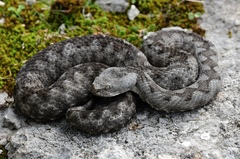
Vipera ammodytes, commonly known as horned viper, long-nosed viper, nose-horned viper, and sand viper, is a species of viper found in northern Italy, the Balkans, and parts of Asia Minor. Like all other vipers, it is venomous. It is reputed to be the most dangerous of the European vipers due to its large size, long fangs (up to 13 mm) and high venom toxicity. The specific name, ammodytes, is derived from the Greek words ammos, meaning "sand", and dutes, meaning "burrower" or "diver", despite its preference for rocky habitats. Five subspecies are currently recognized, including the nominate subspecies described here.

V. ammodytes grows to an average total length (snout-tail) of 85 cm (33.5 in), although individuals usually measure less than 75 cm (29.5 in). Maximum length also depends on locality, with northern forms distinctly larger than southern ones. In one field study on Golem Grad island (in North Macedonia), for example, females averaged 35 cm., and males at 37 cm.; the largest captured during the study was a male, at 66 cm. long. This indicates some degree of regional or insular dwarfism.

The head is covered in small, irregular scales, that are either smooth... Wikipedia →

Global Distribution

Parks Where Found

# Park Country Daily sighting probability
1 Plitvice Lakes National Park 🇭🇷 Croatia
~40%
2 Triglav National Park 🇸🇮 Slovenia
~30%

Zoos & Centres Where Found

# Zoo / Centre Country
1 Chomutov Zoo 🇨🇿 Czechia In captivity
2 Sedgwick County Zoo 🇺🇸 United States In captivity
3 Los Angeles Zoo 🇺🇸 United States In captivity
4 Fort Worth Zoo 🇺🇸 United States In captivity
5 Wilhelma 🇩🇪 Germany In captivity
6 Parken Zoo 🇸🇪 Sweden In captivity
7 Ljubljana Zoo 🇸🇮 Slovenia In captivity
8 San Antonio Zoo 🇺🇸 United States In captivity
9 Faunia 🇪🇸 Spain In captivity
10 Riverbanks Zoo 🇺🇸 United States In captivity
11 Zagreb Zoo 🇭🇷 Croatia In captivity
12 Zoo di Pistoia 🇮🇹 Italy In captivity
13 Cherkasy Zoo 🇺🇦 Ukraine In captivity
14 Alpenzoo Innsbruck 🇦🇹 Austria In captivity
15 Freiland-Aquarium und -Terrarium Stein 🇩🇪 Germany In captivity
16 Public Aquarium and Tropicarium 🇷🇸 Serbia In captivity
17 Public marine aquarium of Trieste 🇮🇹 Italy In captivity

Before you go

What are the chances of seeing a Nose-horned Viper in Triglav National Park?

Possible

About 30% of wildlife watchers report a Nose-horned Viper sighting in Triglav National Park on a given day, based on 61 verified sightings from GBIF citizen-science data from 2019 to 2026. It is the 9th most-seen of the 11 reptiles we can rate there. Over three days the chance rises to about 70%, and over a week to about 90%, if each day is a fresh chance.

When is the best time to see a Nose-horned Viper in Triglav National Park?

April and November

In those months about 50% of wildlife watchers report a Nose-horned Viper in Triglav National Park on a given day, against under 5% in March, the lowest month.

What time of day is best to see a Nose-horned Viper?

Between 10 am and 1 pm

Across all the parks we cover, that three-hour window holds the most Nose-horned Viper sightings with a recorded time, and about 9 in 10 of them come between 6 am and 6 pm: it is a daytime animal.

Is Triglav National Park the best place to see a Nose-horned Viper?

2nd of 2

Of the 2 parks where we can rate Nose-horned Viper sightings, Triglav National Park ranks 2nd at about 30%. The best odds are in Plitvice Lakes National Park (Croatia, about 40%).

Where does the Nose-horned Viper sighting chance come from?

GBIF citizen-science records

It is estimated from how often the Nose-horned Viper is recorded against all the reptiles logged in Triglav National Park (61 verified sightings from 2019 to 2026), calibrated against known sighting rates. Figures are rounded to the nearest 10% because citizen-science data supports honest approximations, not decimals, and months with records from fewer than five people show "—". How it works.

← Back to Triglav National Park