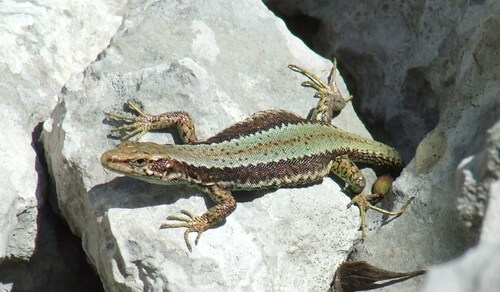
Slow Worm

Slow Worm

Anguis fragilis

Silhouette: Steven Traver · PhyloPic

LCLeast ConcernNTVUENCR
Daily sighting probability ~50% · Likely
at Triglav National Park

In 3 days ~90% in a week >90%

64 Verified sightings at Triglav National Park From 2019 to 2026
805 In all 14 parks
May Best month
☀️ Diurnal When it's spotted

About the Slow Worm

The common slow worm (Anguis fragilis) is a non-venomous species of legless lizard native to Europe. It is also called a deaf adder, blindworm, or regionally, a long-cripple, steelworm, and hazelworm. Despite its name, the common slow worm is neither a worm nor a snake.

Common slow worms are semifossorial (burrowing) lizards that spend much of their time hiding underneath objects. The skin of slow worms is smooth, with scales that do not overlap. The "blind" in blindworm refers to the lizard's small eyes, similar to a blindsnake (although the slow worm's eyes are functional). The common slow worm, i.e. the species Anguis fragilis, is often called simply "slow worm", though all species of the species complex comprising the genus Anguis are also called "slow worms".

The name "slow worm" is only contaminated by the word "slow". In Middle English, it was written "slowurm", from Old English "slāwyrm", where slā- means 'earthworm' or 'slow worm' and wyrm means "serpent, reptile". It is related to the Norwegian slo or Swedish ormslå, of same meaning.

However, recent... Wikipedia →

Sounds

Recording0:53

Poland · 2026

© Liudmyla · iNaturalist · CC BY-NC 4.0

Recording0:33

Austria · 2025

© kaulquappe · iNaturalist · CC BY-NC 4.0

Recording0:05

Spain · 2026

© NPound · iNaturalist · CC BY-NC 4.0

Global Distribution

Parks Where Found

# Park Country Daily sighting probability
1 Snowdonia National Park 🇬🇧 United Kingdom
~60%
2 Triglav National Park 🇸🇮 Slovenia
~50%
3 Plitvice Lakes National Park 🇭🇷 Croatia
~50%
4 Bavarian Forest National Park 🇩🇪 Germany
~40%
5 Cévennes National Park 🇫🇷 France
~30%
6 Picos de Europa National Park 🇪🇸 Spain
~30%
7 Pyrénées National Park 🇫🇷 France
~30%
8 Biebrza National Park 🇵🇱 Poland
~30%
9 Cairngorms National Park 🇬🇧 United Kingdom
~30%
10 Aigüestortes National Park 🇪🇸 Spain
~30%
11 Fertő-Hanság National Park 🇭🇺 Hungary
~20%
12 Hohe Tauern National Park 🇦🇹 Austria
~20%
13 Ecrins National Park 🇫🇷 France
~20%
14 Wadden Sea National Park 🇩🇪 Germany
~10%

Cities Where Found

# City Country Daily sighting probability
1 Prague 🇨🇿 Czechia
~30%
2 Vienna 🇦🇹 Austria
~20%
3 Stockholm 🇸🇪 Sweden
~20%
4 London 🇬🇧 United Kingdom
~20%
5 Paris 🇫🇷 France
~10%
6 Porto 🇵🇹 Portugal
~10%
7 Essen 🇩🇪 Germany
~10%
8 Munich 🇩🇪 Germany
~10%
9 Cologne 🇩🇪 Germany
~10%
10 Berlin 🇩🇪 Germany
~10%

Zoos & Centres Where Found

# Zoo / Centre Country
1 AQUA Akvarium & Dyrepark 🇩🇰 Denmark In captivity

Before you go

What are the chances of seeing a Slow Worm in Triglav National Park?

Likely

About 50% of wildlife watchers report a Slow Worm sighting in Triglav National Park on a given day, based on 64 verified sightings from GBIF citizen-science data from 2019 to 2026. It is the 2nd most-seen of the 11 reptiles we can rate there. Over three days the chance rises to about 90%, and over a week to over 90%, if each day is a fresh chance.

When is the best time to see a Slow Worm in Triglav National Park?

May

In that month about 70% of wildlife watchers report a Slow Worm in Triglav National Park on a given day, against under 5% in March, the lowest month.

What time of day is best to see a Slow Worm?

Between 1 and 4 pm

Across all the parks we cover, that three-hour window holds the most Slow Worm sightings with a recorded time, and about 9 in 10 of them come between 6 am and 6 pm: it is a daytime animal.

Is Triglav National Park the best place to see a Slow Worm?

2nd of 14

Of the 14 parks where we can rate Slow Worm sightings, Triglav National Park ranks 2nd at about 50%. The best odds are in Snowdonia National Park (United Kingdom, about 60%). All parks ranked.

Where does the Slow Worm sighting chance come from?

GBIF citizen-science records

It is estimated from how often the Slow Worm is recorded against all the reptiles logged in Triglav National Park (64 verified sightings from 2019 to 2026), calibrated against known sighting rates. Figures are rounded to the nearest 10% because citizen-science data supports honest approximations, not decimals, and months with records from fewer than five people show "—". How it works.

← Back to Triglav National Park