Tessellated Water Snake

Tessellated Water Snake

Natrix tessellata

Silhouette: Danny S. · PhyloPic

LCLeast ConcernNTVUENCR
Daily sighting probability ~40% · Likely
at Triglav National Park

In 3 days ~80% in a week >90%

34 Verified sightings at Triglav National Park From 2019 to 2026
160 In all 2 parks
June Best month
☀️ Diurnal When it's spotted

About the Tessellated Water Snake

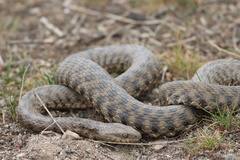
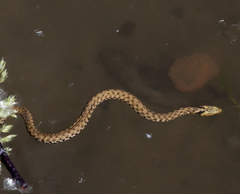
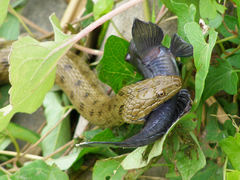
The dice snake (Natrix tessellata) or water snake is a Eurasian nonvenomous snake in the family Colubridae, subfamily Natricinae. Its average length is 1.0–1.3 m (39–51 in). Body color may vary from greyish green to brownish or almost black, with dark spots on the back. The belly is sometimes vividly coloured in yellow or orange, with black spots, very similar to dice, hence the name.

Living mainly near rivers, streams and lakes, it frequently feeds on fish. Sometimes, it feeds also on amphibians such as frogs, toads, and tadpoles. In one instance, a dice snake was even observed trying to feed on an olm (Proteus anguinus) that had been flushed from a cave in Bosnia and Herzegovina following heavy rains. However, the snake was far too small to be able to consume the olm.

While considered nonvenomous, N. tessellata produces a potent antihemorrhagin in its serum. As a defence, it spreads a very bad-smelling secretion from its cloaca. Another defence mechanism is thanatosis, playing dead. During the mating season (March–May), they congregate in large groups. Egg-laying is usually in July, and one clutch consists of 10–30 eggs. The young snakes hatch in early September. Dice... Wikipedia →

Global Distribution

Parks Where Found

# Park Country Daily sighting probability
1 Plitvice Lakes National Park 🇭🇷 Croatia
~90%
2 Triglav National Park 🇸🇮 Slovenia
~40%

Cities Where Found

# City Country Daily sighting probability
1 Antalya 🇹🇷 Turkey
~30%
2 Sofia 🇧🇬 Bulgaria
~20%
3 Bucharest 🇷🇴 Romania
~20%
4 Rostov-on-Don 🇷🇺 Russia
~20%
5 Prague 🇨🇿 Czechia
~10%
6 Budapest 🇭🇺 Hungary
~10%
7 Belgrade 🇷🇸 Serbia
~10%
8 Tel Aviv 🇮🇱 Israel
~10%
9 Almaty 🇰🇿 Kazakhstan
~10%
10 Vienna 🇦🇹 Austria
~10%

Zoos & Centres Where Found

# Zoo / Centre Country
1 Prague Zoo 🇨🇿 Czechia In captivity
2 Wilhelma 🇩🇪 Germany In captivity
3 Augsburg Zoo 🇩🇪 Germany In captivity
4 Tiergarten Straubing 🇩🇪 Germany In captivity
5 Zagreb Zoo 🇭🇷 Croatia In captivity
6 Alpenzoo Innsbruck 🇦🇹 Austria In captivity
7 Tierpark Herborn 🇩🇪 Germany In captivity
8 Rákosův pavilon 🇨🇿 Czechia In captivity
9 Velemlokárium 🇨🇿 Czechia In captivity

Before you go

What are the chances of seeing a Tessellated Water Snake in Triglav National Park?

Likely

About 40% of wildlife watchers report a Tessellated Water Snake sighting in Triglav National Park on a given day, based on 34 verified sightings from GBIF citizen-science data from 2019 to 2026. It is the 6th most-seen of the 11 reptiles we can rate there. Over three days the chance rises to about 80%, and over a week to over 90%, if each day is a fresh chance.

When is the best time to see a Tessellated Water Snake in Triglav National Park?

June

In that month about 50% of wildlife watchers report a Tessellated Water Snake in Triglav National Park on a given day, against under 5% in March, the lowest month.

What time of day is best to see a Tessellated Water Snake?

Between 2 and 5 pm

Across all the parks we cover, that three-hour window holds the most Tessellated Water Snake sightings with a recorded time, and about 8 in 10 of them come between 6 am and 6 pm: it is a daytime animal.

Is Triglav National Park the best place to see a Tessellated Water Snake?

2nd of 2

Of the 2 parks where we can rate Tessellated Water Snake sightings, Triglav National Park ranks 2nd at about 40%. The best odds are in Plitvice Lakes National Park (Croatia, about 90%).

Where does the Tessellated Water Snake sighting chance come from?

GBIF citizen-science records

It is estimated from how often the Tessellated Water Snake is recorded against all the reptiles logged in Triglav National Park (34 verified sightings from 2019 to 2026), calibrated against known sighting rates. Figures are rounded to the nearest 10% because citizen-science data supports honest approximations, not decimals, and months with records from fewer than five people show "—". How it works.

← Back to Triglav National Park