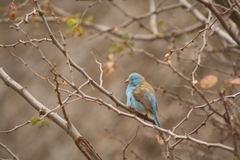

Blue-capped Cordonbleu

Blue-capped Cordonbleu

Uraeginthus cyanocephalus

Silhouette: Sheatherius · PhyloPic

LCLeast ConcernNTVUENCR
Daily sighting probability ~10% · With luck
at Tsavo East National Park

In 3 days ~30% in a week ~60%

85 Verified sightings at Tsavo East National Park From 2019 to 2026
2,739 In all 10 parks
July Best month
☀️ Diurnal When it's spotted

About the Blue-capped Cordonbleu

The blue-capped cordon-bleu or blue-capped cordonbleu (Uraeginthus cyanocephalus) is native to Ethiopia, Kenya, Somalia, South Sudan, and Tanzania in East Africa. This small finch does fairly well in captivity given adequate conditions; however, breeding this finch is said to be quite difficult.

The blue-capped cordon-bleu inhabits the subtropical or tropical (lowland) dry grasslands, shrublands, and deserts of subsaharan Africa. It has an estimated global extent of occurrence of 390,000 km2. The finch is an omnivorous passerine eating seeds and small insects. Most of this species do not exceed 7.5 cm (3.0 in) in length and are quiet relative to other finches.

Males have blue on the tops of their heads and tend to be more vivid in colour. On female blue-caps the light brown coloration on the wings extends to the nape of the neck and over the top the head. Pairs dance holding twigs in their beaks, and film using a high-speed camera shows partners tapping their feet between twenty-five and fifty times a second, making a buzzing sound. Wikipedia →

Sounds

Call0:10

Tanzania · 2019

© Peter Boesman · XC510454 · CC BY-NC-ND 4.0

Song1:15

Tanzania · 2011

© Martin St-Michel · XC93575 · CC BY-NC-ND 2.5

Call1:15

Tanzania · 2017

© Frank Lambert · XC429977 · CC BY-NC-ND 4.0

Global Distribution

Parks Where Found

# Park Country Daily sighting probability
1 Tarangire National Park 🇹🇿 Tanzania
~30%
2 Serengeti National Park 🇹🇿 Tanzania
~30%
3 Ngorongoro Conservation Area 🇹🇿 Tanzania
~20%
4 Mkomazi National Park 🇹🇿 Tanzania
~20%
5 Tsavo West National Park 🇰🇪 Kenya
~20%
6 Lake Manyara National Park 🇹🇿 Tanzania
~20%
7 Samburu National Reserve 🇰🇪 Kenya
~10%
8 Tsavo East National Park 🇰🇪 Kenya
~10%
9 Ruaha National Park 🇹🇿 Tanzania
~10%
10 Amboseli National Park 🇰🇪 Kenya
~10%

Cities Where Found

# City Country Daily sighting probability
1 Dar es-Salaam 🇹🇿 Tanzania
<5%

Zoos & Centres Where Found

# Zoo / Centre Country
1 Pairi Daiza 🇧🇪 Belgium In captivity
2 Cambridge Butterfly Conservatory 🇨🇦 Canada In captivity

Before you go

What are the chances of seeing a Blue-capped Cordonbleu in Tsavo East National Park?

With luck

About 10% of wildlife watchers report a Blue-capped Cordonbleu sighting in Tsavo East National Park on a given day, based on 85 verified sightings from GBIF citizen-science data from 2019 to 2026. It is the 120th most-seen of the 345 birds we can rate there. Over three days the chance rises to about 30%, and over a week to about 60%, if each day is a fresh chance.

When is the best time to see a Blue-capped Cordonbleu in Tsavo East National Park?

July

In that month about 30% of wildlife watchers report a Blue-capped Cordonbleu in Tsavo East National Park on a given day, against about 10% in April–June and September–February, the lowest months. That is one of Tsavo East National Park's driest months, with about 10 mm of rain against 130 mm in November.

What time of day is best to see a Blue-capped Cordonbleu?

Between noon and 3 pm

Across all the parks we cover, that three-hour window holds the most Blue-capped Cordonbleu sightings with a recorded time, and about 9 in 10 of them come between 6 am and 6 pm: it is a daytime animal.

Is Tsavo East National Park the best place to see a Blue-capped Cordonbleu?

8th of 10

Of the 10 parks where we can rate Blue-capped Cordonbleu sightings, Tsavo East National Park ranks 8th at about 10%. The best odds are in Tarangire National Park (Tanzania, about 30%), Serengeti National Park (Tanzania, about 30%) and Ngorongoro Conservation Area (Tanzania, about 20%).

Where does the Blue-capped Cordonbleu sighting chance come from?

GBIF citizen-science records

It is estimated from how often the Blue-capped Cordonbleu is recorded against all the birds logged in Tsavo East National Park (85 verified sightings from 2019 to 2026), calibrated against known sighting rates. Figures are rounded to the nearest 10% because citizen-science data supports honest approximations, not decimals, and months with records from fewer than five people show "—". How it works.

← Back to Tsavo East National Park