Yellow-fronted Barbet

Yellow-fronted Barbet

Psilopogon flavifrons

Silhouette: Vijay Cavale (photo), John E. McCormack, Michael G. Harvey, Brant C. Faircloth, Nicholas G. Crawford, Travis C. Glenn, Robb T. Brumfield & T. Michael Keesey · PhyloPic

LCLeast ConcernNTVUENCR Endemic
Daily sighting probability <5% · Rare
at Udawalawe National Park

In 3 days ~10% in a week ~20%

13 Verified sightings at Udawalawe National Park From 2019 to 2026
1,579 In all 3 parks
February Best month
🌅 Crepuscular When it's spotted

About the Yellow-fronted Barbet

The yellow-fronted barbet (Psilopogon flavifrons) is an Asian barbet, which is an endemic resident breeder in Sri Lanka, where it inhabits subtropical and tropical moist forests, wetlands, plantations and rural gardens up to an altitude of 2,000 m (6,600 ft).

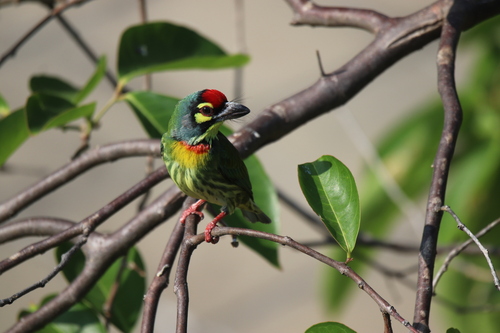
It has green plumage with a yellow crown and blue patches below the eyes, on the throat and the chin. It is 21–22 cm (8.3–8.7 in) long and weighs 57–60 g (2.0–2.1 oz). It feeds on berries, fruits and occasionally insects. It nests in a tree hole, where it lays 2-3 eggs.

The yellow-fronted barbet appears on a 5 rupee Sri Lankan postal stamp. Wikipedia →

Sounds

Duet0:33

Sri Lanka · 2026

© Uku Paal · XC1097249 · CC BY-NC-SA 4.0

Call0:15

Sri Lanka · 2021

© THILANKA EDIRISINGHE · XC634460 · CC BY-NC-SA 4.0

Song1:00

Sri Lanka · 2007

© Jelle Scharringa · XC620157 · CC BY-NC-SA 4.0

Global Distribution

Parks Where Found

# Park Country Daily sighting probability
1 Sinharaja Forest Reserve 🇱🇰 Sri Lanka
~70%
2 Horton Plains National Park 🇱🇰 Sri Lanka
~10%
3 Udawalawe National Park 🇱🇰 Sri Lanka
<5%

Cities Where Found

# City Country Daily sighting probability
1 Colombo [Sri Jayawardenepura Kotte] 🇱🇰 Sri Lanka
<5%

Before you go

What are the chances of seeing a Yellow-fronted Barbet in Udawalawe National Park?

Rare

Under 5% of wildlife watchers report a Yellow-fronted Barbet sighting in Udawalawe National Park on a given day, based on 13 verified sightings from GBIF citizen-science data from 2019 to 2026. It is the 144th most-seen of the 166 birds we can rate there. Over three days the chance rises to about 10%, and over a week to about 20%, if each day is a fresh chance.

When is the best time to see a Yellow-fronted Barbet in Udawalawe National Park?

February

In that month about 10% of wildlife watchers report a Yellow-fronted Barbet in Udawalawe National Park on a given day, against under 5% in March to January, the lowest months.

What time of day is best to see a Yellow-fronted Barbet?

Between 3 and 6 am

Across all the parks we cover, that three-hour window holds the most Yellow-fronted Barbet sightings with a recorded time, and about half of them come between 6 am and 6 pm: it is most active around dawn and dusk.

Is Udawalawe National Park the best place to see a Yellow-fronted Barbet?

3rd of 3

Of the 3 parks where we can rate Yellow-fronted Barbet sightings, Udawalawe National Park ranks 3rd at under 5%. The best odds are in Sinharaja Forest Reserve (Sri Lanka, about 70%) and Horton Plains National Park (Sri Lanka, about 10%).

Which relatives of the Yellow-fronted Barbet live in Udawalawe National Park?

Same genus: Psilopogon

The closest relatives of the Yellow-fronted Barbet that you can see in Udawalawe National Park (genus Psilopogon, Typical Asian Barbets) are Coppersmith Barbet (about 60%) and Brown-headed Barbet (about 60%), with each one's daily chance of a sighting.

Where does the Yellow-fronted Barbet sighting chance come from?

GBIF citizen-science records

It is estimated from how often the Yellow-fronted Barbet is recorded against all the birds logged in Udawalawe National Park (13 verified sightings from 2019 to 2026), calibrated against known sighting rates. Figures are rounded to the nearest 10% because citizen-science data supports honest approximations, not decimals, and months with records from fewer than five people show "—". How it works.

← Back to Udawalawe National Park