Major Mitchell's Cockatoo

Major Mitchell's Cockatoo

Cacatua leadbeateri

Silhouette: Ferran Sayol · PhyloPic

LCLeast ConcernNTVUENCR Endemic
Daily sighting probability ~10% · With luck
at Uluru-Kata Tjuta National Park

In 3 days ~20% in a week ~40%

46 Verified sightings at Uluru-Kata Tjuta National Park From 2019 to 2026
151 In all 2 parks
April Best month
☀️ Diurnal When it's spotted

About the Major Mitchell's Cockatoo

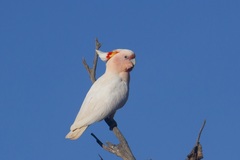
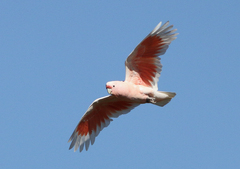
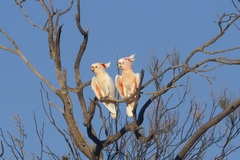
The pink cockatoo (Cacatua leadbeateri), also known as Major Mitchell's cockatoo or Leadbeater's cockatoo, is a medium-sized cockatoo that inhabits arid and semiarid inland areas across Australia, with the exception of the north-east.

Irish naturalist Nicholas Aylward Vigors described the species in 1831 as Plyctolophus leadbeateri. The scientific name commemorates the London naturalist and taxidermist Benjamin Leadbeater, who had given Vigors what would become the type specimen. Edward Lear painted it in his 1832 work Illustrations of the Family of Psittacidae, or Parrots. Citing Lear, William Swainson gave it the name Plyctolophus erythropterus.

The pink cockatoo is more closely related to Cacatua than is the galah. Its lineage diverged around the time of or shortly after the acquisition of the long crest, probably the former, as this crest type is not found in all Cacatua cockatoos, so must have been present in an early or incipient stage at the time of the divergence of the pink cockatoo's ancestors. Like the galah, this species has not lost the ability to deposit diluted pigment dyes in its body plumage, although it does not produce melanin colouration... Wikipedia →

Sounds

Recording0:20

Australia · 2026

© Thomas Mesaglio · iNaturalist · CC BY 4.0

Recording0:22

Australia · 2022

© Sue Tardif · iNaturalist · CC BY-NC 4.0

Recording0:23

Australia · 2025

© scottglobetrots · iNaturalist · CC BY-NC 4.0

Global Distribution

Parks Where Found

# Park Country Daily sighting probability
1 Uluru-Kata Tjuta National Park 🇦🇺 Australia
~10%
2 Hattah-Kulkyne National Park 🇦🇺 Australia
~10%

Cities Where Found

# City Country Daily sighting probability
1 Perth 🇦🇺 Australia
<5%

Zoos & Centres Where Found

# Zoo / Centre Country
1 Natura Artis Magistra 🇳🇱 Netherlands In captivity
2 Le rocher des aigles 🇫🇷 France In captivity
3 Healesville Sanctuary 🇦🇺 Australia In captivity
4 Hobart Zoo and Aquarium 🇦🇺 Australia In captivity
5 Lisbon Zoo 🇵🇹 Portugal In captivity
6 Taronga Zoo 🇦🇺 Australia In captivity
7 Cleland Wildlife Park 🇦🇺 Australia In captivity
8 Currumbin Wildlife Sanctuary 🇦🇺 Australia In captivity
9 Halls Gap Zoo 🇦🇺 Australia In captivity
10 Melbourne Zoo 🇦🇺 Australia In captivity
11 Karlsruhe Zoo 🇩🇪 Germany In captivity
12 Lone Pine Koala Sanctuary 🇦🇺 Australia In captivity
13 Perth Zoo 🇦🇺 Australia In captivity
14 Bird Paradise 🇸🇬 Singapore In captivity
15 Rainforest Wild Asia 🇸🇬 Singapore In captivity
16 Zamość Zoo 🇵🇱 Poland In captivity
17 Hartley’s Crocodile Adventures 🇦🇺 Australia In captivity
18 Moonlit Sanctuary Wildlife Conservation Park 🇦🇺 Australia In captivity
19 Billabong Sanctuary 🇦🇺 Australia In captivity
20 Loro Parque 🇪🇸 Spain In captivity
21 Tamworth Marsupial Park & Adventure Playground 🇦🇺 Australia In captivity
22 Rancho Texas Park 🇪🇸 Spain In captivity
23 Santillana Zoo 🇪🇸 Spain In captivity
24 Rockhampton Zoo 🇦🇺 Australia In captivity
25 Wildlife Trail 🇦🇺 Australia In captivity
26 Sunken Gardens 🇺🇸 United States In captivity
27 Flying High Bird Sanctuary 🇦🇺 Australia In captivity
28 Cairns Aquarium 🇦🇺 Australia In captivity
29 Fauna Reserve 🇦🇺 Australia In captivity
30 Birdworld Kuranda 🇦🇺 Australia In captivity
31 Kuranda Koala Gardens 🇦🇺 Australia In captivity
32 The Green Planet 🇦🇪 United Arab Emirates In captivity
33 Cairns Zoom and Wildlife Dome 🇦🇺 Australia In captivity
34 Campbelltown Forest of Wild Birds 🇯🇵 Japan In captivity
35 Caversham Wildlife Park 🇦🇺 Australia In captivity
36 Ranger Red’s Zoo & Conservation Park 🇦🇺 Australia In captivity
37 Wildlife Habitat Port Douglas 🇦🇺 Australia In captivity
38 Wirrimbirra Flora & Fauna Sanctuary 🇦🇺 Australia In captivity
39 Zoodoo Wildlife Park 🇦🇺 Australia In captivity

Before you go

What are the chances of seeing a Major Mitchell's Cockatoo in Uluru-Kata Tjuta National Park?

With luck

About 10% of wildlife watchers report a Major Mitchell's Cockatoo sighting in Uluru-Kata Tjuta National Park on a given day, based on 46 verified sightings from GBIF citizen-science data from 2019 to 2026. It is the 50th most-seen of the 84 birds we can rate there. Over three days the chance rises to about 20%, and over a week to about 40%, if each day is a fresh chance.

When is the best time to see a Major Mitchell's Cockatoo in Uluru-Kata Tjuta National Park?

February and April

In those months about 20% of wildlife watchers report a Major Mitchell's Cockatoo in Uluru-Kata Tjuta National Park on a given day, against under 5% in March, June, August and October–November, the lowest months. Those are among Uluru-Kata Tjuta National Park's driest months, with about 10 mm of rain a month against 65 mm in January.

What time of day is best to see a Major Mitchell's Cockatoo?

Between 8 and 11 am

Across all the parks we cover, that three-hour window holds the most Major Mitchell's Cockatoo sightings with a recorded time, and about 9 in 10 of them come between 6 am and 6 pm: it is a daytime animal.

Is Uluru-Kata Tjuta National Park the best place to see a Major Mitchell's Cockatoo?

Yes

Of the 2 parks where we can rate Major Mitchell's Cockatoo sightings, Uluru-Kata Tjuta National Park has the highest daily chance: about 10%. Next come Hattah-Kulkyne National Park (Australia, about 10%).

Where does the Major Mitchell's Cockatoo sighting chance come from?

GBIF citizen-science records

It is estimated from how often the Major Mitchell's Cockatoo is recorded against all the birds logged in Uluru-Kata Tjuta National Park (46 verified sightings from 2019 to 2026), calibrated against known sighting rates. Figures are rounded to the nearest 10% because citizen-science data supports honest approximations, not decimals, and months with records from fewer than five people show "—". How it works.

← Back to Uluru-Kata Tjuta National Park