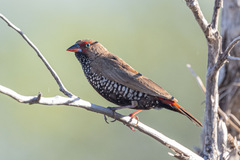
Painted Firetail

Painted Firetail

Emblema pictum

Silhouette: Traci DuBose · PhyloPic

LCLeast ConcernNTVUENCR Endemic
Daily sighting probability <5% · Rare
at Uluru-Kata Tjuta National Park

In 3 days ~10%

6 Verified sightings at Uluru-Kata Tjuta National Park From 2019 to 2026
6 In 1 park
January Best month
☀️ Diurnal When it's spotted

About the Painted Firetail

The painted finch (Emblema pictum) is a common species of estrildid finch found in Australia. The painted finch acquired its name due to the red and white spotted and mottled underparts of both males and females. The binomial comes from emblema meaning 'mosaic or inlaid work'; and pictum derives from the Latin word pictus, meaning 'painted' (from pingere, 'to paint'). Other names include Emblema finch, mountain finch, painted firetail and Emblema. The painted finch is a popular bird to be kept in captivity and in backyard aviaries.

The painted finch is within the genus Emblema which early studies placed four species inside of. More recent research has since determined that this genus did not form a natural assemblage and three of the four species were segregated into the genus Stagonopleura. The species include S. bella (Beautiful firetail), S. oculata (Red-eared firetail) and S. guttata (Diamond firetail). This species, Emblema pictum, is currently the only one allied to the genus.

The painted finch belongs to the family Estrildidae which consists of small passerine birds that occur naturally in the old world including Africa, southern Asia and Australasia. There are... Wikipedia →

Sounds

Call0:21

Australia · 2017

© Christopher Watson · XC641817 · CC BY-NC-SA 4.0

Call0:42

Australia · 2012

© Nigel Jackett · XC165127 · CC BY-NC-SA 3.0

Call0:53

Australia · 2014

© Mark Carter · XC492735 · CC BY-NC-SA 4.0

Global Distribution

Parks Where Found

# Park Country Daily sighting probability
1 Uluru-Kata Tjuta National Park 🇦🇺 Australia
<5%

More parks will be added in future updates.

Zoos & Centres Where Found

# Zoo / Centre Country
1 Alice Springs Desert Park 🇦🇺 Australia In captivity
2 Yaroslavl Zoo 🇷🇺 Russia In captivity
3 Taronga Zoo 🇦🇺 Australia In captivity
4 Featherdale Sydney Wildlife Park 🇦🇺 Australia In captivity

Before you go

What are the chances of seeing a Painted Firetail in Uluru-Kata Tjuta National Park?

Rare

Under 5% of wildlife watchers report a Painted Firetail sighting in Uluru-Kata Tjuta National Park on a given day, based on 6 verified sightings from GBIF citizen-science data from 2019 to 2026. It is the 80th most-seen of the 84 birds we can rate there. Over three days the chance rises to about 10%, if each day is a fresh chance.

When is the best time to see a Painted Firetail in Uluru-Kata Tjuta National Park?

December and January

In those months about 10% of wildlife watchers report a Painted Firetail in Uluru-Kata Tjuta National Park on a given day, against under 5% in February to November, the lowest months. Those are among Uluru-Kata Tjuta National Park's wettest months, with about 50 mm of rain a month against almost none in July.

What time of day is best to see a Painted Firetail?

Between 9 am and noon

Across all the parks we cover, that three-hour window holds the most Painted Firetail sightings with a recorded time, and about 9 in 10 of them come between 6 am and 6 pm: it is a daytime animal.

Where else can you see a Painted Firetail?

Only Uluru-Kata Tjuta National Park, in our data

Uluru-Kata Tjuta National Park is the only park on Wallace's Line with enough records to rate Painted Firetail sightings: under 5% of wildlife watchers there report one on a given day.

Where does the Painted Firetail sighting chance come from?

GBIF citizen-science records

It is estimated from how often the Painted Firetail is recorded against all the birds logged in Uluru-Kata Tjuta National Park (6 verified sightings from 2019 to 2026), calibrated against known sighting rates. Figures are rounded to the nearest 10% because citizen-science data supports honest approximations, not decimals, and months with records from fewer than five people show "—". How it works.

← Back to Uluru-Kata Tjuta National Park