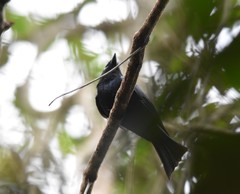
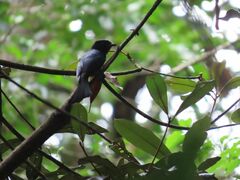
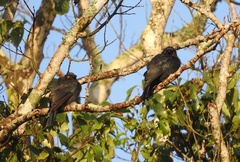
Common Square-tailed Drongo

Common Square-tailed Drongo

Dicrurus ludwigii

Silhouette: Ferran Sayol · PhyloPic

LCLeast ConcernNTVUENCR
Daily sighting probability ~30% · Possible
at uMkhuze Game Reserve

In 3 days ~60% in a week ~90%

121 Verified sightings at uMkhuze Game Reserve From 2019 to 2026
1,244 In all 8 parks
May Best month
☀️ Diurnal When it's spotted

About the Common Square-tailed Drongo

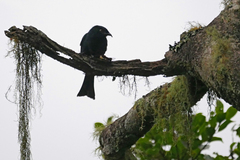
The square-tailed drongo (Dicrurus ludwigii), formerly the common square-tailed drongo, is a passerine bird in the family Dicruridae. It is a common resident breeder in parts of southern Africa. These insectivorous birds are usually found in forests or dense bush. They are aggressive and fearless birds, given their small size, at 19 cm (7.5 in), and will attack much larger species if their nest or young are threatened. The male is mainly glossy black, although the wings are duller. The female is similar but less glossy. The bill is black and heavy, and the eye is red. This species is similar to the fork-tailed drongo, but is smaller, and the shorter tail lacks the deep fork which gives the latter species its name. The fork-tailed drongo is also typically found in more open habitat. The common square-tailed drongo has short legs and sits very upright whilst perched prominently, like a shrike. It flycatches or take prey from the ground. The call is a harsh cherit-cherit. Two to three eggs are laid in a cup nest in a fork high in a tree.

The square-tailed drongo was described by the Scottish zoologist Andrew Smith in 1834 from birds observed around Port Natal (now Durban... Wikipedia →

Sounds

Song0:39

Tanzania · 2026

Kileo Jumah · XC1148965 · CC0

Call1:11

Zambia · 2026

© Magnus Wadstein · XC1102304 · CC BY-NC-SA 4.0

Duet0:25

South Africa · 2024

© Daan van der Hoeven · XC934213 · CC BY-NC-SA 4.0

Global Distribution

Parks Where Found

# Park Country Daily sighting probability
1 iSimangaliso Wetland Park 🇿🇦 South Africa
~50%
2 uMkhuze Game Reserve 🇿🇦 South Africa
~30%
3 Hluhluwe-Imfolozi Park 🇿🇦 South Africa
~20%
4 Gorongosa National Park 🇲🇿 Mozambique
~20%
5 Liwonde National Park 🇲🇼 Malawi
~10%
6 Gonarezhou National Park 🇿🇼 Zimbabwe
<5%
7 Mikumi National Park 🇹🇿 Tanzania
<5%
8 Kruger National Park 🇿🇦 South Africa
<5%

Cities Where Found

# City Country Daily sighting probability
1 Durban 🇿🇦 South Africa
~10%

Before you go

What are the chances of seeing a Common Square-tailed Drongo in uMkhuze Game Reserve?

Possible

About 30% of wildlife watchers report a Common Square-tailed Drongo sighting in uMkhuze Game Reserve on a given day, based on 121 verified sightings from GBIF citizen-science data from 2019 to 2026. It is the 96th most-seen of the 283 birds we can rate there. Over three days the chance rises to about 60%, and over a week to about 90%, if each day is a fresh chance.

When is the best time to see a Common Square-tailed Drongo in uMkhuze Game Reserve?

May

In that month about 40% of wildlife watchers report a Common Square-tailed Drongo in uMkhuze Game Reserve on a given day, against about 20% in February–March, June–July, September and November–December, the lowest months.

What time of day is best to see a Common Square-tailed Drongo?

Between 10 am and 1 pm

Across all the parks we cover, that three-hour window holds the most Common Square-tailed Drongo sightings with a recorded time, and about 9 in 10 of them come between 6 am and 6 pm: it is a daytime animal.

Is uMkhuze Game Reserve the best place to see a Common Square-tailed Drongo?

2nd of 8

Of the 8 parks where we can rate Common Square-tailed Drongo sightings, uMkhuze Game Reserve ranks 2nd at about 30%. The best odds are in iSimangaliso Wetland Park (South Africa, about 50%). All parks ranked.

Where does the Common Square-tailed Drongo sighting chance come from?

GBIF citizen-science records

It is estimated from how often the Common Square-tailed Drongo is recorded against all the birds logged in uMkhuze Game Reserve (121 verified sightings from 2019 to 2026), calibrated against known sighting rates. Figures are rounded to the nearest 10% because citizen-science data supports honest approximations, not decimals, and months with records from fewer than five people show "—". How it works.

← Back to uMkhuze Game Reserve