Bumble Bee Hover Fly

Bumble Bee Hover Fly

Volucella bombylans

Daily sighting probability ~10% · With luck
at Vanoise National Park

In 3 days ~30% in a week ~60%

8 Verified sightings at Vanoise National Park From 2019 to 2026
114 In all 10 parks
June Best month
☀️ Diurnal When it's spotted

About the Bumble Bee Hover Fly

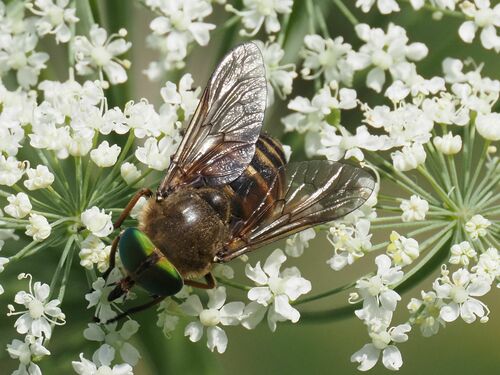
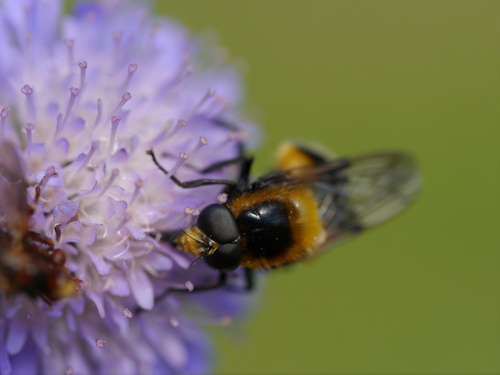
Volucella bombylans is a large species of hoverfly belonging to the family Syrphidae. This species is present in most of Europe, in the East Palearctic realm, in the Near East and in the Nearctic realm. These hoverflies can be found in forest edges and clearings, woodland margins, hedgerows, wet meadows, spruce forest edge and urban wasteland or gardens, usually sunning on leaves.

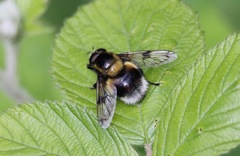
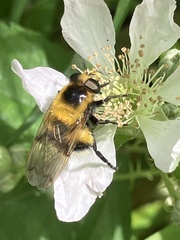
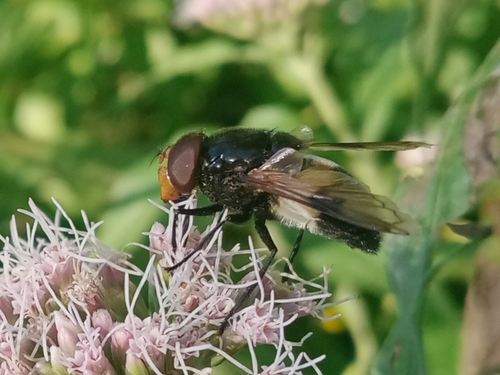
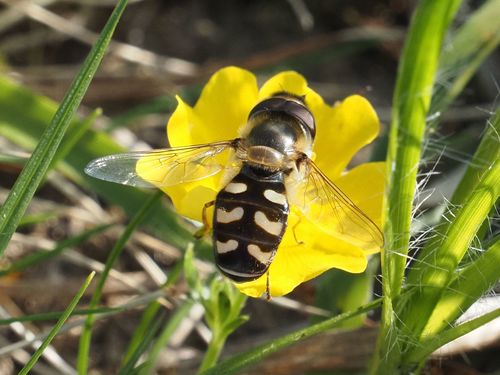
Volucella bombylans is larger than most hoverflies, reaching a body length of 11 to 17 mm. and a wingspan length of 8–14 mm. They look something like a bumblebee with a furry black, yellow and/or white body, but they are given away by their heads, plumed antennae, large eyes and the particular wing venation, which make them quite easy to identify as a true fly, like a blowfly.

The mesonotum bears black or yellow hairs on the sides, while the scutellum is brownish or yellowish. The wings are milky white with a dark cross-bands in the anterior half and a diffuse dark spot at the wing tip. The abdomen is yellow at the base and black in the middle, with long, dense hairs at the end. The legs are rather short and black.

This species occurs in several forms, each... Wikipedia →
Global Distribution

Parks Where Found

# Park Country Daily sighting probability
1 Hohe Tauern National Park 🇦🇹 Austria
~20%
2 Mercantour National Park 🇫🇷 France
~10%
3 Vanoise National Park 🇫🇷 France
~10%
4 Triglav National Park 🇸🇮 Slovenia
~10%
5 Aigüestortes National Park 🇪🇸 Spain
~10%
6 Tatra National Park 🇸🇰 Slovakia
~10%
7 Cairngorms National Park 🇬🇧 United Kingdom
~10%
8 Ecrins National Park 🇫🇷 France
~10%
9 Bavarian Forest National Park 🇩🇪 Germany
~10%
10 Pyrénées National Park 🇫🇷 France
~10%

Cities Where Found

# City Country Daily sighting probability
1 Birmingham 🇬🇧 United Kingdom
~10%
2 Manchester 🇬🇧 United Kingdom
~10%
3 London 🇬🇧 United Kingdom
~10%
4 Leeds 🇬🇧 United Kingdom
~10%
5 Liverpool 🇬🇧 United Kingdom
~10%
6 Rotterdam [The Hague] 🇳🇱 Netherlands
<5%
7 Copenhagen 🇩🇰 Denmark
<5%

Before you go

What are the chances of seeing a Bumble Bee Hover Fly in Vanoise National Park?

With luck

About 10% of wildlife watchers report a Bumble Bee Hover Fly sighting in Vanoise National Park on a given day, based on 8 verified sightings from GBIF citizen-science data from 2019 to 2026. It is the 168th most-seen of the 308 insects we can rate there. Over three days the chance rises to about 30%, and over a week to about 60%, if each day is a fresh chance.

When is the best time to see a Bumble Bee Hover Fly in Vanoise National Park?

June

In that month about 30% of wildlife watchers report a Bumble Bee Hover Fly in Vanoise National Park on a given day, against under 5% in August to May, the lowest months.

What time of day is best to see a Bumble Bee Hover Fly?

Between 11 am and 2 pm

Across all the parks we cover, that three-hour window holds the most Bumble Bee Hover Fly sightings with a recorded time, and about 9 in 10 of them come between 6 am and 6 pm: it is a daytime animal.

Is Vanoise National Park the best place to see a Bumble Bee Hover Fly?

3rd of 10

Of the 10 parks where we can rate Bumble Bee Hover Fly sightings, Vanoise National Park ranks 3rd at about 10%. The best odds are in Hohe Tauern National Park (Austria, about 20%) and Mercantour National Park (France, about 10%).

Where does the Bumble Bee Hover Fly sighting chance come from?

GBIF citizen-science records

It is estimated from how often the Bumble Bee Hover Fly is recorded against all the insects logged in Vanoise National Park (8 verified sightings from 2019 to 2026), calibrated against known sighting rates. Figures are rounded to the nearest 10% because citizen-science data supports honest approximations, not decimals, and months with records from fewer than five people show "—". How it works.

← Back to Vanoise National Park