Italian Sparrow

Italian Sparrow

Passer italiae

Silhouette: Andrew Butko (modified) · PhyloPic

LCNTVUVulnerableENCR
Daily sighting probability ~10% · With luck
at Vanoise National Park

In 3 days ~20% in a week ~40%

22 Verified sightings at Vanoise National Park From 2019 to 2026
48 In all 3 parks
June Best month
☀️ Diurnal When it's spotted

About the Italian Sparrow

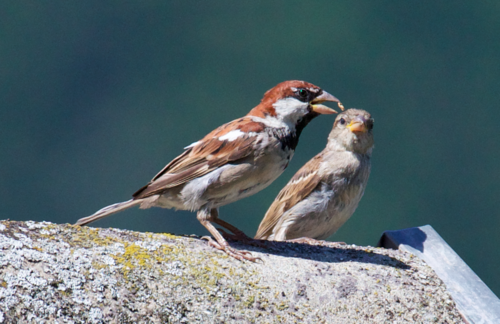
The Italian sparrow (Passer italiae), also known as the cisalpine sparrow, is a passerine bird of the sparrow family Passeridae, found in Italy and other parts of the Mediterranean region. In appearance, it is intermediate between the house sparrow, and the Spanish sparrow, a species of the Mediterranean and Central Asia closely related to the house sparrow. The Italian sparrow occurs in northern Italy and neighbouring regions, with intermediates with the house sparrow in a very narrow contact zone in the Alps, a slow gradation in appearance from the Italian to Spanish sparrows across central and southern Italy, and more birds of intermediate appearance in Malta, Crete, and other parts of the Mediterranean.

There has been much debate on the origins and taxonomic status of the Italian sparrow, especially given its possible hybrid origin. Some have classified it as a subspecies of the house sparrow, a subspecies of the Spanish sparrow, or as a separate species, a treatment followed if only for convenience by authorities such as the Handbook of the Birds of the World. A DNA analysis by Glenn-Peter Sætre and colleagues published in 2011 indicated an origin of the Italian sparrow through hybridisation between the Spanish and house sparrows, and Sætre and colleagues argued that given its origins and the limited extent of hybridisation, the treatment as a distinct species was supported. The Italian sparrow is unofficially considered the national bird of Italy. Wikipedia →
Sounds

Roosting calls0:25

Italy · 2026

© Gianluca Congi · XC1177731 · CC BY-NC-SA 4.0

Begging call1:22

Italy · 2026

© Luca Baghino · XC1144986 · CC BY-NC-SA 4.0

Call0:14

Italy · 2026

© Filippo Ceccolini · XC1104563 · CC BY-NC-SA 4.0

Global Distribution

Parks Where Found

# Park Country Daily sighting probability
1 Mercantour National Park 🇫🇷 France
~10%
2 Hohe Tauern National Park 🇦🇹 Austria
~10%
3 Vanoise National Park 🇫🇷 France
~10%

Cities Where Found

# City Country Daily sighting probability
1 Rome 🇮🇹 Italy
~70%
2 Naples 🇮🇹 Italy
~70%
3 Turin 🇮🇹 Italy
~30%
4 Milan 🇮🇹 Italy
~10%
5 Cordoba 🇦🇷 Argentina
<5%

Before you go

What are the chances of seeing an Italian Sparrow in Vanoise National Park?

With luck

About 10% of wildlife watchers report an Italian Sparrow sighting in Vanoise National Park on a given day, based on 22 verified sightings from GBIF citizen-science data from 2019 to 2026. It is the 63rd most-seen of the 81 birds we can rate there. Over three days the chance rises to about 20%, and over a week to about 40%, if each day is a fresh chance.

When is the best time to see an Italian Sparrow in Vanoise National Park?

May to July

In those months about 10% of wildlife watchers report an Italian Sparrow in Vanoise National Park on a given day, against under 5% in August–October and December–April, the lowest months. November has too few records to rate.

What time of day is best to see an Italian Sparrow?

Between 1 and 4 pm

Across all the parks we cover, that three-hour window holds the most Italian Sparrow sightings with a recorded time, and about 8 in 10 of them come between 6 am and 6 pm: it is a daytime animal.

Is Vanoise National Park the best place to see an Italian Sparrow?

Among the best

Of the 3 parks where we can rate Italian Sparrow sightings, Vanoise National Park ranks 3rd at about 10%, level with the leaders once rounded. The best odds are in Mercantour National Park (France, about 10%) and Hohe Tauern National Park (Austria, about 10%).

Where does the Italian Sparrow sighting chance come from?

GBIF citizen-science records

It is estimated from how often the Italian Sparrow is recorded against all the birds logged in Vanoise National Park (22 verified sightings from 2019 to 2026), calibrated against known sighting rates. Figures are rounded to the nearest 10% because citizen-science data supports honest approximations, not decimals, and months with records from fewer than five people show "—". How it works.

← Back to Vanoise National Park

