Narrow-Bordered Five-Spot Burnet

Narrow-Bordered Five-Spot Burnet

Zygaena lonicerae

Daily sighting probability ~10% · With luck
at Vanoise National Park

In 3 days ~40% in a week ~60%

12 Verified sightings at Vanoise National Park From 2019 to 2026
128 In all 8 parks
July Best month
☀️ Diurnal When it's spotted

About the Narrow-Bordered Five-Spot Burnet

Zygaena lonicerae, the narrow-bordered five-spot burnet, is a moth of the family Zygaenidae. The species was first described by Theodor Gottlieb von Scheven in 1777. This species can be found in most of Europe, from Ireland to Fennoscandia, up to west of China. In the southern Europe the species is widespread from northern and central Spain to Turkey and the Caucasus.

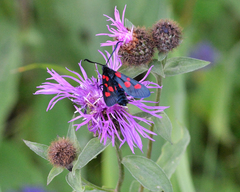
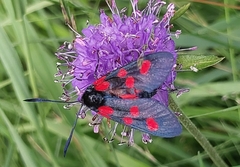
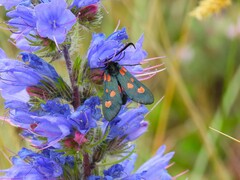
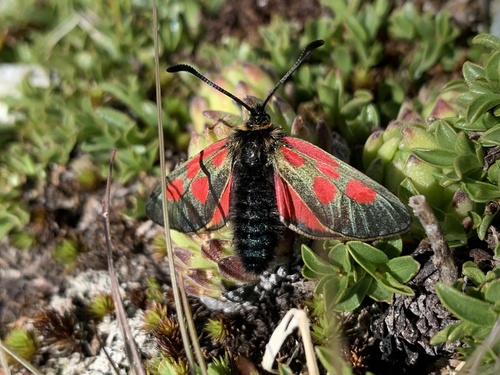
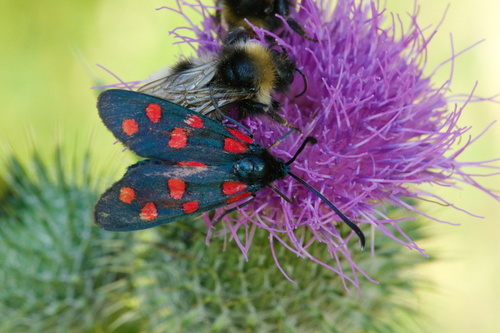
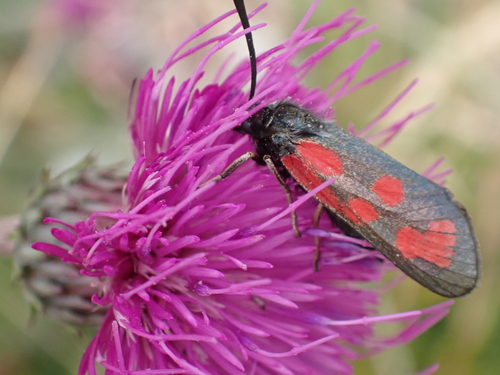
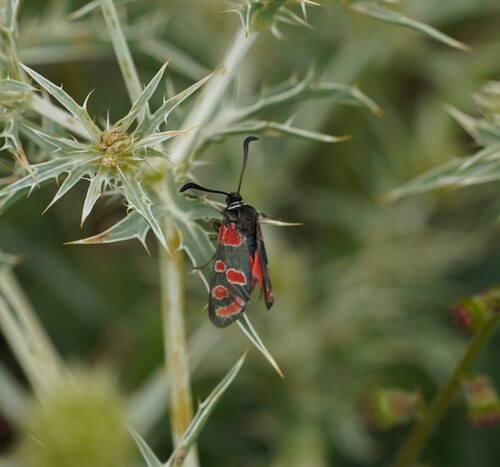
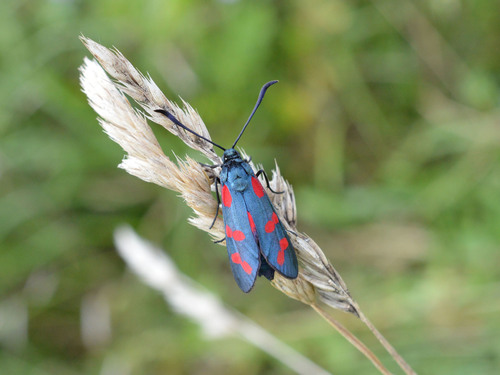
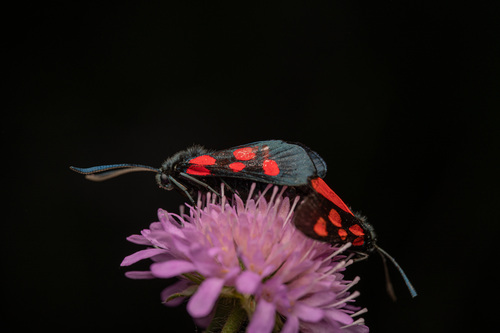
In western Europe it prefers dry to mesophilic habitats in coastal areas, sea-cliffs, open forests, grassland, chalk downland and subalpine valleys, at an elevation up to 2,000 metres (6,600 ft) above sea level. Zygaena lonicerae have a wingspan of 30–46 millimetres (1.2–1.8 in). The forewings reach a length of 16–19 millimetres (0.63–0.75 in) in the females, while they are slightly smaller in males. The forewings usually show five crimson to vermilion spots and a black basic colour, with a strong bluish or blue-green reflection. The third spot is smaller than the fourth one. Head, thorax and abdomen are black and moderately to strongly hairy. The antennae are long and slender and slightly clavate (club shaped) and tapered. The females are similar to... Wikipedia →
Global Distribution

Parks Where Found

# Park Country Daily sighting probability
1 Hohe Tauern National Park 🇦🇹 Austria
~20%
2 Aigüestortes National Park 🇪🇸 Spain
~20%
3 Mercantour National Park 🇫🇷 France
~20%
4 Vanoise National Park 🇫🇷 France
~10%
5 Ordesa y Monte Perdido National Park 🇪🇸 Spain
~10%
6 Triglav National Park 🇸🇮 Slovenia
~10%
7 Ecrins National Park 🇫🇷 France
~10%
8 Pyrénées National Park 🇫🇷 France
~10%

Cities Where Found

# City Country Daily sighting probability
1 Manchester 🇬🇧 United Kingdom
~10%
2 Liverpool 🇬🇧 United Kingdom
~10%
3 Birmingham 🇬🇧 United Kingdom
~10%
4 Moscow 🇷🇺 Russia
<5%
5 London 🇬🇧 United Kingdom
<5%

Before you go

What are the chances of seeing a Narrow-Bordered Five-Spot Burnet in Vanoise National Park?

With luck

About 10% of wildlife watchers report a Narrow-Bordered Five-Spot Burnet sighting in Vanoise National Park on a given day, based on 12 verified sightings from GBIF citizen-science data from 2019 to 2026. It is the 149th most-seen of the 308 insects we can rate there. Over three days the chance rises to about 40%, and over a week to about 60%, if each day is a fresh chance.

When is the best time to see a Narrow-Bordered Five-Spot Burnet in Vanoise National Park?

July

In that month about 20% of wildlife watchers report a Narrow-Bordered Five-Spot Burnet in Vanoise National Park on a given day, against under 5% in September to June, the lowest months.

What time of day is best to see a Narrow-Bordered Five-Spot Burnet?

Between noon and 3 pm

Across all the parks we cover, that three-hour window holds the most Narrow-Bordered Five-Spot Burnet sightings with a recorded time, and about 9 in 10 of them come between 6 am and 6 pm: it is a daytime animal.

Which relatives of the Narrow-Bordered Five-Spot Burnet live in Vanoise National Park?

Same genus: Zygaena

The closest relatives of the Narrow-Bordered Five-Spot Burnet that you can see in Vanoise National Park (genus Zygaena) are Mountain Burnet (about 40%), Transalpine Burnet Moth (about 30%) and Slender Scotch Burnet (about 20%), with each one's daily chance of a sighting.

Where does the Narrow-Bordered Five-Spot Burnet sighting chance come from?

GBIF citizen-science records

It is estimated from how often the Narrow-Bordered Five-Spot Burnet is recorded against all the insects logged in Vanoise National Park (12 verified sightings from 2019 to 2026), calibrated against known sighting rates. Figures are rounded to the nearest 10% because citizen-science data supports honest approximations, not decimals, and months with records from fewer than five people show "—". How it works.

← Back to Vanoise National Park